Real or Nonsense Words Worksheets
- 30 pages
- Kindergarten, 1st
$4.00
DownloadOr get it with All-Access: pick any 20 resources a month for $7.
New here? Your first month of All-Access is half off with code TEACHERTOK
Already bought this, or a member?
Instant download. One teacher's license: colleagues need their own copy. Each file carries a license number.
Also on Teachers Pay Teachers: see the Bright Path Sped store
About this resource
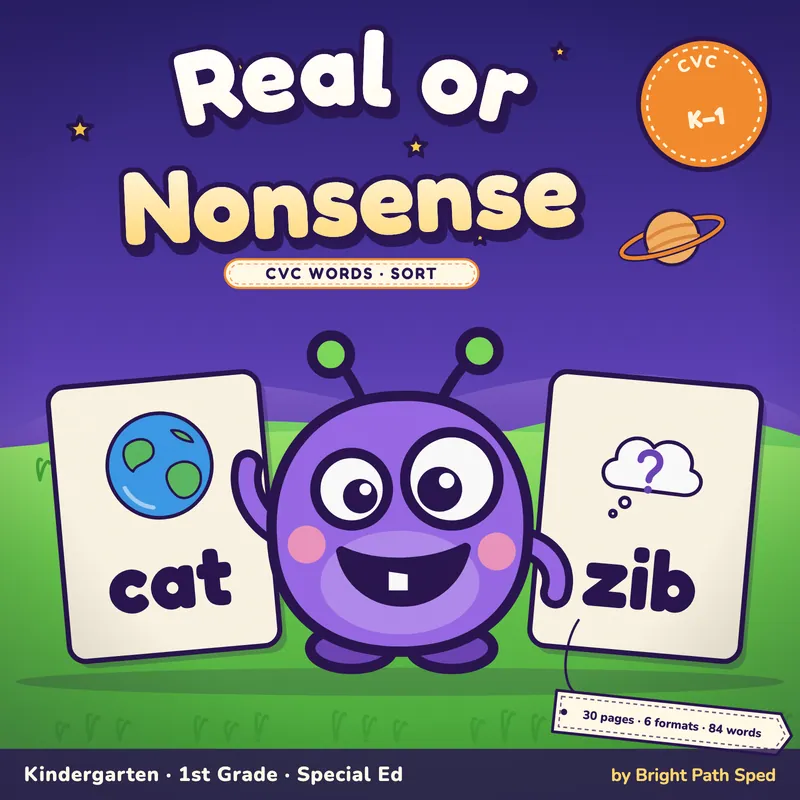
Is "zib" a word? A child who can read "cat" can sound out "zib", and deciding that it means nothing is a small,
friendly way to practice decoding without a picture or a guess to lean on. This is a full real-or-nonsense kit for
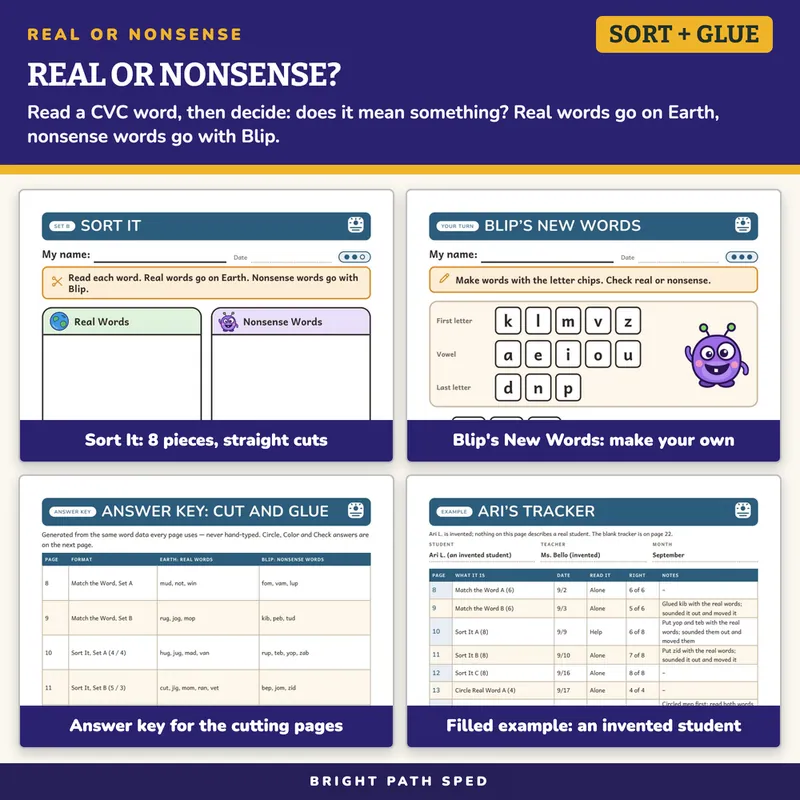
kindergarten and first grade: real words live on Earth, nonsense words belong to Blip, a silly purple alien, and
children cut, glue, circle, color, check and write to show which is which.
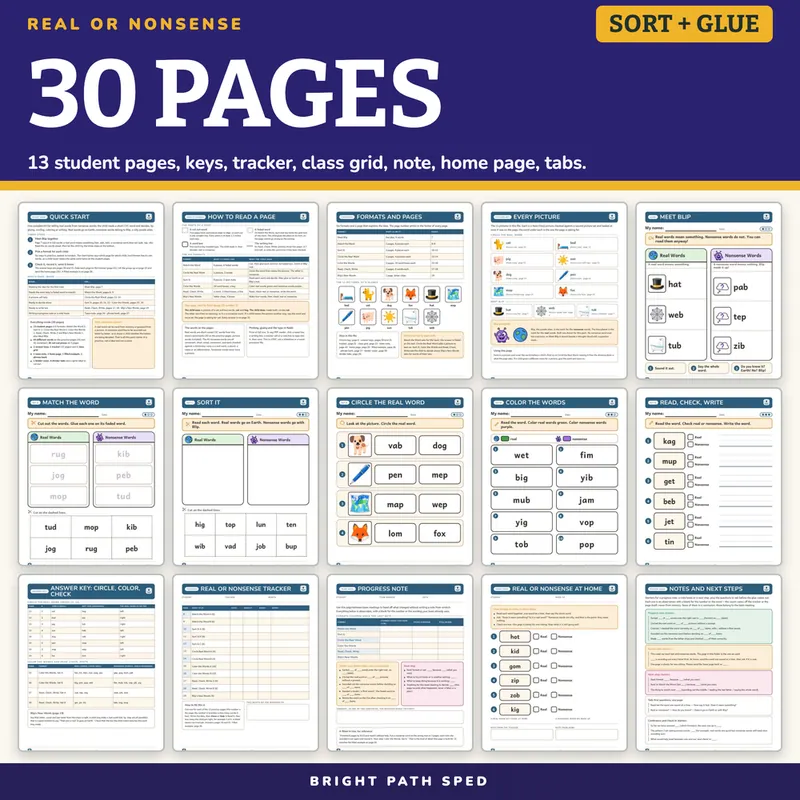
EVERYTHING INSIDE (30 pages)
- 13 student pages in 6 formats, plus a Meet Blip page that explains the idea in kid words
- 84 different words on the practice pages: 42 real CVC words and 42 nonsense words, none repeated on any student page
- 36 cut-out word pieces on 5 cutting pages: 12 Match the Word pieces and 24 Sort It pieces, edge to edge, every piece
at least 1.1 inches each way
- 11 pictures (a picture for each real word on the Circle pages, three on Meet Blip); nonsense words never get one
- 2 answer keys, generated from the same data as the pages
- 1 tracker (12 practice pages), 1 class progress grid
- 1 team note page and 1 home page (six words and check boxes for a family)
- 1 filled example (an invented student), 1 phrase bank (16 starters in 5 groups), 1 binder cover, and 6 divider tabs
with a spine label to cut out
- Start Here, a how-to-read-a-page page, a contents page that gives every page number, and a picture key
The Six Formats, Easiest To Hardest
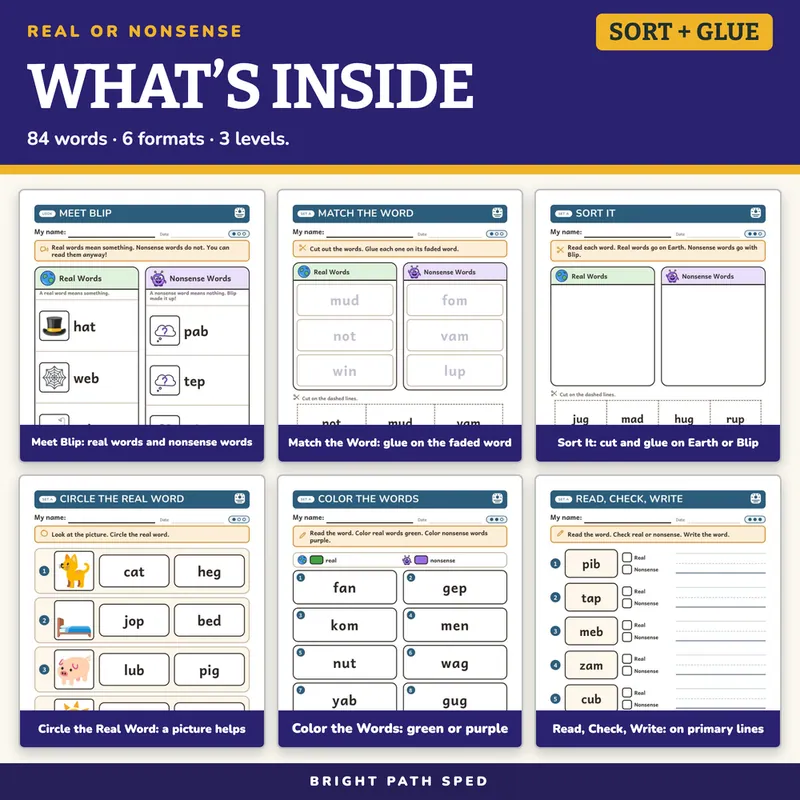
1. Match the Word (starting) — 2 pages, 6 pieces each. Cut the words and glue each on its faded twin on the Earth mat
or on Blip's mat. The answer is on the page, so a child can succeed while learning what the mats mean.
2. Circle the Real Word (starting) — 2 pages, 4 rows each. A picture and two words, one real and one nonsense: circle
the real one.
3. Sort It (building) — 3 pages, 8 pieces each. Read each word and glue it on Earth or on Blip's mat. The split changes
from page to page (4 and 4, 5 and 3, 3 and 5), so a child cannot assume half are real.
4. Color the Words (building) — 2 pages, 10 word boxes each. Color real words green and nonsense words purple.
5. Read, Check, Write (ready for more) — 2 pages, 6 words each. Read the word, check Real or Nonsense, then write the
word on primary handwriting lines.
6. Blip's New Words (ready for more) — 1 page. Pick a first letter, a vowel and a last letter from the letter chips,
write the word in three boxes and check whether it is real or nonsense.
Each format has its own words, so a child never meets the same word twice on the student pages.
Why Nonsense Words
A real word can be read from memory or guessed from a picture. A nonsense word has to be sounded out letter by letter,
so it shows whether the letters are being decoded. That is all this pack claims: it is practice, not a label and not a
score.
Words You Can Trust
The real words come from this store's short-vowel CVC word banks, and every practice page mixes at least three of the five short vowels (four on the eight-word pages). The 48
nonsense words are all consonant, short vowel, consonant, and every one was checked against the macOS dictionary and four
more word lists: none is a real word, a plural, a name or an abbreviation in any of them. Words a child could hear as a real word (kup for
cup, kod for cod) were left out. Odd-looking first letters do not give the answer away: real words include zip, van, vet
and job, and nonsense words include pab, mub and tob.
Built For The Child Holding The Page
A big "My name" line, one short instruction with a picture, large rounded type, big boxes, and dots (not words) to show
which level a page is. Nothing on a student page is written for an adult. Every cutting page has at least five pieces, laid
edge to edge so each cut is one straight line. The writing lines on Read, Check, Write are primary three-line paper 0.7
inch tall.
Pictures That Name Their Word
The eleven pictures are Google Noto Emoji, each checked against Microsoft Fluent Emoji High Contrast and looked at once it
was on the page. If a child gives a different name for a picture, say the word and move on: the page is asking for that word.
Blip, the Earth and the question cloud are drawn by us.
Type In, Or Print
The name and date lines, the writing lines, the tracker, the class grid, the team note and the home page are type-in
fields in any PDF reader. The cutting, gluing, circling and coloring are pencil-and-scissors work. This is a fillable PDF;
it is not a Google Slides or PowerPoint file.
Who This Is For
Kindergarten and first grade classrooms, self-contained and resource rooms, and any teacher working with an older student
who still needs to sound out short words. The home page sends the same job to a family; the team note hands off what
changed since the last meeting.
What This Is, And What It Is Not
Real-or-nonsense word practice with the record-keeping around it. It is not a probe, a goal bank or a score sheet, not a
reading assessment, and not a claim about any student's age or rate of progress.