Reconstruction Worksheets
- 33 pages
- 6th, 7th, 8th
$2.25 $4.50 on Teachers Pay Teachers
Half the Teachers Pay Teachers price. The same PDF, sold direct.
DownloadOr get it with All-Access: pick any 20 resources a month for $7.
New here? Your first month of All-Access is half off with code TEACHERTOK
Already bought this, or a member?
Instant download. One teacher's license: colleagues need their own copy. Each file carries a license number.
Also on Teachers Pay Teachers: see the Bright Path Sped store
About this resource
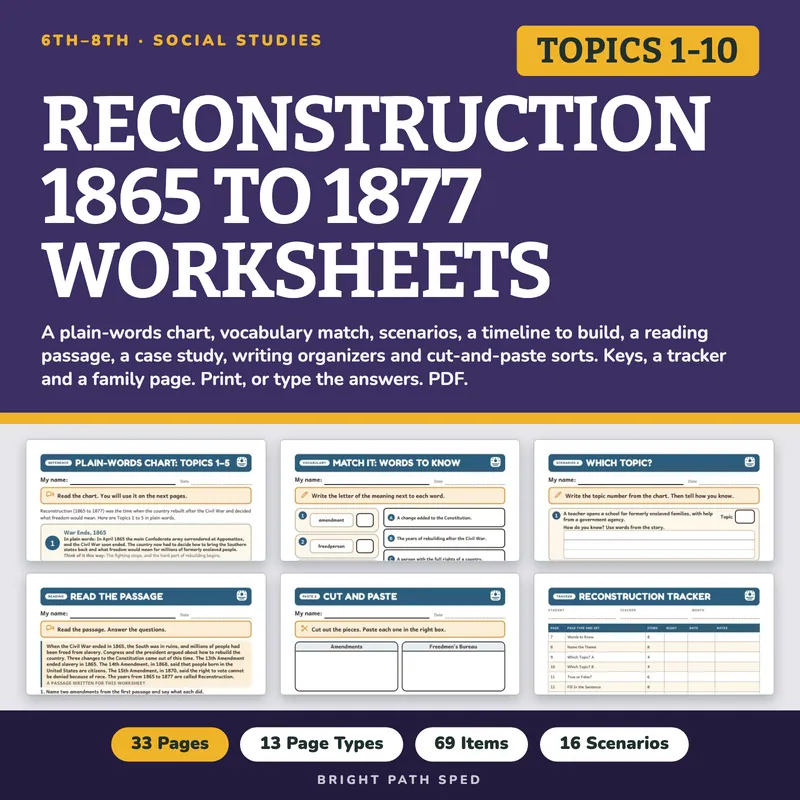
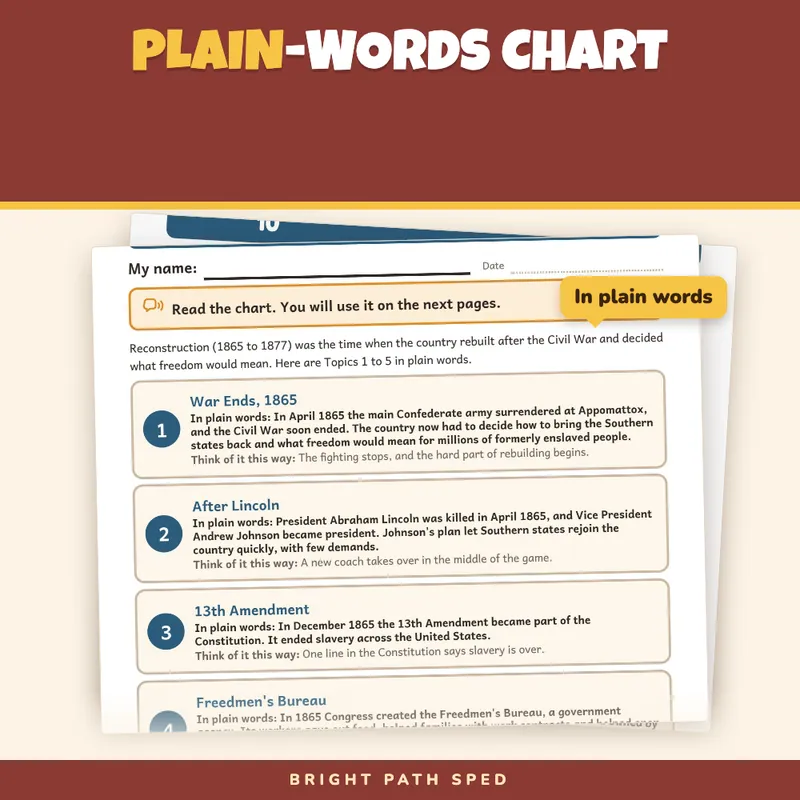
Teaching Reconstruction and need something students can actually write on? This is a complete kit for one short unit, written at a middle school reading level and laid out with real room to work. It starts with two plain-words charts that cover ten topics: the end of the Civil War in 1865, the change of presidents after Lincoln, the 13th Amendment, the Freedmen's Bureau, the Black Codes, Congress taking charge, the 14th Amendment, the 15th Amendment, sharecropping and the Compromise of 1877. Students then match the vocabulary, sort statements into four themes (rights, help, farms, limits), tell which topic fits a real-life situation and how they know, decide true or false and fix the false ones, fill in sentences, build a timeline from clues, read two short passages, think through an invented case study about a family and a landowner in the town of Marlow, list gains and setbacks, and write in ruled boxes. Three cut-and-paste sort mats finish it. It comes with answer keys, a tracker, a class grid, a team note and a family page, so nothing has to be written from scratch.
EVERYTHING INSIDE (33 pages)
- 17 student pages in 13 page types: Plain-Words Chart (2 pages), Match It, Name the Theme, Which Topic? (2 pages), True or False?, Fill In the Sentence, Build the Timeline, Read the Passage, Case Study, Explain It, Build a Paragraph, Gains and Setbacks, and Cut and Paste (3 pages)
- 69 scored items on 10 pages, every answer read from the same lists that print the page, never typed by hand
- 16 invented scenarios and statements (8 to name the theme, 8 to match to a topic of the chart) plus 1 invented case study with no outcome given
- 8 vocabulary words matched to 10 meanings (two meanings are not used)
- 1 timeline with 5 steps to fill in from clues
- 2 short reading passages, written for this file
- 1 Gains and Setbacks page: write four of each, then draw one
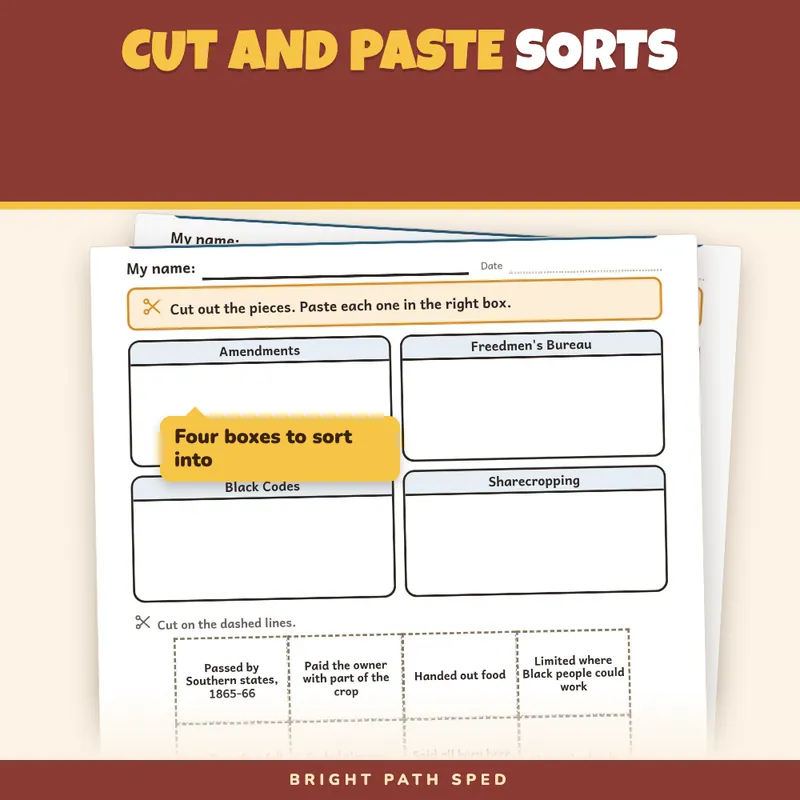
- 26 cut-and-paste pieces on 3 sort mats (8 pieces into 2 boxes, 8 pieces into 4 boxes, 10 names into 10 numbered slots)
- 3 answer keys, including what to look for on the 5 open-response pages
- 1 tracker (page, page type, items right, date, notes) and 1 whole-class progress grid
- 1 team note (a hand-off page), 1 family page and 1 filled example (an invented student)
- 1 phrase bank (17 starters, including student sentence starters for explaining and claim-evidence-reasoning), 1 binder cover and 6 divider tabs with a spine label to cut out
- Start Here and a how-to-read-a-page page
The Page Types
1. Plain-Words Chart, 2 pages: Topics 1-5 and 6-10, each with a short name, what it says in plain words, and a way to picture it. Students keep it beside them for the other pages.
2. Match It: 8 words (Reconstruction, amendment, citizen, freedperson, sharecropper, contract, discrimination, Confederacy) matched to lettered meanings.
3. Name the Theme: 8 short statements; pick rights, help, farms or limits from a box.
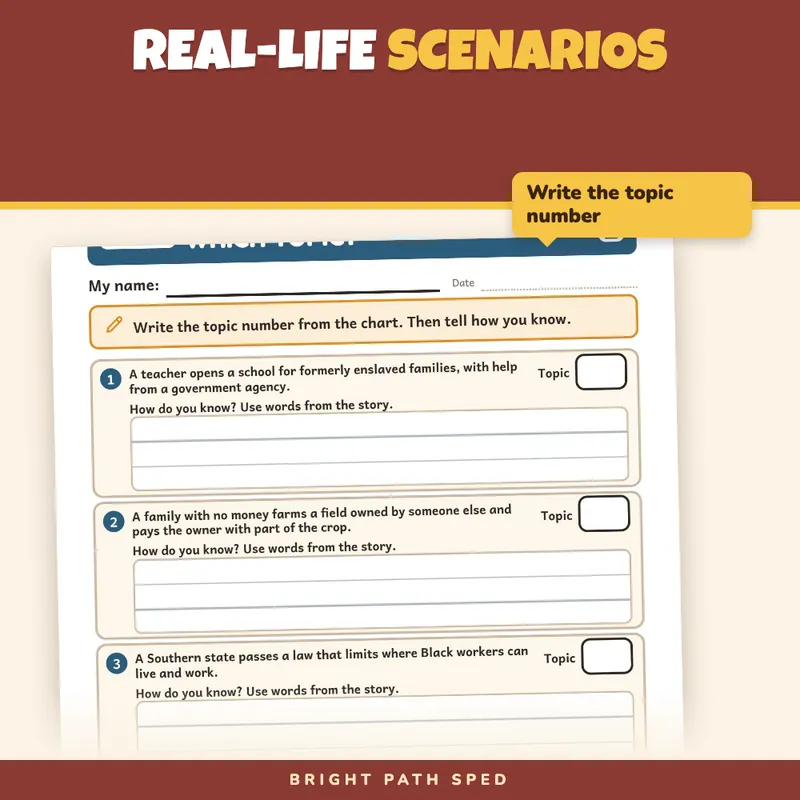
4. Which Topic?, 2 pages: 8 scenarios; write the topic number from the chart, then explain how you know in a 3-line ruled box.
5. True or False?: 6 statements, then fix two false ones in 4-line ruled boxes.
6. Fill In the Sentence: 8 sentences and a box of 10 words (two are not used).
7. Build the Timeline: five steps, a clue for each (April 1865, December 1865, 1868, 1870, 1877), and a box of five events. Write each event on its step, earliest first, then say which event mattered most to you.
8. Read the Passage: two short passages, one about the three amendments and one about the Freedmen's Bureau, the Black Codes and sharecropping, with four questions.
9. Case Study: an invented story about a made-up town (Marlow) in 1866 where a freed family is offered a field to farm for part of the crop, an agent can help read work contracts, and the town council has just passed a law about where Black workers may live and work. Match the story to topics of the chart, say what the family and the landowner might each want, give what each might say, and name what you would want to know first. No outcome is given.
10. Explain It: four prompts with ruled boxes and sentence starters.
11. Build a Paragraph: a claim, evidence, reasoning organizer on whether Reconstruction kept its promises to formerly enslaved people, plus a counterpoint from a formerly enslaved person in 1870.
12. Gains and Setbacks: two panels, write four gains and four setbacks, then draw one item.
13. Cut and Paste, 3 pages: two boxes, four boxes, then ten numbered slots. The pieces touch edge to edge, so cutting is a few straight lines, and every piece is over an inch each way.
Built For The Student Holding The Page
A "My name" line, one short instruction, large type, and no cartoons, mascots or clip art. Nothing on a student page is written for an adult. Ruled boxes are about a third of an inch a line: a short answer gets 3 lines and an explanation gets 5 or more. Body text is 11 point or larger. The file prints clean in black and white.
No Guessing The Answer
Wherever a student picks among printed spots (the lettered meanings, the box of words, the order of the cut pieces), the position of the right answer is checked so it never sits in the same spot three times in a row.
Textbook-Level Facts
The topic summaries are the standard, textbook-level kind, kept short. The main Confederate army surrendered in April 1865. President Lincoln was killed that month and Vice President Andrew Johnson became president. The 13th Amendment (December 1865) ended slavery, the 14th (1868) made people born in the United States citizens, and the 15th (1870) said the right to vote cannot be denied because of race. Congress created the Freedmen's Bureau in 1865, Southern states passed Black Codes in 1865 and 1866, Congress passed Reconstruction Acts in 1867, and the Compromise of 1877 left Rutherford B. Hayes as president and federal troops out of the South. The file gives no casualty counts, no population numbers and no quotations. Textbooks describe some details differently, so the answer key says to accept a timeline order your own text supports. Every scenario, passage and the case study are made up for practice. There is a blank line on the tracker for your own standard or wording.
Type In, Or Print
The name line, every answer box and every ruled box are type-in fields in any PDF reader: click one, type, then save. The same goes for the tracker, the class grid, the team note and the family page. This is a fillable PDF; it is not a Google Slides or PowerPoint file.
Who This Is For
Middle school social studies, U.S. history, Reconstruction unit classes, special education and resource rooms working on the same unit, co-taught classes, and substitutes who need a unit that is ready to hand out. The reading is written at about a grades 6-8 level.
What This Is, And What It Is Not
A Reconstruction worksheet set with the record-keeping around it. It is not a timed test, a screener, a clinical tool, or a claim about any student's age or rate of progress. There is no IEP goal language or eligibility wording anywhere in the file.