Rounding to the Nearest 10 Worksheets
- 29 pages
- 2nd
$4.00
DownloadOr get it with All-Access: pick any 20 resources a month for $7.
New here? Your first month of All-Access is half off with code TEACHERTOK
Already bought this, or a member?
Instant download. One teacher's license: colleagues need their own copy. Each file carries a license number.
Also on Teachers Pay Teachers: see the Bright Path Sped store
About this resource
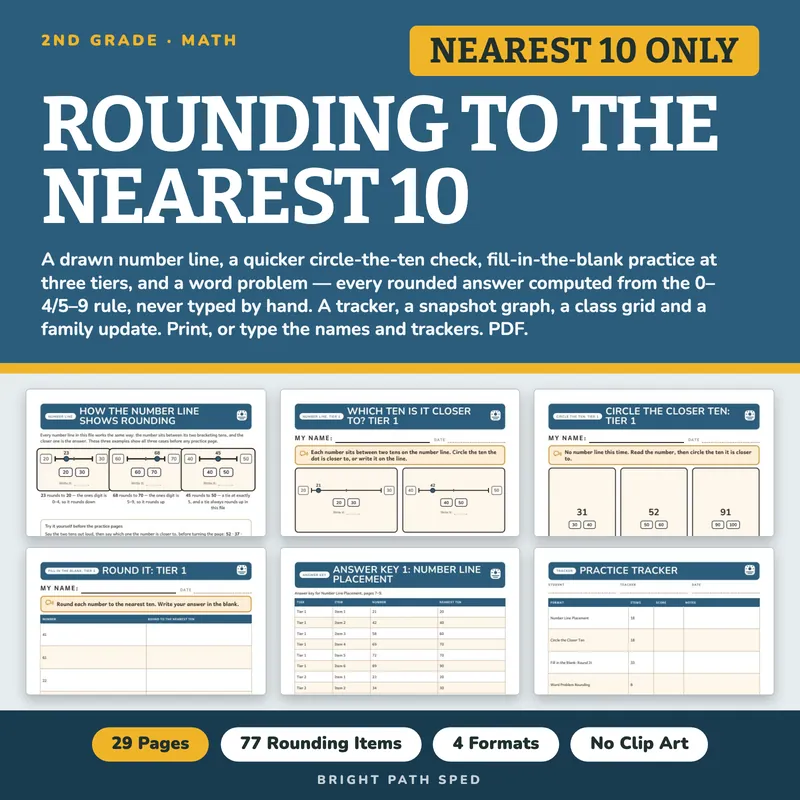
A rounding kit for second grade: rounding a two-digit number to the nearest ten, practiced four
genuinely different ways, plus the record-keeping a classroom or small group needs around it.
Nearest-10 only — no nearest-100, no mixed rounding.
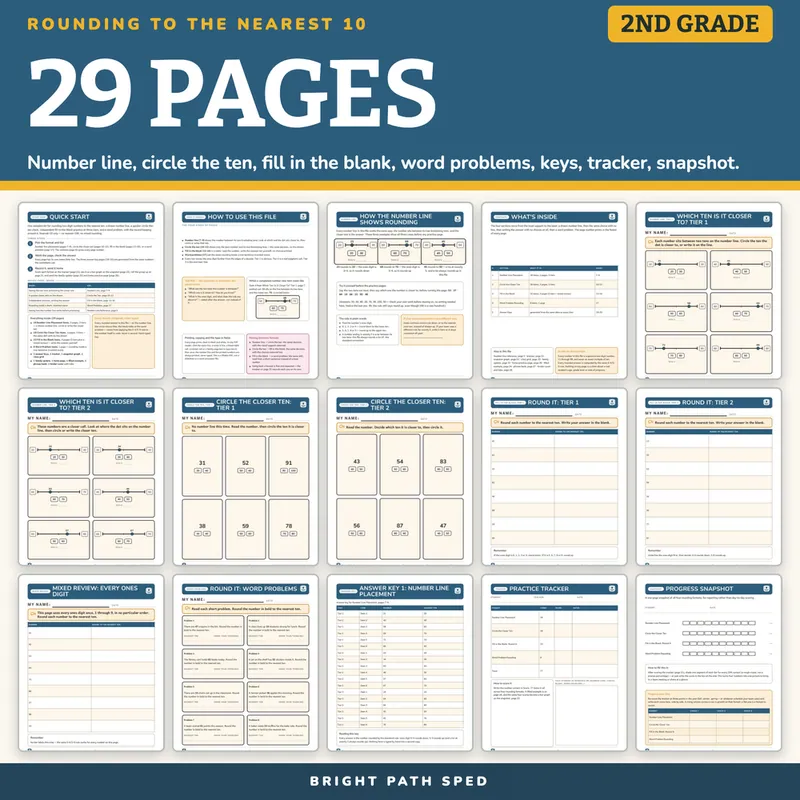
EVERYTHING INSIDE (29 pages)
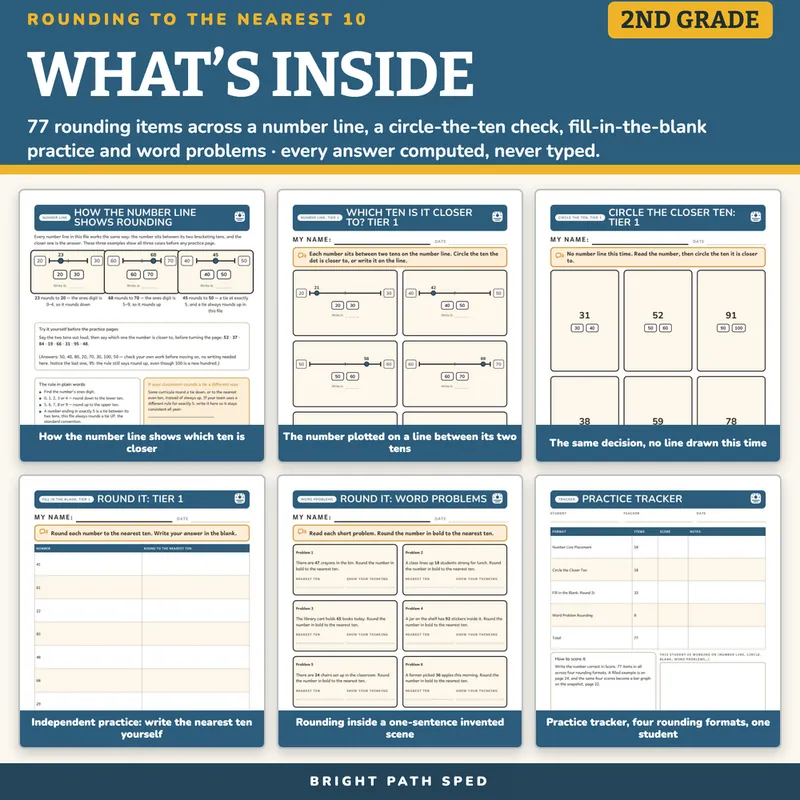
- 18 Number Line Placement items across 3 pages (3 tiers) — a drawn number line between the
number's two bracketing tens, the number plotted on it; circle or write the closer ten
- 18 Circle the Closer Ten items across 3 pages (3 tiers) — the same decision with no line
drawn, just the bare number and its two bracketing tens to circle
- 33 Fill in the Blank items across 4 pages (3 tiers plus a mixed review set) — a table of
numbers; write the nearest ten yourself, no choices printed
- 8 Word Problem items on 1 page — one two-digit number named inside a one-sentence invented
scene; round the number in bold
- 3 answer keys, generated from the same numbers every worksheet uses
- 1 number-line reference page — three worked examples (rounds down, rounds up, an exact tie)
before any practice tier begins
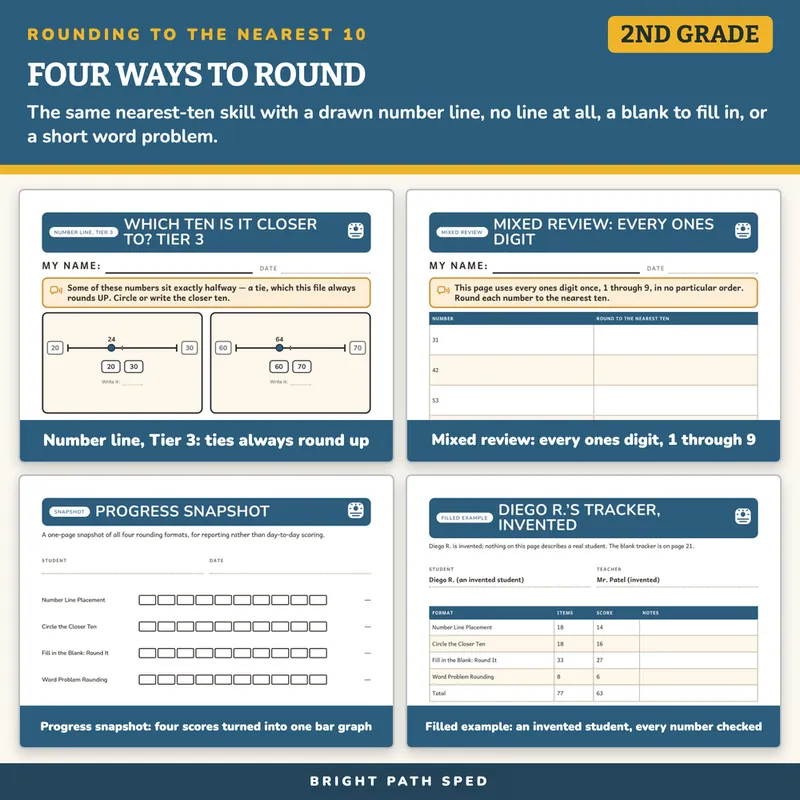
- 1 practice tracker (one student, four rounding formats), 1 progress snapshot (a bar graph
rolling the four scores into one picture), and 1 class grid (whole class), type-in or print
- 1 family update — a note home with blanks for the week's formats and the district's own wording
- 1 home practice page — a second, self-contained practice set for a family to use together, with
no school materials needed
- 1 filled example — an invented student, every number checked against its own table
- 1 phrase bank — progress-note, family-note, next-step and talk-first starters
- 1 binder cover with a spine label and six divider tabs
- Start Here, a how-it-works page, and a contents page that gives every page number
Every Number Is A Genuine Two-Digit Number, Never Already A Multiple Of Ten
Every number in this file is checked at build time to fall between 11 and 99 and to never be an
exact multiple of ten — on the worksheets, the answer keys, the filled example and the tracker.
There is always a real decision to make.
Every Answer Computed, Never Typed
Every rounded answer in this file — on the number line, the circle-choice tiles, the blank table
or the word problem — comes from applying the standard "0-4 rounds down, 5-9 rounds up" rule to
the number itself in code. A tie at exactly 5 always rounds up, the standard convention, every
time in this file. There is no second, hand-typed key anywhere.
Four Ways To Round, Three Tiers Each
The number line shows the number plotted between its two bracketing tens — the most support.
Circle the closer ten removes the line but keeps the two choices. Fill in the blank removes the
choices too, so the student writes the answer. A word problem asks the same rounding inside a
one-sentence invented scene. Three tiers move the ones digit from obvious (1, 2, 8, 9) to a real
judgment call (3, 4, 6, 7) to ties and near-ties (4, 5).
Type In, Or Print
The name and date lines, the write-it lines, the blank table cells, the tracker, the snapshot, the
class grid, the family update and the home page are type-in fields in any PDF reader; the number
line and every printed number are always printed, never typed. This is a fillable PDF; it is not
a Google Slides, Google Docs or PowerPoint file.
Who This Is For
Second-grade classrooms, self-contained and resource rooms, and any small group working on
rounding to the nearest ten below or above grade level.
What This Is, And What It Is Not
A rounding-to-the-nearest-10 practice set with the record-keeping around it. It is not a full
math curriculum, not an assessment, and not a claim about any student's age, grade level or rate
of progress. The tracker has a blank line for your own scoring criteria, and the number-line
reference page has a blank line for a classroom whose own convention for rounding a tie differs
from this file's "always rounds up."