September Print and Go Month 1 SPED Lesson Plans Math Reading Social Skills
- 218 pages
- PreK, Kindergarten, 1st, 2nd
$13.00
DownloadOr get it with All-Access: pick any 20 resources a month for $7.
New here? Your first month of All-Access is half off with code TEACHERTOK
Already bought this, or a member?
Instant download. One teacher's license: colleagues need their own copy. Each file carries a license number.
Also on Teachers Pay Teachers: see the Bright Path Sped store
About this resource
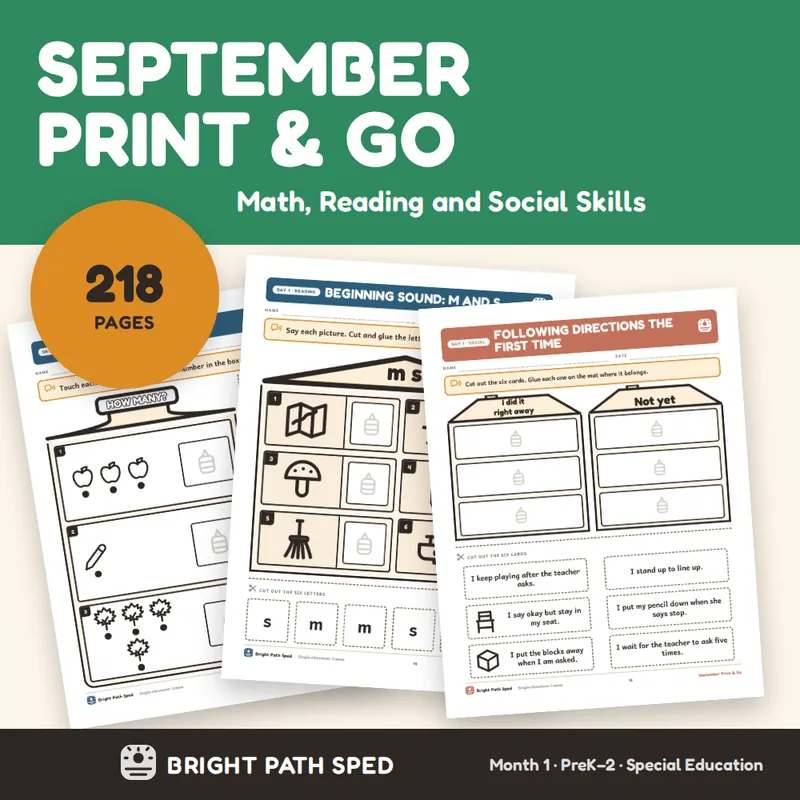
Four weeks of September, planned. You do not plan on Sunday. You open it to today, print what is behind the plan page, and teach it.
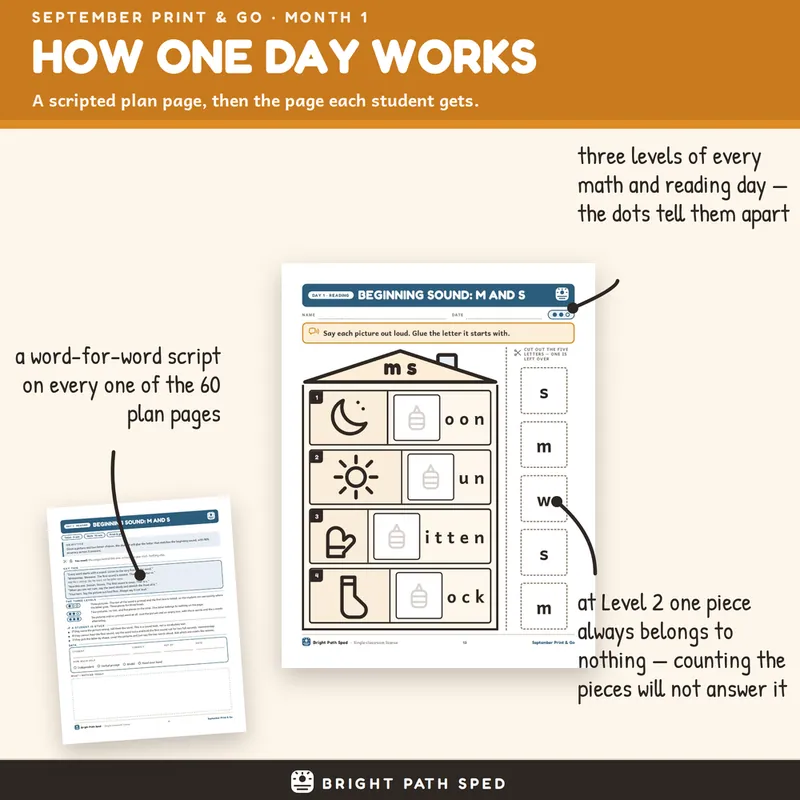
Every single lesson in here has its own printable plan page with a word-for-word script on it. Not a topic, not a suggestion of what to talk about, but the actual sentences, in quotation marks, that you read out loud. A substitute or a paraprofessional who has never seen the lesson can pick the page up cold and run it.
WHAT IS INCLUDED: 218 pages
- 60 lesson plan pages. Twenty days, three lessons a day: math, reading, social skills.
- 140 student pages. Math and reading come at three levels every single day. Social skills is one page a day.
- 8 answer key pages covering all twenty days in every block.
- A week divider for each week, a month-at-a-glance map, and a start-up guide.
What Is On A Plan Page
- The objective, written the way an IEP goal is written.
- SAY THIS: the script. Spoken lines are in quotation marks; the lighter italic lines are stage directions telling you what to hold up or do with your hands.
- What each of the three levels actually gives the student, so you can pick without printing all three to compare.
- IF A STUDENT IS STUCK: three or four things you can do in the next ten seconds, at the table, without fetching anything.
- A data box. Student, correct, out of, date, and how much help: independent, verbal prompt, model, hand over hand. It is on the plan page rather than a separate data sheet, because a separate data sheet does not get filled in.
- A notes box at the foot for what you actually saw.
How The Three Levels Work
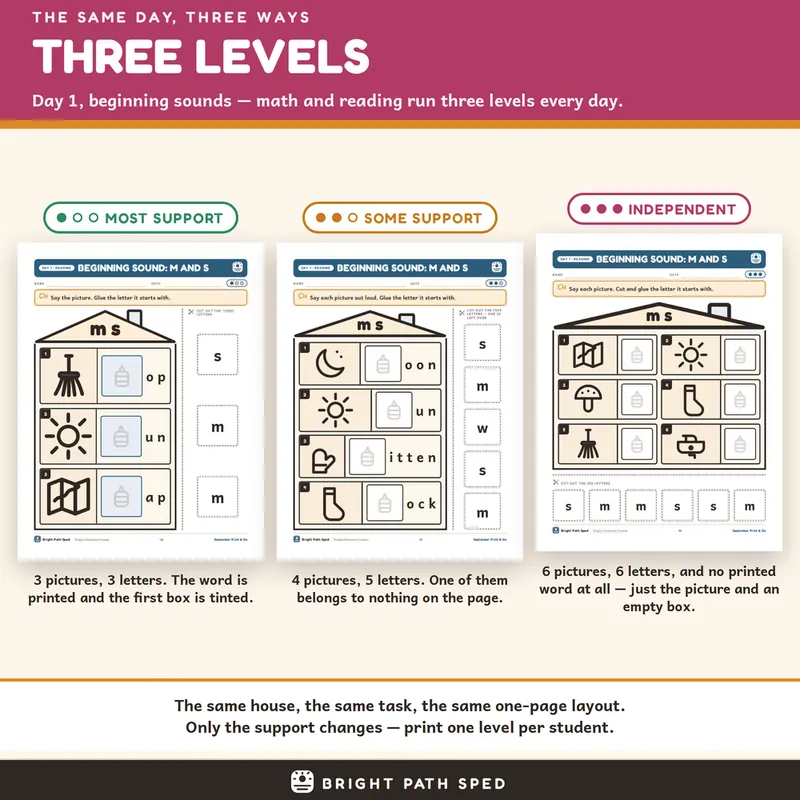
Level 1: errorless. There are exactly as many pieces on the strip as there are boxes, so there is no wrong piece to pick up.
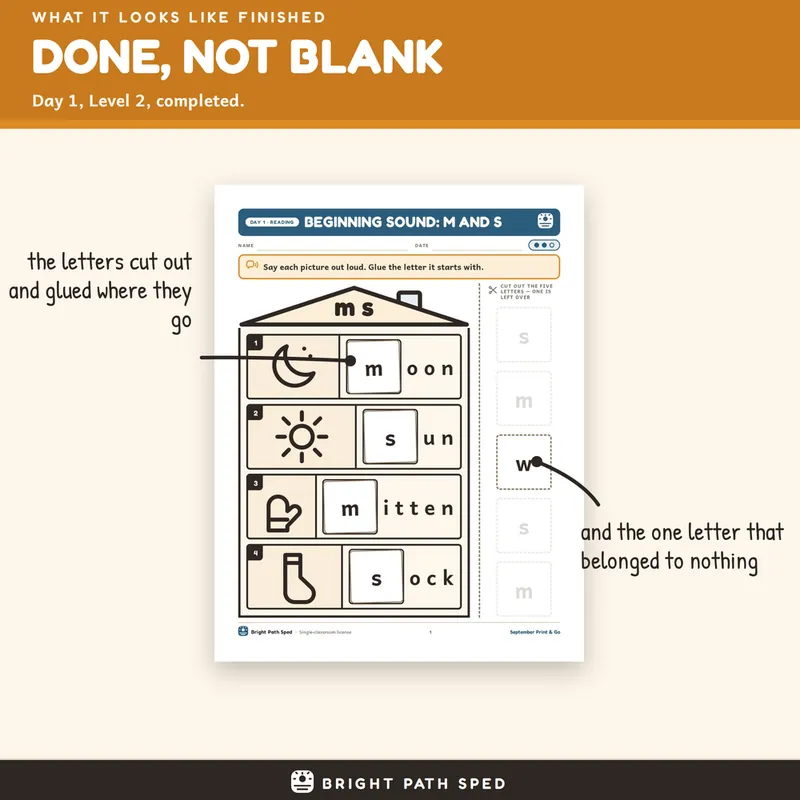
Level 2: one spare piece on the strip that belongs to nothing. The student has to reject something instead of matching everything.
Level 3: the supports are gone. No cue, no tint, no printed word, and the items are chosen to be confusable rather than convenient.
The level is printed on the child's sheet as a color tone and a row of dots and nothing else. No student page says "Level 1" in words a child reads, so the three levels look the same on the desk and nobody's paper is obviously the easy one.
What A Student Page Looks Like
Every reading page is a house: the day's sound or word family on the roof, one picture in each window, and the cut pieces standing in a column beside it at a size a five-year-old can cut and hold. Every math page is a jar with the skill on its lid, the counted sets inside it and a touch dot under each counter. Social skills pages sort short printed sentences into houses, strips and windows. A child who has done one page knows what to do on the next one, and the same three frames run through October, so nothing has to be relearned.
Pictures are big enough to name across a table. Where the licensed picture set has a picture that names the word, it is in full color; where it does not, the picture is a heavy black line drawing made for this store, and a page never mixes the two. Every page copies cleanly in grayscale, and the print is clear and child-friendly throughout.
The Twenty Days
Math starts at counting to 5 and does not reach addition until week 4. That is deliberate: a September packet has to be usable on day one with a class you have not assessed yet, so it opens below where most of the room will be and climbs. Counting to 5, to 10, to 20, comparing sets, then joining groups and adding with pictures.
Reading runs beginning sounds, then ending sounds, then middle vowels, then building and reading whole CVC words. Eight days on beginning sounds before it asks for anything else.
Social skills runs arrival routines, then working next to another person, then naming feelings, then friendship. That is the real September order: you cannot teach "join a game" in week one to a group that cannot yet line up. Every social lesson also has a TRY IT IN THE ROOM TODAY box: one concrete thing to do at line-up or clean-up that day, so the skill leaves the paper.
Format
Print-and-go PDF. Scissors and a glue stick is the entire materials list for the month. Nothing to laminate, no counters, no cards to cut apart in advance: the student does the cutting, and the cutting is part of the work.
Who This Is For
Self-contained and resource rooms, early intervention, life skills, and any elementary room with a wide skill range in it. It is also built to be handed to somebody else: a sub, a new para, a student teacher, or the person covering your room the week you are out.
A Note On The Social Skills Pages
The cards on those pages are short sentences rather than pictures, and every script tells you to read them aloud before anybody picks up scissors. That is on purpose. A picture of a child standing slightly too close to another child is not a picture that reads at worksheet size, and a decorative icon that does not name the sentence hands a non-reader a shape cue instead of a skill. Where a social page names a real object, the object is drawn.
Not A Calendar
Nothing in here is tied to a date. Day 1 is the first day you teach it. If you start on the 8th, or you skip a Friday, or the whole thing runs long, it still works.