Silent E Worksheets
- 32 pages
- Kindergarten, 1st, 2nd
$4.00
DownloadOr get it with All-Access: pick any 20 resources a month for $7.
New here? Your first month of All-Access is half off with code TEACHERTOK
Already bought this, or a member?
Instant download. One teacher's license: colleagues need their own copy. Each file carries a license number.
Also on Teachers Pay Teachers: see the Bright Path Sped store
About this resource
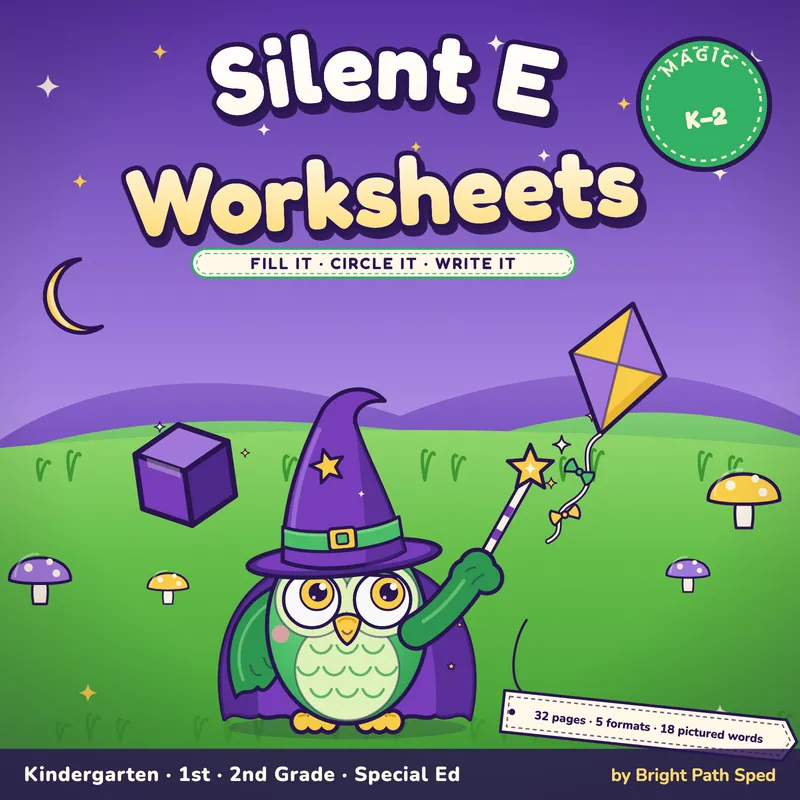
Silent e is the pattern where "cap" becomes "cape" and "kit" becomes "kite" — and it sticks better when a
child writes it and circles it, not only sorts it. This is a full silent-e worksheet kit: five different
things to do with the magic e, eighteen pictured words, and the record-keeping around them. Every student
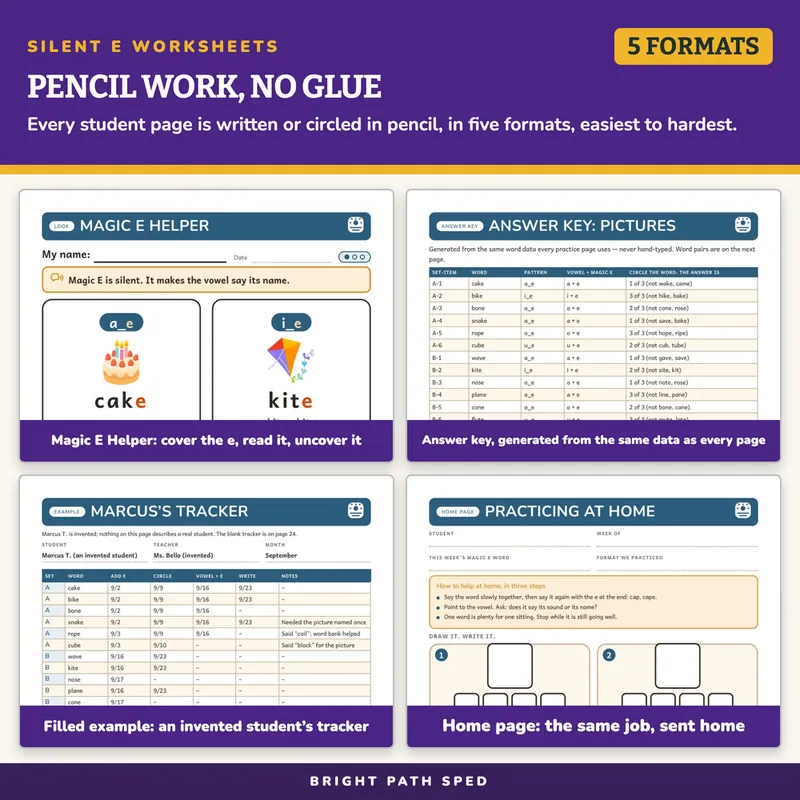
answer is written or circled in pencil, so no student page needs scissors or glue.
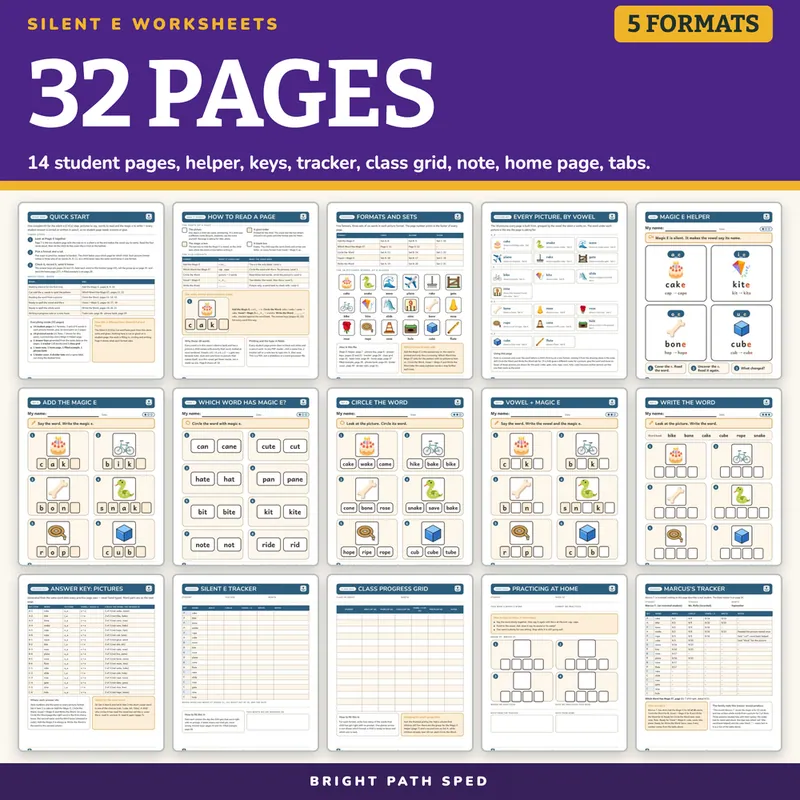
EVERYTHING INSIDE (32 pages)
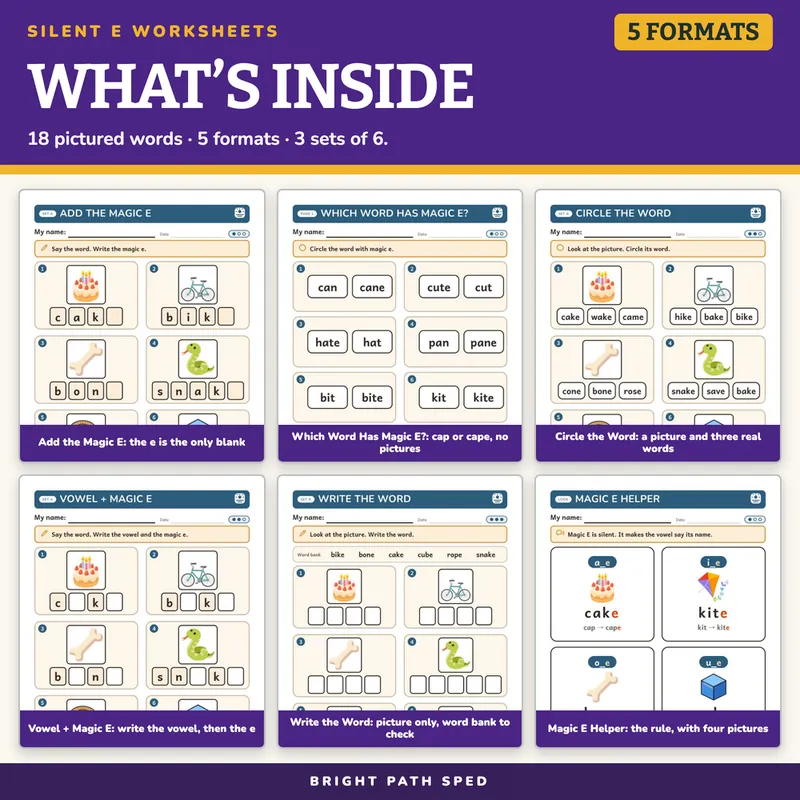
- 14 student pages in 5 formats — three sets of six words in each of four picture formats, plus 16 word
pairs on 2 pages
- 1 Magic E Helper page: the rule with four pictures (cake, kite, bone, cube) and a cover-the-e, read-it,
uncover-the-e trick
- 18 pictured words: a_e cake, snake, wave, plane, rake, gate; i_e bike, kite, slide, nine; o_e bone,
nose, rose, rope, cone, hole; u_e cube, flute
- 2 answer keys, generated from the same data as the pages
- 1 tracker (all 18 words, four formats), 1 class progress grid
- 1 team note page and 1 home page (four draw-it-and-write-it boxes)
- 1 filled example (an invented student), 1 phrase bank (16 starters), 1 binder cover, and 6 divider tabs
with a spine label to cut out
- Start Here, a how-to-read-a-page page, a contents page that gives every page number, and a picture key
The Five Formats, Easiest To Hardest
1. Add the Magic E (starting) — the word is printed and the last box, the e, is the only blank.
2. Which Word Has Magic E? (starting) — 16 pairs like cap / cape and kit / kite on 2 pages, no pictures:
circle the word with the magic e.
3. Circle the Word (building) — a picture and three real words, one or two letters apart; circle the
picture's word. The short-vowel partner (kit next to kite, cub next to cube) is a choice where there is one.
4. Vowel + Magic E (building) — two blanks: write the vowel, then the e.
5. Write the Word (ready for more) — picture only, empty boxes, and a word bank to check with.
Each picture format is three sets of six words (A, B, C), so a child never meets the same word twice in one
format: 72 picture exercises (18 words x 4 formats) plus the 16 pairs.
Built For The Child Holding The Page
A big "My name" line, one short instruction with a picture, large rounded letters, big boxes with room to
write, and dots (not words) to show which level a page is. Nothing on a student page is written for an adult.
Pictures That Name Their Word
Every word has a picture a child names with exactly that word, looked at once rendered. Eleven come from Google
Noto Emoji, each checked against Microsoft Fluent Emoji High Contrast; seven (rake, gate, nine, rope, cone,
hole, cube) are drawn by us because neither set has a picture that reads as that word: the nearest "cube" is an
ice cube, the nearest "cone" is ice cream, the nearest "rope" is a knot. Words with no picture that names
itself were left out rather than given a wrong one, so the u_e group has two words.
How This Is Different From Silent E Cut And Paste
Type In, Or Print
The name and date lines, the tracker, the class grid, the team note and the home page are type-in fields in
any PDF reader. The letters a student writes in the boxes are pencil work. This is a fillable PDF; it is not a
Google Slides or PowerPoint file.
Who This Is For
Kindergarten, first and second grade classrooms, self-contained and resource rooms, and any teacher working
with an older student who still needs the silent-e pattern. The home page sends the same job to a family; the
team note hands off what changed since the last meeting.
What This Is, And What It Is Not
Silent-e practice with the record-keeping around it. It is not a probe, a goal bank or a score sheet, not a
reading assessment, and not a claim about any student's age or rate of progress.