Simple Machines Worksheets
- 29 pages
- 3rd, 4th, 5th
$2.00 $4.00 on Teachers Pay Teachers
Half the Teachers Pay Teachers price. The same PDF, sold direct.
DownloadOr get it with All-Access: pick any 20 resources a month for $7.
New here? Your first month of All-Access is half off with code TEACHERTOK
Already bought this, or a member?
Instant download. One teacher's license: colleagues need their own copy. Each file carries a license number.
Also on Teachers Pay Teachers: see the Bright Path Sped store
About this resource
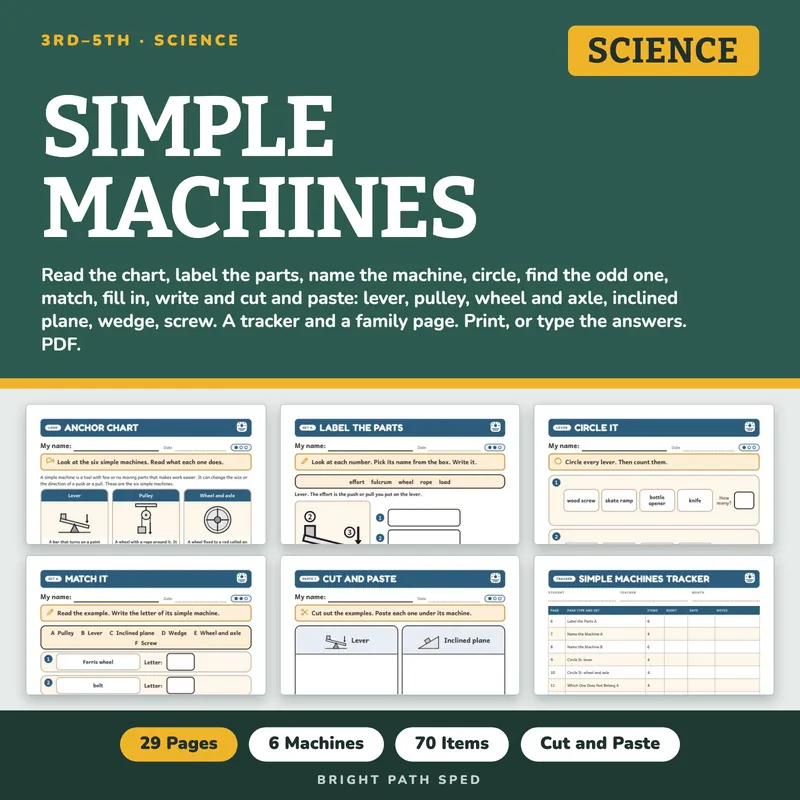
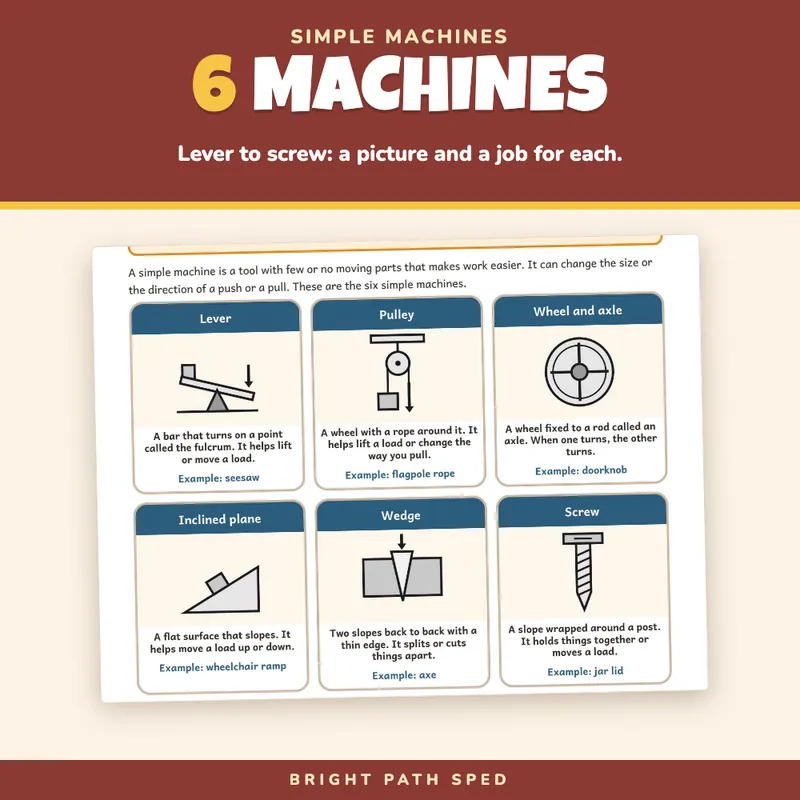
Is a ramp a lever, a wedge or an inclined plane? This is a complete kit for one idea: the six simple machines. It starts with an anchor chart of the lever, pulley, wheel and axle, inclined plane, wedge and screw, each with a plain diagram, what it does and one example. Children then label the parts of a lever and a pulley, name the machine from a picture or an example, circle every lever or wheel and axle in a row, find the example that does not belong, match examples to machines by letter, fill in words, write short answers and cut and paste. Every example is a real-world thing that uses exactly one of the six machines, so there is one right answer. It comes with a tracker, a class grid and a family page, so nothing has to be written from scratch.
EVERYTHING INSIDE (29 pages)
- 14 student pages in 9 page types: Anchor Chart, Label the Parts, Name the Machine, Circle It, Which One Does Not Belong?, Match It, Fill It In, Think and Write and Cut and Paste
- 70 scored items on 12 pages, every answer read from the example lists, never typed by hand
- The 6 simple machines: lever, pulley, wheel and axle, inclined plane, wedge and screw, each drawn as a plain diagram in code
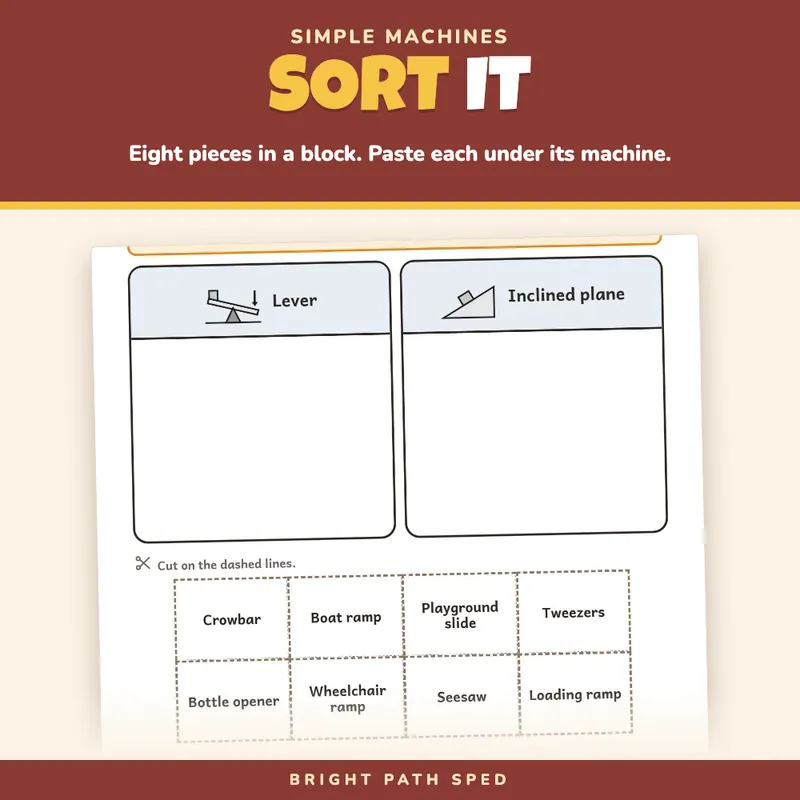
- 24 cut-and-paste pieces on 3 mats: sort examples under lever and inclined plane, under wheel and axle and pulley, and under wedge and screw
- 3 short-response questions in big answer boxes (not scored)
- 2 answer keys, generated from the same data as the student pages
- 1 tracker (page, page type, items right, date) and 1 whole-class progress grid
- 1 team note (a hand-off page between team meetings) and 1 home page
- 1 filled example (an invented student), 1 phrase bank (16 observable-language starters), 1 binder cover and 6 divider tabs with a spine label to cut out
- Start Here and a how-to-read-a-page page
The Page Types, Easiest First
1. Anchor Chart (starting): six machine cards with a diagram, a one-line job and an example, plus two lines for the child to write what a load is and how a machine helps.
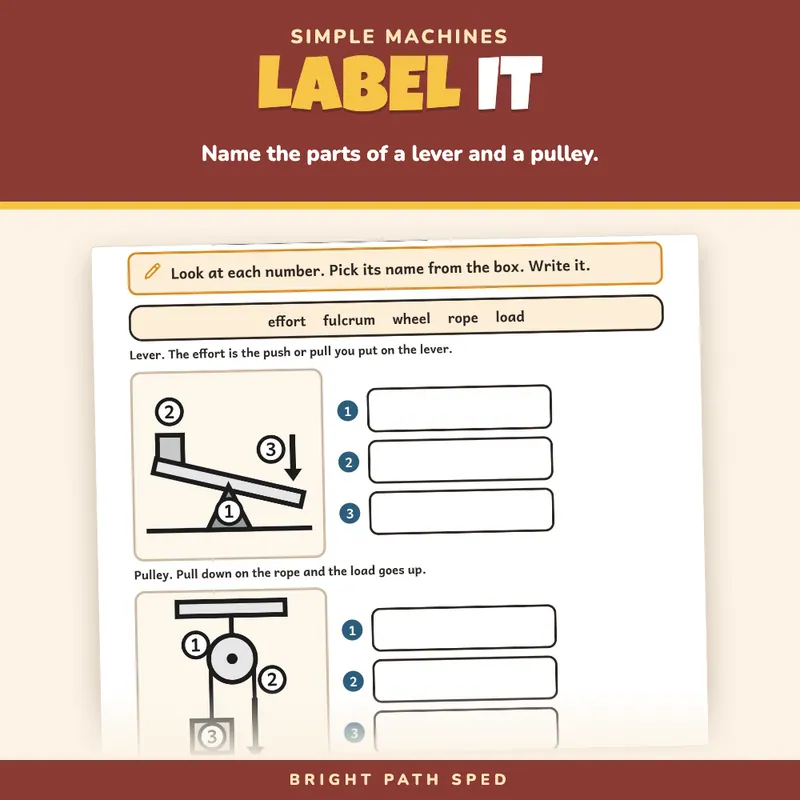
2. Label the Parts (building): a lever and a pulley, each with three numbered parts. Write each name from a box of five words.
3. Name the Machine, 2 pages (1 or 3 dots): Set A shows four diagrams and a box of six machine names; Set B gives six examples and no box.
4. Circle It, 2 pages (1 or 2 dots): four rows of four examples. Circle every lever (or every wheel and axle), then write how many.
5. Which One Does Not Belong?, 1 page (2 dots): four examples, three use the same machine. Circle the odd one and write its number.
6. Match It, 1 page (2 dots): eight examples and six lettered machines. Write the letter. Two machines are used twice.
7. Fill It In, 2 pages (2 or 3 dots): Set A reads a clue and writes the machine from a box of six names (five clues); Set B finishes a sentence from a box of eight words (five sentences, three words not used).
8. Think and Write, 1 page (3 dots): three short questions with big answer boxes.
9. Cut and Paste, 3 pages (1 or 2 dots): a block of 8 pieces that touch edge to edge, so cutting is a few straight lines. Paste each example under its machine.
Drawn And Checked
Every diagram is a plain vector picture drawn in code. Every example in the file is checked against a list that gives it one machine only: a seesaw, crowbar, bottle opener and tweezers are levers; a wheelchair ramp and a playground slide are inclined planes; a knife and an axe are wedges; a wood screw and a jar lid are screws. Things that could fit two machines are left out on purpose.
Built For The Child Holding The Page
A big "My name" line, one short instruction, large rounded type, big answer boxes, and dots (not words or colors) to show which level a page is. Nothing on a student page is written for an adult. The Think and Write boxes are about an inch and a half tall so there is room to work. The file prints clean in black and white.
No Guessing The Answer
Wherever a child picks among printed spots (which example is the odd one, which letter on Match It, where a word sits in the box), the position of the right answer is checked so it does not sit in the same spot three times in a row. Match It has eight examples for six machines, so a child cannot finish by crossing off letters.
Type In, Or Print
The name line and every answer box are type-in fields in any PDF reader: click one, type, then save. The same goes for the tracker, the class grid, the team note and the home page. This is a fillable PDF; it is not a Google Slides or PowerPoint file.
Who This Is For
Elementary classrooms, self-contained and resource rooms, and any teacher building a physical science unit into a center, a small group or a morning work folder. The reading is written at about a grade 3 level, and the teacher can read each page aloud.
What This Is, And What It Is Not
A simple machines worksheet set with the record-keeping around it. It is not a timed test, a screener, a clinical tool, or a claim about any student's age or rate of progress. There is no IEP goal language or eligibility wording anywhere in the file.