Simple Machines Worksheets: Reading, Diagrams, Mechanical Advantage Grades 6-8
- 29 pages
- 6th, 7th, 8th
$2.00 $4.00 on Teachers Pay Teachers
Half the Teachers Pay Teachers price. The same PDF, sold direct.
DownloadOr get it with All-Access: pick any 20 resources a month for $7.
New here? Your first month of All-Access is half off with code TEACHERTOK
Already bought this, or a member?
Instant download. One teacher's license: colleagues need their own copy. Each file carries a license number.
Also on Teachers Pay Teachers: see the Bright Path Sped store
About this resource
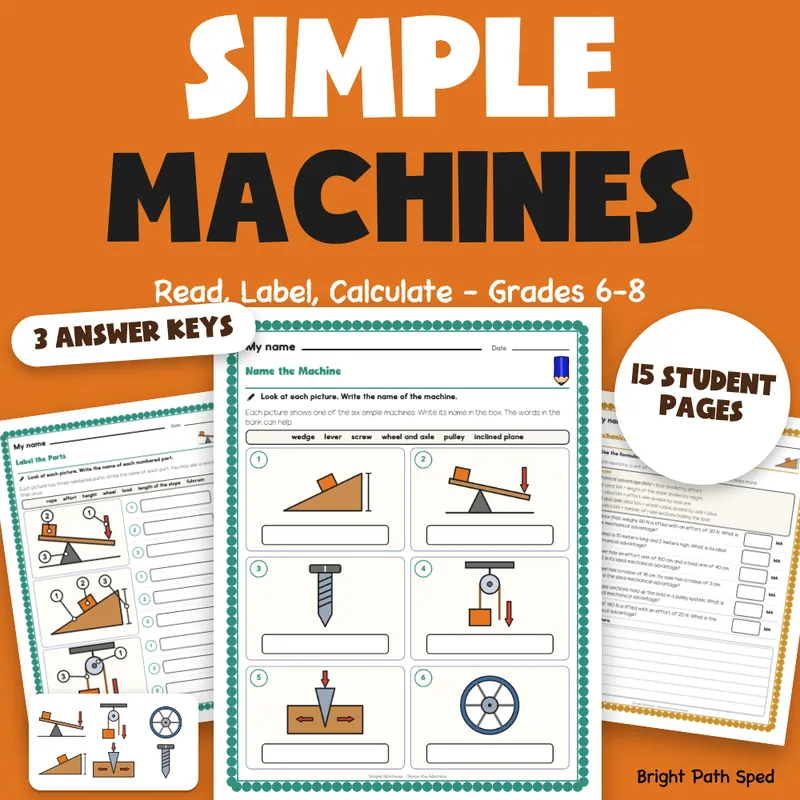
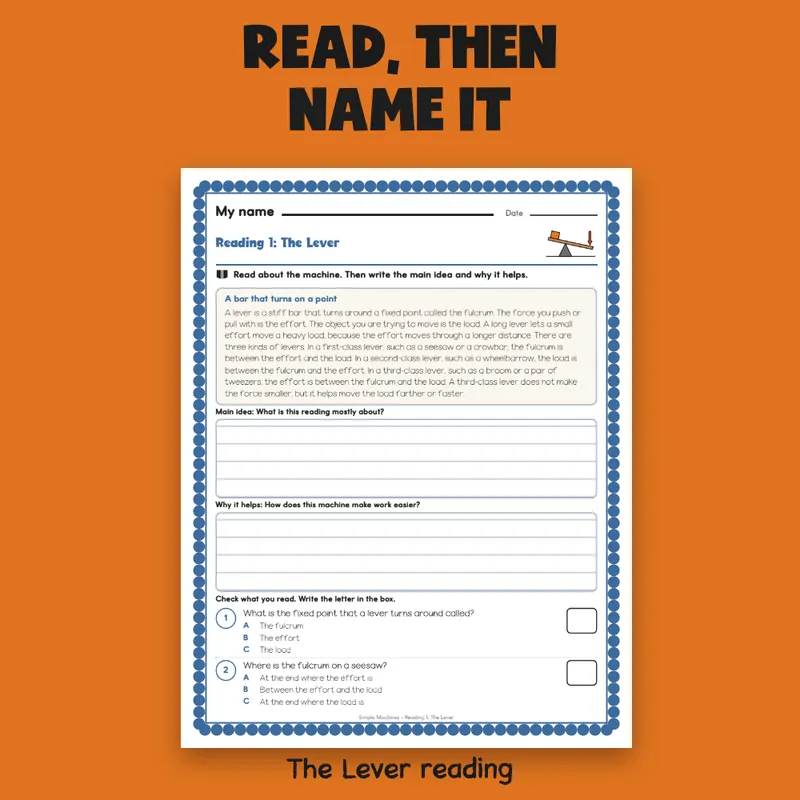
Teaching simple machines and need pages students can actually work on? This is a complete set for grades 6-8. Students read about all six simple machines (lever, pulley, wheel and axle, inclined plane, wedge and screw), name and label drawn machines, practice mechanical advantage and work with the formulas printed right on the page, sort real tools by machine, match tools in a cut-and-paste mat, and design a machine of their own. Everything has a name line, one short instruction and room to write.
EVERYTHING INSIDE (29 sheets)
- 15 student pages in 8 kinds of page, each with a name line and one short instruction
- 68 scored items spread over 14 scored worksheets, every answer key built from the same lists that print on the page
- 6 readings, one per machine, of 114 to 137 words each, with a main idea box, a why-it-helps box and 2 checks each (12 checks in all)
- Topics: the lever and its three classes (effort, load, fulcrum); fixed and movable pulleys; the wheel and axle; the inclined plane and friction; the wedge; the screw and its threads
- 1 Before and After Check (5 questions, an answer box for each time)
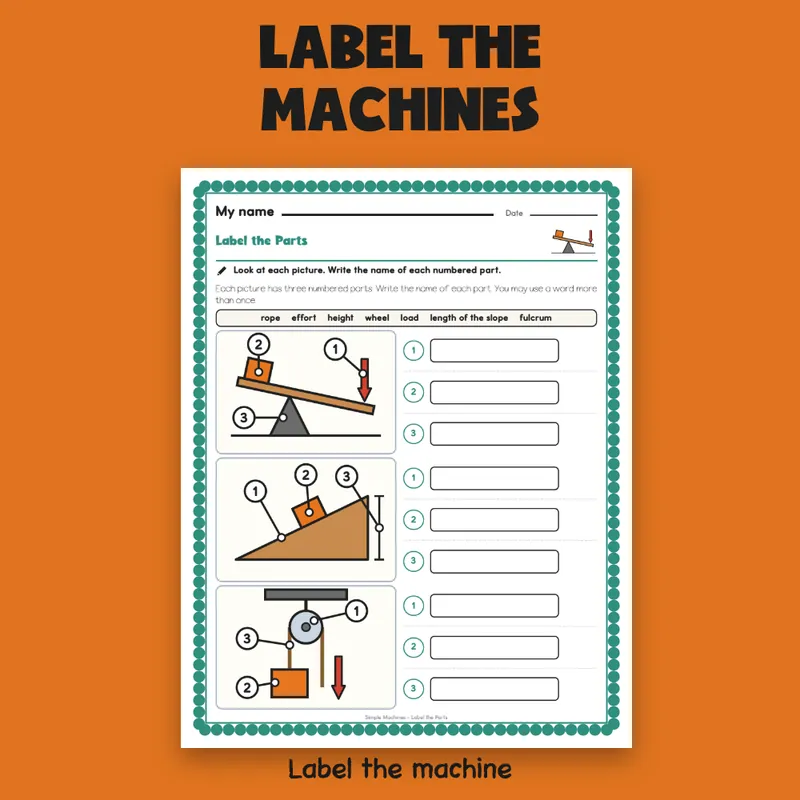
- Name the Machine: 6 flat drawings to name, with a word bank. Label the Parts: 3 drawings (a lever, a ramp, a pulley) with 3 numbered parts each, 9 labels. The numbers sit in a different order on each drawing
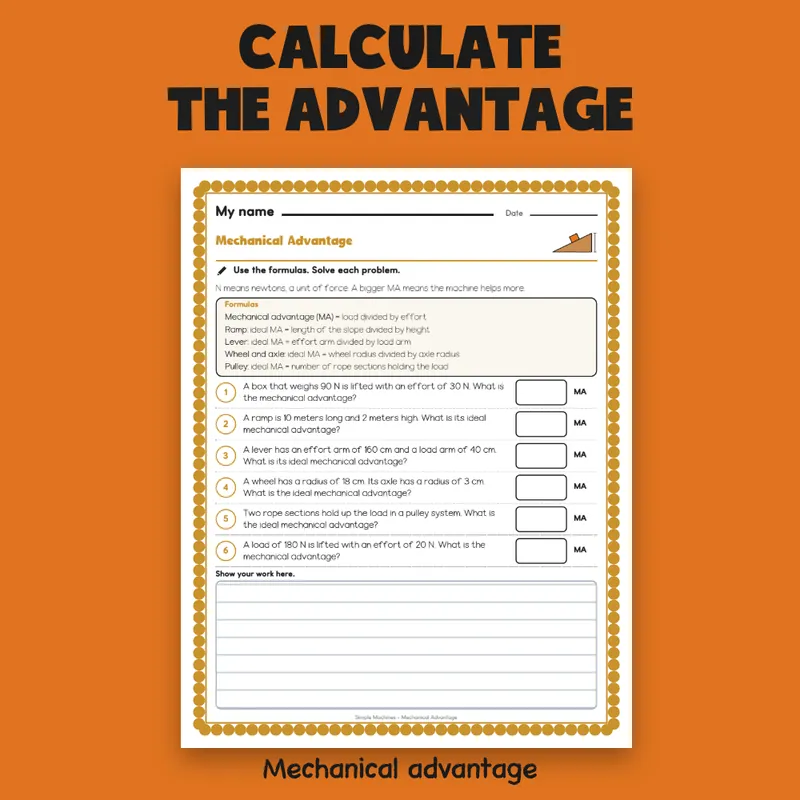
- 2 mechanical advantage pages, 12 problems in all, with the formulas printed on each page: mechanical advantage as load divided by effort, ramp, lever, wheel and axle and pulley formulas, work as force times distance, and finding a missing height, effort or arm. The numbers are invented. Each has a show-your-work box
- 1 sort of 12 real tools and objects (a seesaw, a doorknob, an axe blade, a jar lid and more), 2 for each of the six machines
- 1 design page: pick a job, pick a machine, draw it and label the effort and the load, and explain how it makes the work easier
- 1 quiz of 6 questions
- 6 cut-and-paste pieces on 1 mat with 6 machine boxes (3 by 2 grid, 2.4 by 1.25 inches, edge to edge)
- 3 answer keys; 1 tracker, 1 class grid, 1 family page
- 1 filled example (an invented student), 1 phrase bank (17 starters in 6 groups)
- A binder cover with type-in teacher and class fields, and a page of divider tabs (Readings, Labels and Math, Sort and Cut, Keys, Records) with a spine label to cut out
- Start Here page with a which-page-for-which-job chooser
Built For The Student Holding The Page
A "My name" line, one short instruction with a small picture cue, a plain scalloped border and big ruled boxes. Nothing on a student page is written for an adult: the keys and records are on separate teacher pages. The cut page has its pieces edge to edge, so there are only a few straight cuts. The six machine drawings are flat, colored objects drawn for this file (a plank on a triangle, a wheel on a rope, a ramp with a box, a wedge in a log, a threaded screw). There are no people and no photos.
A Short Account, Not A Full Textbook
Each reading is a plain-words summary written for this file. Check the readings against your own textbook; they are not tied to any standard. Mechanical advantage on the pages is the ideal kind, which leaves out friction. The drawings are not to scale. The only student in the file is an invented example, and it says so.
Type In, Or Print
The name line, every answer box, every check box and every ruled work box are type-in fields in any PDF reader: click one, type, then save. This is a fillable PDF; it is not a Google Slides or PowerPoint file.
What This Is, And What It Is Not
A set of simple machines readings and practice pages with the record-keeping around it. It is not a timed test, a screener, a clinical tool, or a claim about any student's age or rate of progress. There is no IEP goal language or eligibility wording anywhere in the file, and no claim of alignment to any standard.
If You Want More
Plate Tectonics Worksheets | Diagram, Sort, Fill In, Short Answer 6th-8th Grade; Cell City Project Grades 6-8; Atomic Structure Worksheets | Bohr Models, Particle Sort, Neutrons 6th-8th Grade.