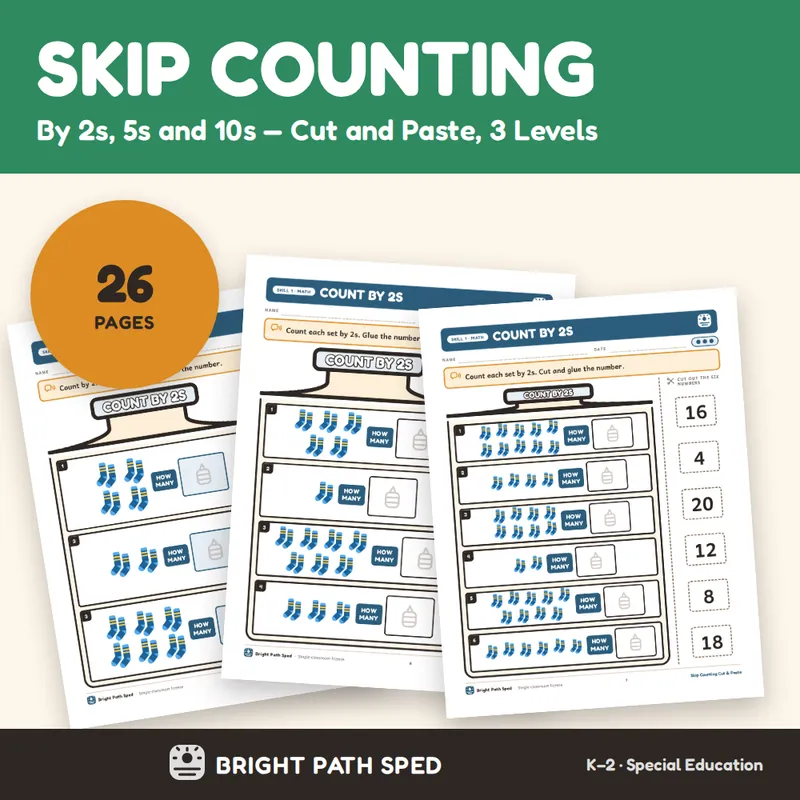
Skip Counting Cut and Paste 3 Levels
- 26 pages
- PreK, Kindergarten, 1st, 2nd
$4.00
DownloadOr get it with All-Access: pick any 20 resources a month for $7.
New here? Your first month of All-Access is half off with code TEACHERTOK
Already bought this, or a member?
Instant download. One teacher's license: colleagues need their own copy. Each file carries a license number.
Also on Teachers Pay Teachers: see the Bright Path Sped store
About this resource
A student who can count to twenty one at a time is not yet ready for nickels, dimes or the minute
hand. Those all count in jumps — by 2s, by 5s, by 10s — and the jump is a separate skill from the
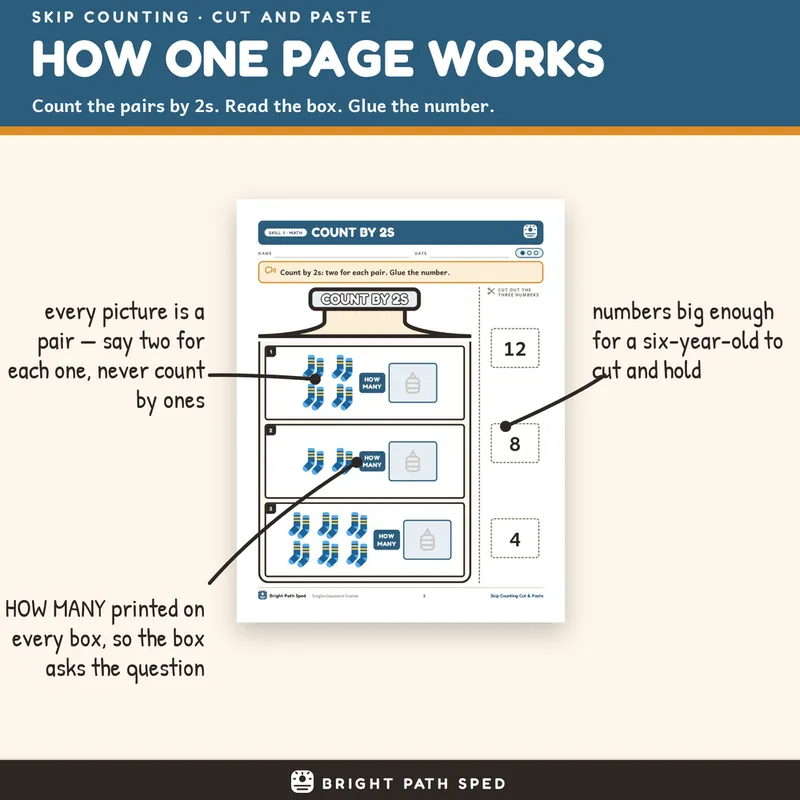
count. This pack teaches the three jumps one at a time, with a picture that IS the jump: a pair of
socks is two, a hand is five, a ten-rod is ten.
Five skills, one skip-counting job each, three levels of every single one. Count by 2s over pairs
of socks. Count by 5s over hands. Count by 10s over ten-rods, all the way to a hundred. Then a
Missing Number page — a count-by strip drawn as a number line with one tile gone, by 2s, 5s and 10s
— and a mixed check that puts all four jobs on one page in no particular order.
Every page is the same jar, drawn in heavy black line with the boxes inside it and the number cards
in a column beside it, so a student who has done one page knows what to do on the next: look at what
is in the box, say the chant, glue the number. The socks and the hands are full-color pictures; the
rods and the number lines are the store's own line work; and every box prints its question — HOW
MANY beside every counted set, NEXT or MISSING beside every strip.
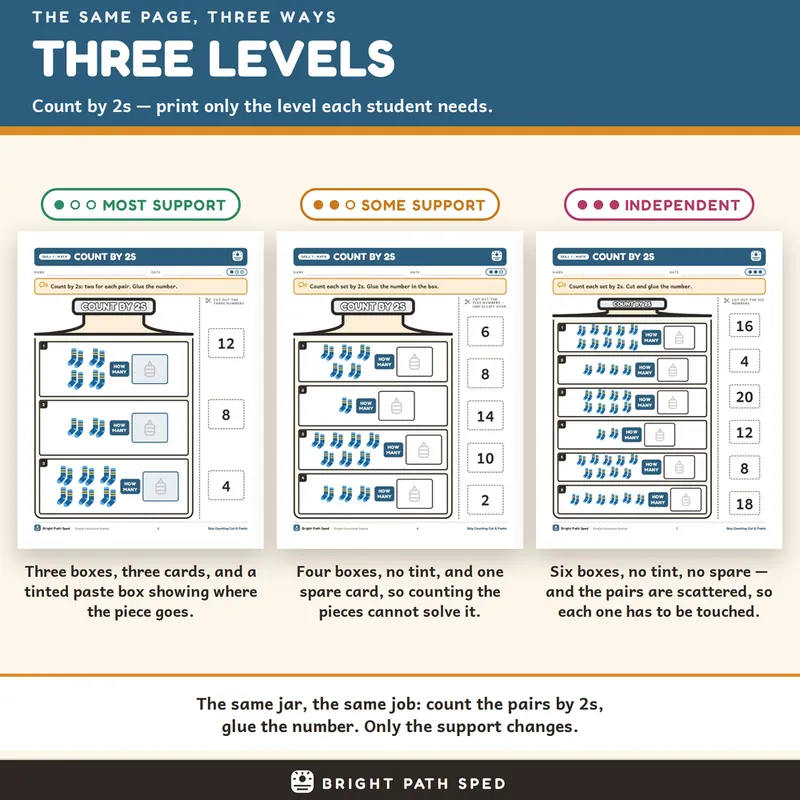
How The Three Levels Work
Level 1 — the fewest boxes, a tinted paste box showing exactly where the piece goes, sets lined up
in neat rows, and no spare piece. Every card still has to be read, because choosing the right number
is the skill.
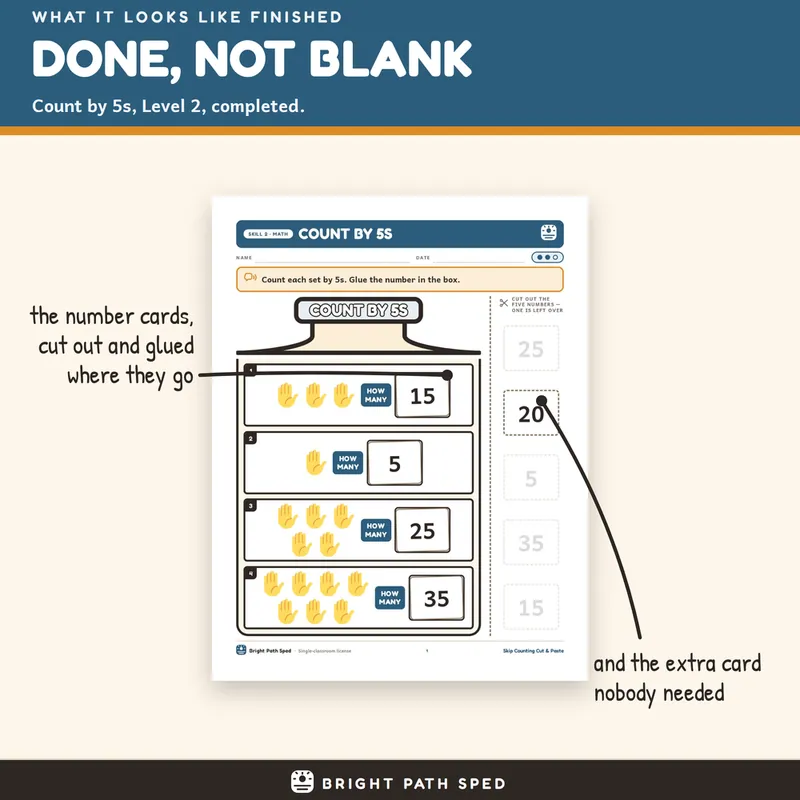
Level 2 — one more box, no tint, and one spare piece that answers nothing on the page, so counting
the pieces and counting the boxes will not solve it.
Level 3 — six boxes, no tint, nothing spare, and the hard arrangement: the sets are scattered instead
of lined up, and on Missing Number the gap can be first, in the middle or last on strips that count
by 2s, 5s and 10s in no pattern. The pieces are never printed in the order the boxes are answered in.
The Five Skills
1. Count by 2s — pairs of socks: say two for each pair, glue the number (2 to 20)
2. Count by 5s — hands: say five for each hand, glue the number (5 to 50)
3. Count by 10s — ten-rods: say ten for each rod, glue the number (10 to 100)
4. Missing Number — a count-by strip with one tile missing; find the step, glue the number
5. Skip Counting Check — pairs, hands, rods and a strip on one page, nothing in the order it was taught
The Box Prints The Question
Every counted set prints HOW MANY beside its paste box, and every strip prints NEXT when the gap is
the last tile or MISSING when it is not. On the mixed check the thing in the box changes from row to
row — socks, then hands, then rods — so a student who says one chant for the whole page gets it
wrong. That is deliberate: it is what that page is built to show you.
What Is In The File
- 26 pages, one PDF
- 5 scripted lesson plan pages — a script in quotation marks a substitute could read cold, three
level notes, three "if a student is stuck" tips with the likely cause named, a try-it-today idea
and a data box on every plan
- 15 student worksheets (5 skills x 3 levels)
- 2 pages of answer keys, recomputed from the same data that draws the worksheets
- 1-page "how to use this packet" guide
- A name and date line, a big direction line and a cut rule on every worksheet
- Every numeral a student reads — on the strip and on the card — set at the same size, in a box big
enough for a six-year-old to cut and hold
- No level word and no teacher note anywhere on a student page: the three dots on the name line are
the only level code, and they are there for you, not for the child
Who This Is For
Self-contained, resource and early-intervention classrooms, and any K–2 room with students who count
to twenty and are being asked for the next thing: coins, the clock, or the hundreds chart. It sits
after this store's counting work and before money and time.
What This Is, And What It Is Not
A print-and-cut worksheet packet with a scripted plan page in front of each skill. It is not a
fillable form, not a full curriculum, and not a claim about how quickly any student will learn to
skip count — every objective is written the way a classroom goal is written, with nothing clinical,
no timeline and no eligibility claim attached to it.
It is also not a set of probes. This store's Skip Counting by 2s, 5s and 10s Progress Monitoring
Probes measure the chant; these pages teach it. Every page in this pack was written for it and
checked against every page already in print.