Slope and Y Intercept Worksheets
- 24 pages
- 8th, 9th
$1.75 $3.50 on Teachers Pay Teachers
Half the Teachers Pay Teachers price. The same PDF, sold direct.
DownloadOr get it with All-Access: pick any 20 resources a month for $7.
New here? Your first month of All-Access is half off with code TEACHERTOK
Already bought this, or a member?
Instant download. One teacher's license: colleagues need their own copy. Each file carries a license number.
Also on Teachers Pay Teachers: see the Bright Path Sped store
About this resource
One skill, start to finish. A slope and y-intercept IEP goal, four equivalent untimed probe forms that measure it, an answer key and a graph scaled to the probe. Baseline on Monday, goal written by Tuesday, first data point on Friday.
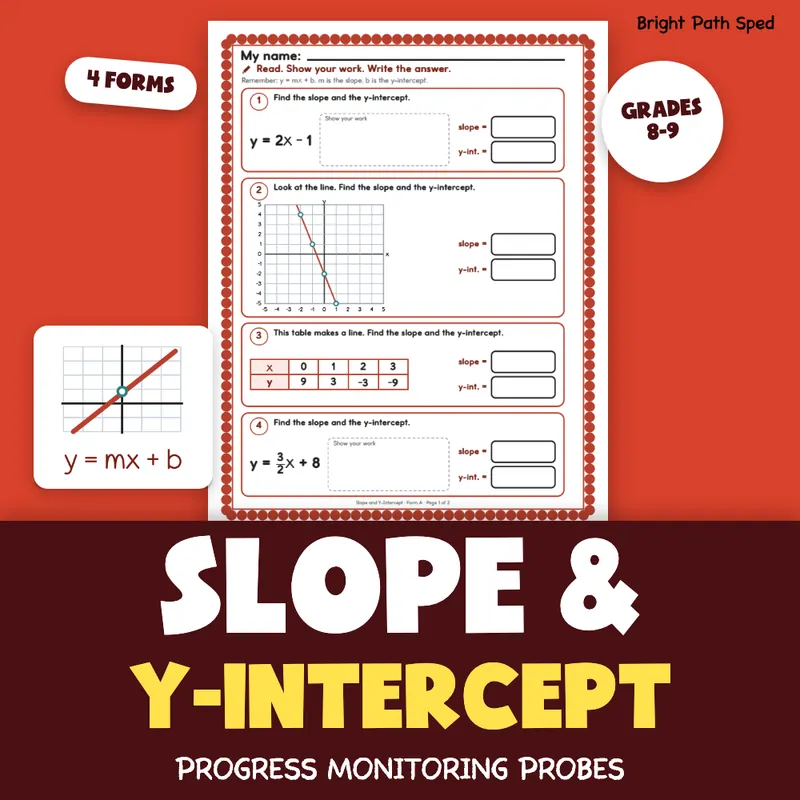
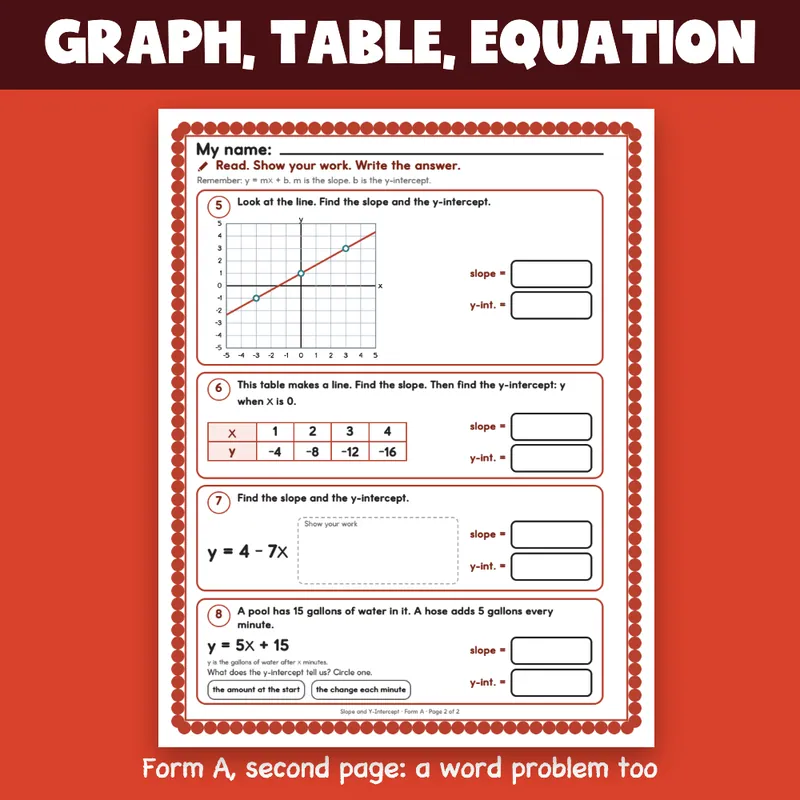
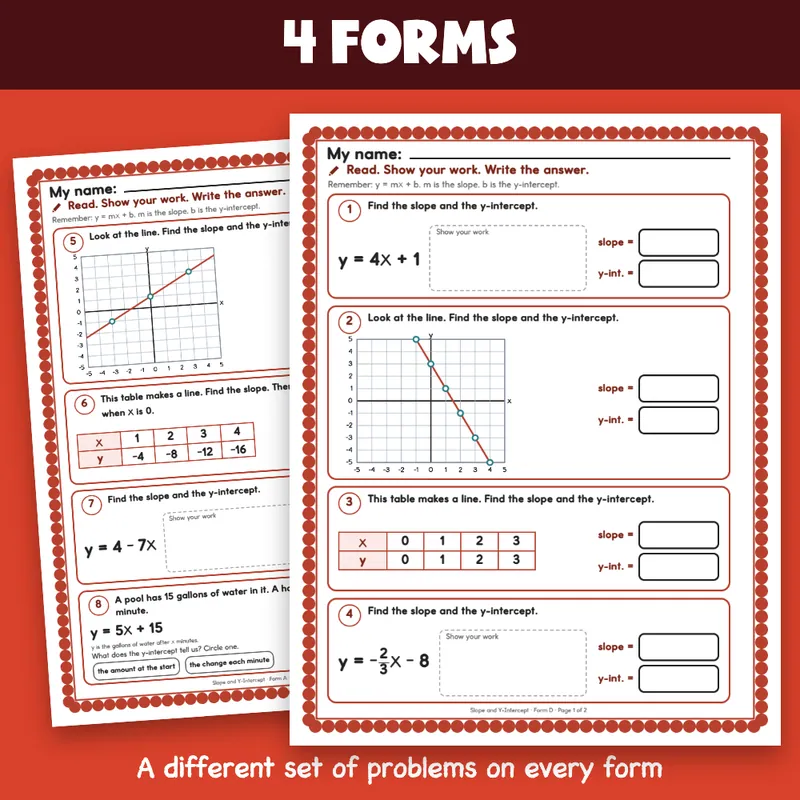
Every form has eight problems over two student pages, four problems a page, each with a work box and two answer boxes (slope and y-intercept): three equations, two graphs, two tables and one short story. The graphs are drawn on a grid from -5 to 5 with open dots where the line crosses grid points. The kinds of problem are in the same places on every form, so the score means the same thing on Form A and on Form D. Four slopes are positive and four are negative on every form, two slopes are fractions, and one problem has a y-intercept of 0. One equation on every form is written with the y-intercept first, as in y = 7 - 3x, and one table starts at x = 1, so the student has to work back to x = 0.
WHAT IS INCLUDED - 24 pages, four probe forms of eight problems each (32 problems, none repeated), 8 student form pages, a graph-it page with four blank grids, a two-page answer key, a directions page, a teacher notes page, a one-line-three-ways reference page, a binder cover and divider tabs, a family update page
Start Here And The Goal
- A one-page quick start: six steps and which page is for which job
- A goal page with a sample goal (every bracket meant to be edited), the goal frame as type-in fields, a baseline table and three benchmark rows
- Lines for your district's own rules, this student's scoring rules and the supports the IEP allows
Four Probe Forms, A Through D
- A big My name line, one short instruction with a pencil picture, and a "Show your work" box and slope and y-intercept answer boxes for every problem
- Equations in y = mx + b form (12 across the four forms), graphs on a -5 to 5 grid (8), tables of x and y values (8) and a short story with its equation (4)
- Whole-number and fraction slopes, positive and negative, and a y-intercept of 0 on one problem per form
- The story asks what the slope or the y-intercept tells us: the amount at the start, or the change each minute, hour or week
- No answers, goal text or scoring strip on a student sheet
Graph It
- One student page with four blank coordinate grids and four equations: plot the y-intercept, use the slope, draw the line, write the slope and the y-intercept
Directions, Answer Key And Teacher Notes
- A directions page: what to say, what is on every form, how each kind of problem is placed
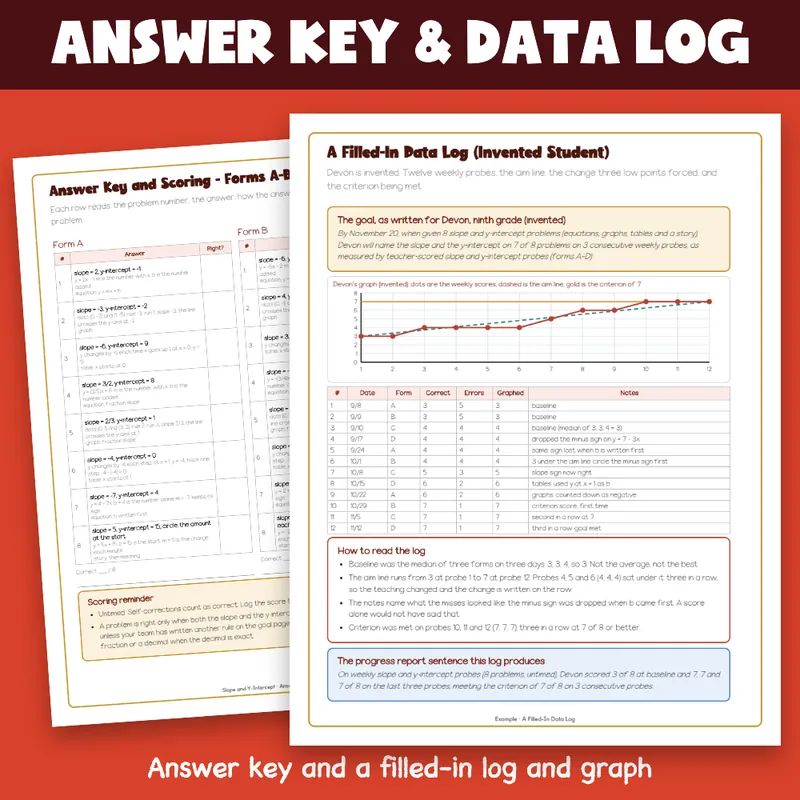
- A two-page answer key with a mark box per problem, the working shown and the kind of problem named
- Reading the misses: the minus sign lost when b is written first, m and b swapped, the sign and the count on graphs, where x starts in a table, misses that cluster on one kind of problem
- A one-line-three-ways reference page: the same line as an equation, a graph, a table and a story, one with a whole-number slope and one with a negative fraction slope
Data Log, Graph And Caseload
- A graph scaled 0 to 8 with twelve probe columns and a ten-row log
- A caseload summary grid, a filled-in example with a plotted graph (Devon, invented) and a family update and team handoff page
What This Is, And What It Is Not
It is a fillable PDF. The goal page, data log, caseload page, family update page and the mark boxes on the answer key are type-in fields: open the file in a PDF reader, click a line or a cell, type, and Save As once per student. The probe forms print: the student writes on paper.
Who This Is For
Eighth and ninth grade special education teachers and case managers writing slope and y-intercept goals, math intervention and resource teachers, and the paraprofessionals who give the weekly probe.