Solving Systems of Equations by Graphing Worksheets Grades 8-9
- 44 pages
- 8th, 9th
$2.50 $5.00 on Teachers Pay Teachers
Half the Teachers Pay Teachers price. The same PDF, sold direct.
DownloadOr get it with All-Access: pick any 20 resources a month for $7.
New here? Your first month of All-Access is half off with code TEACHERTOK
Already bought this, or a member?
Instant download. One teacher's license: colleagues need their own copy. Each file carries a license number.
Also on Teachers Pay Teachers: see the Bright Path Sped store
About this resource
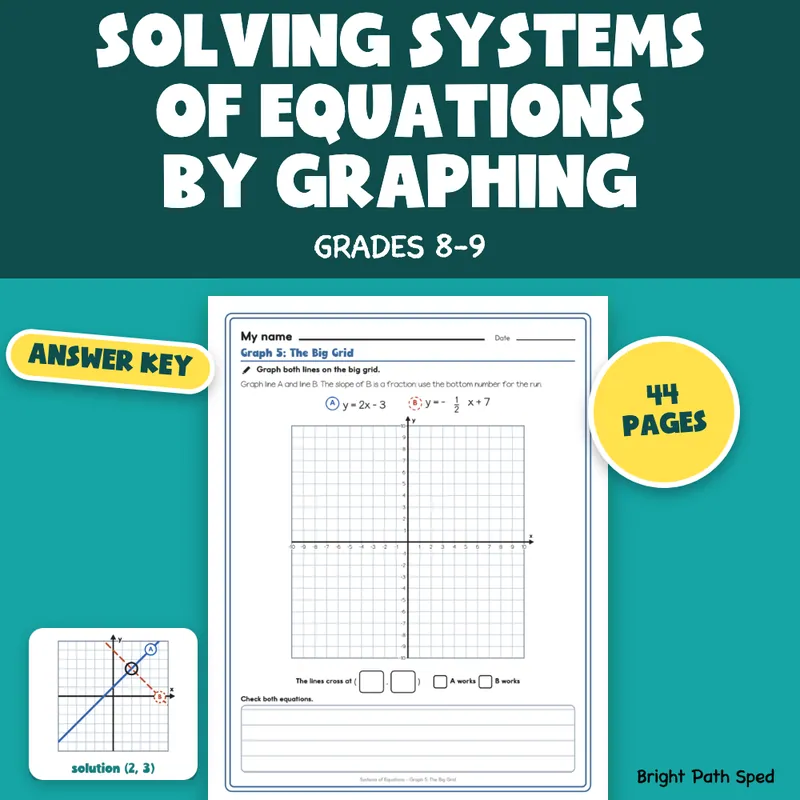
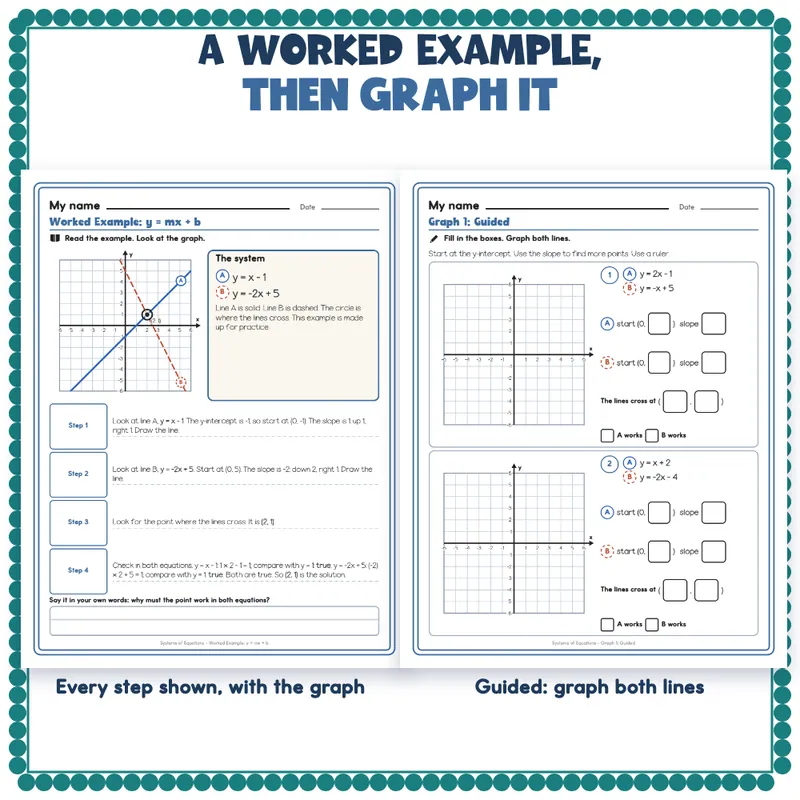
Teaching systems of equations and want graph pages students can actually work on? This is a complete unit for grades 8-9: how to graph a line, the four steps of solving by graphing, two worked examples with the graph drawn, slope and y-intercept practice, graphing pages that go from guided to on-your-own, a big full-page grid, reading and checking the crossing point, parallel and same-line systems, and word problems. Every student page has a "My name" line, one short instruction and real room to work, and every system has its own blank grid. Answer keys show every check, and a tracker, class grid, team note and family page are included.
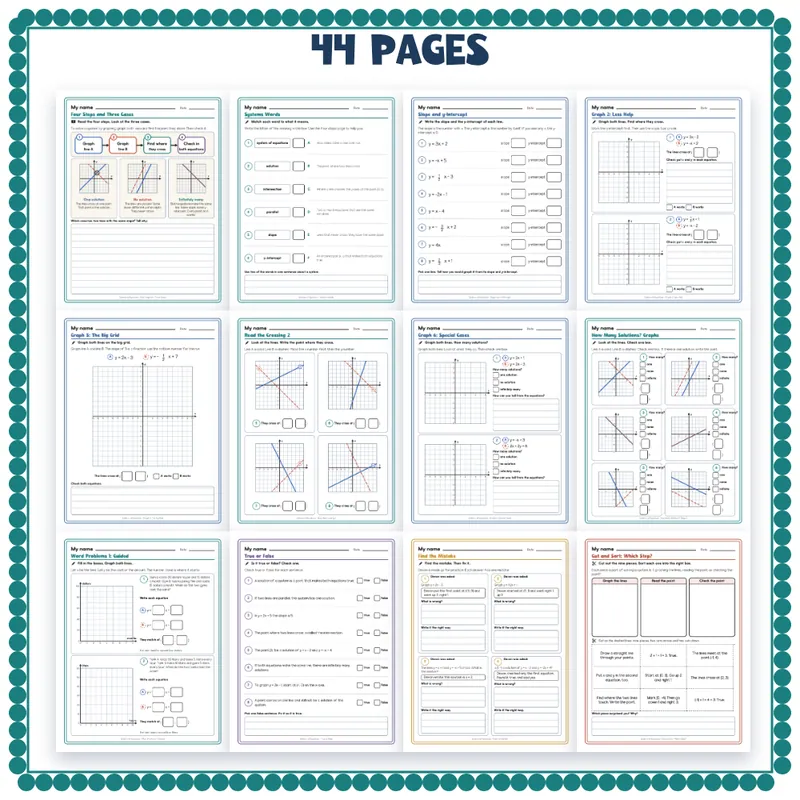
EVERYTHING INSIDE (44 pages)
- 28 student sheets in 15 kinds of sheet, each with a name line and one short instruction
- 99 scored items on 22 sheets; every answer is computed in the module from the equations
- 15 blank coordinate grids to draw on: 11 for graphing a system (two per page, 3.6 inches across, and one 5.6-inch grid for a whole page) and 4 for word problems
- 1 how-to-graph sheet (start at the y-intercept, use the slope) and 1 sheet with the four steps and the three cases (one solution, no solution, infinitely many)
- 1 vocabulary match: 6 words (system of equations, solution, intersection, parallel, slope, y-intercept)
- 2 worked examples, each with the graph drawn and every step shown: one in y = mx + b form and one in standard form
- 1 slope and y-intercept sheet: 8 lines
- 6 graphing sheets, 11 systems in all: guided (boxes for the start point and slope), less help, standard form (rewrite each line first), on your own, the big grid, and special cases (parallel lines and the same line written two ways)
- 2 read-the-crossing sheets: 8 systems with both lines already drawn, read the point where they cross
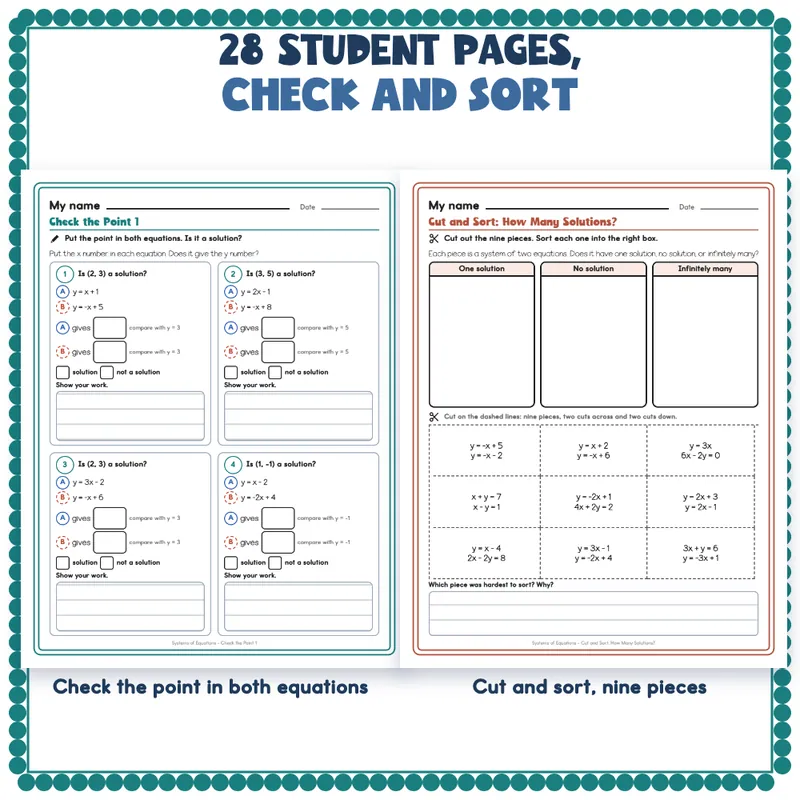
- 2 check-the-point sheets: 8 points to test in both equations, 4 in y = mx + b form and 4 with standard-form equations mixed in
- 2 how-many-solutions sheets: 12 systems, first from drawn lines, then from the equations alone
- 2 word-problem sheets: 4 problems (two gym plans, two tanks, two savers, two rides), the first sheet guided and the second on your own
- 1 true-or-false sheet (8 sentences), 1 Find the Mistake sheet (4 answers from an invented student), 1 explain-it sheet (3 prompts with five ruled lines each)
- 2 quizzes (12 multiple-choice items), 1 exit-ticket sheet (3 tickets)
- 18 cut-and-paste pieces on 2 sort mats: 9 systems sorted into one solution, no solution and infinitely many, and 9 steps sorted into graph the lines, read the point and check the point
- 5 answer key sheets that show the check for every system; 1 tracker, 1 class grid, 1 team note, 1 family page
- 1 filled example (an invented student), 1 phrase bank (17 starters in 6 groups)
- Start Here and a how-to-read-a-page sheet
- A "What's next" page with two more of our algebra worksheets
Built For The Student Holding The Page
A "My name" line, one short instruction with a small picture cue, and a plain double-rule border. Nothing on a student page is written for an adult: the keys and records are on separate teacher sheets. Line A is solid and line B is dashed, so the pages still read when copied in black and white. The grids students draw on have numbered axes, and every answer box is at least half an inch tall.
The Math, Shown Step By Step
Every system is solved the same way: graph line A from its y-intercept and slope, graph line B, read the point where they cross, then put that point in both equations. The answer key shows the check for every system, and the special cases are on their own sheets: parallel lines have the same slope and different y-intercepts, and the same line written two ways has the same slope and the same y-intercept. Every crossing point is a whole-number point inside its grid, so a student can read it off the graph.
Invented Examples
The student in the filled example (Casey M.) and the student in the mistake sheet (Devon) are made up and say so. The explain-it sheet has no single right sentence: the key says what to look for.
Type In, Or Print
The name line, every answer box, every check box and every ruled work box are type-in fields in any PDF reader: click one, type, then save. The graphs themselves are drawn in pencil on the printed grid, so print the graph pages. This is a fillable PDF, not a slideshow or a word-processor file; it is not a Google Slides or PowerPoint file.
What This Is, And What It Is Not
A solving-by-graphing practice set with the record-keeping around it. It does not teach substitution or elimination, and it is not a timed test, a screener, a clinical tool, or a claim about any student's age or rate of progress. There is no IEP goal language or eligibility wording anywhere in the file, and it does not claim to match any one state's standards: there is a line on the tracker for your own.
If You Want More
Graphing Linear Inequalities Worksheets | Graph, Shade and Check Algebra 1; Solving Equations with Variables on Both Sides | Notes, Practice Grades 8-9.