Sound Boxes Segmenting CVC Words Worksheets
- 31 pages
- Kindergarten, 1st
$4.00
DownloadOr get it with All-Access: pick any 20 resources a month for $7.
New here? Your first month of All-Access is half off with code TEACHERTOK
Already bought this, or a member?
Instant download. One teacher's license: colleagues need their own copy. Each file carries a license number.
Also on Teachers Pay Teachers: see the Bright Path Sped store
About this resource
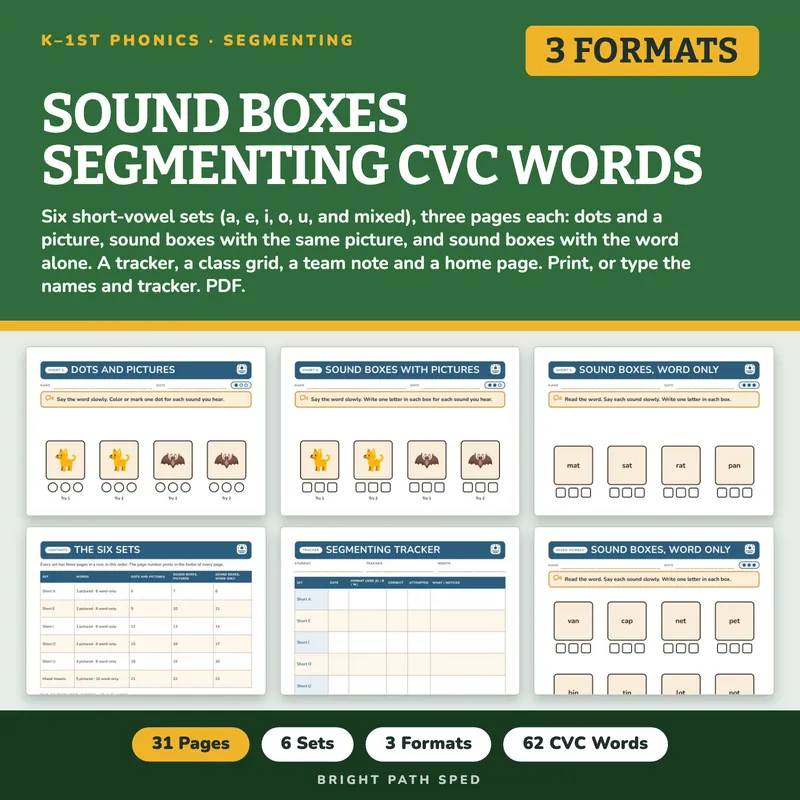
A child who can hear that "cat" has three sounds is not automatically a child who can write c-a-t. This
gives both jobs their own page, at three levels of support, for six short-vowel sets: color a dot for
each sound, write the letters under the same picture, then write the letters with no picture at all.
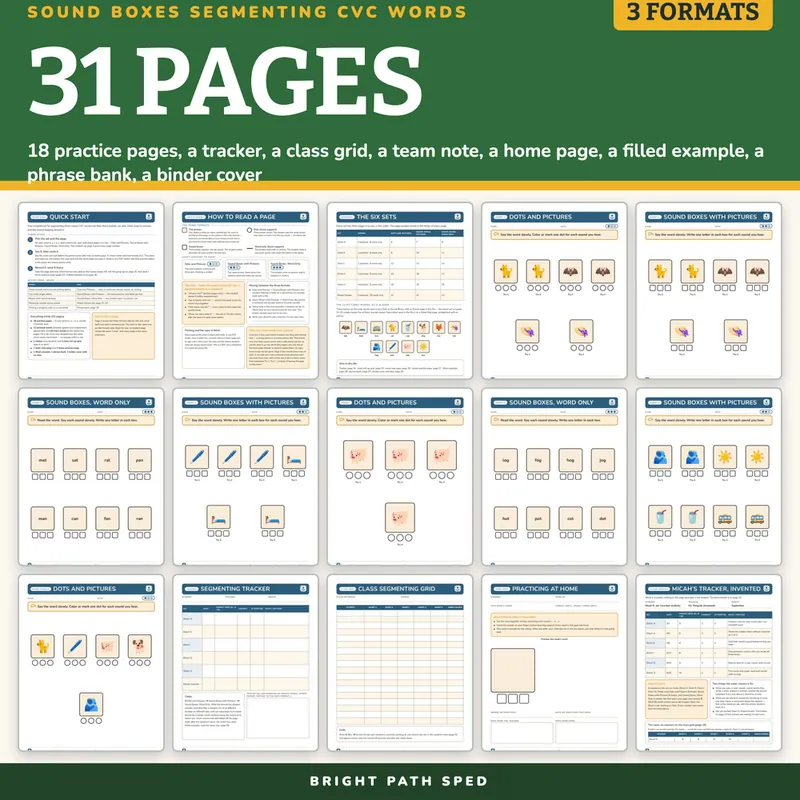
EVERYTHING INSIDE (31 pages)
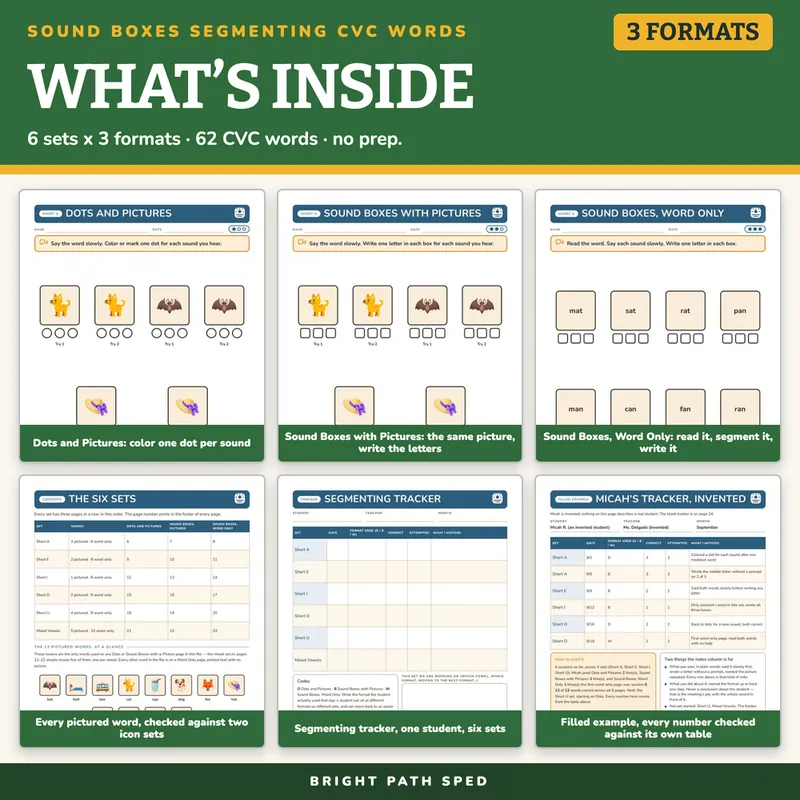
- 18 practice pages — 6 sets (short a, e, i, o, u, and a mixed set) x 3 formats each: Dots and
Pictures, Sound Boxes with Pictures, Sound Boxes Word Only
- 12 pictured words, each checked against two independent icon sets (Google Noto and Microsoft Fluent
High Contrast) so a wrong picture never becomes a wrong answer key, plus 50 more words on the
word-only pages — 62 real CVC words in all, straight from a short-vowel word bank, no repeats within
a set
- 1 segmenting tracker (one student, all six sets) and 1 class grid (whole class x six sets), type-in
or print
- 1 team note page and 1 home-practice page
- 1 filled example, 1 phrase bank, 1 binder cover with a spine label and six divider tabs
- Start Here, a how-to-read-a-page key, and a contents page that gives every page number, plus a
gallery of all 12 pictured words
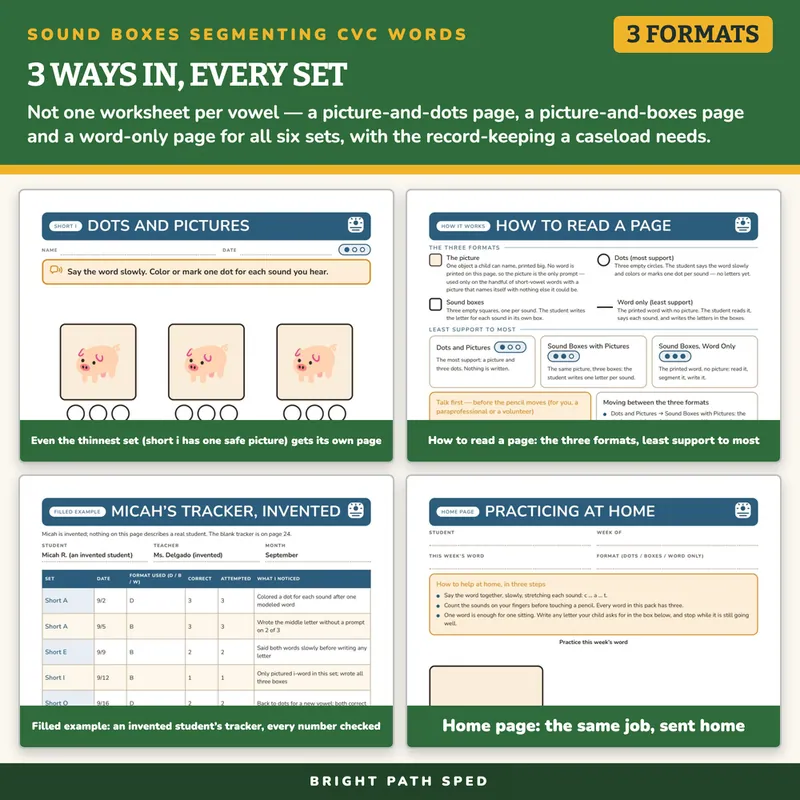
The Three Formats, Every Set
1. Dots and Pictures (most support) — a picture, three empty dots. Say the word slowly and color or
mark one dot per sound; nothing is written yet.
2. Sound Boxes with Pictures — the same picture, three empty boxes. Write one letter per sound.
3. Sound Boxes, Word Only (least support) — the printed word, no picture. Read it, say each sound,
write the letters.
The dots on the name line are the format code, there for the teacher: no student or home page carries
the word "Level."
The Six Sets
Short a, short e, short i, short o, short u, and a mixed-vowel set for discrimination practice. A
picture is only used where it names one thing and nothing else — a wrong picture is a wrong answer
key — so the picture-based pages carry as few as one word (short i) and as many as four (short u); the
word-only pages carry eight fresh words per vowel instead, because no picture is needed there. Where a
vowel has only one or two pictured words, that word repeats as fresh "Try 1 / Try 2 / Try 3…"
practice sets with new blank dots or boxes each time, so the page is a full page of repeated practice,
not a single small picture on a mostly empty sheet. Page 5 lists exactly how many pictured and
word-only words are in each set, with a gallery of every picture.
Type In, Or Print
The name and date lines, the tracker, the class grid, the team note and the home page are type-in
fields in any PDF reader. The dots and the letters a student writes are always pencil work. This is a
fillable PDF; it is not a Google Slides or PowerPoint file.
Who This Is For
Kindergarten and first-grade classrooms, self-contained and resource rooms, and any teacher with three
kinds of speller at one table. The home page sends the same job to a family; the team note hands off
what changed since the last meeting.
What This Is, And What It Is Not
A segmenting and spelling practice set with the record-keeping around it. It is not a reading
assessment, not a speech-language evaluation tool, and not a claim about any student's age or rate of
progress. The how-it-works page has a blank line for your district's own criterion.