Story Problems Worksheets Within 20
- 37 pages
- 1st
$4.00
DownloadOr get it with All-Access: pick any 20 resources a month for $7.
New here? Your first month of All-Access is half off with code TEACHERTOK
Already bought this, or a member?
Instant download. One teacher's license: colleagues need their own copy. Each file carries a license number.
Also on Teachers Pay Teachers: see the Bright Path Sped store
About this resource
By first grade a story problem stops staying under 10: "14 hedgehogs are in the garden. 7 hedgehogs toddle off. How
many hedgehogs does the class still see?" This is a full kit for that step up: seven kinds of student page, 72 short
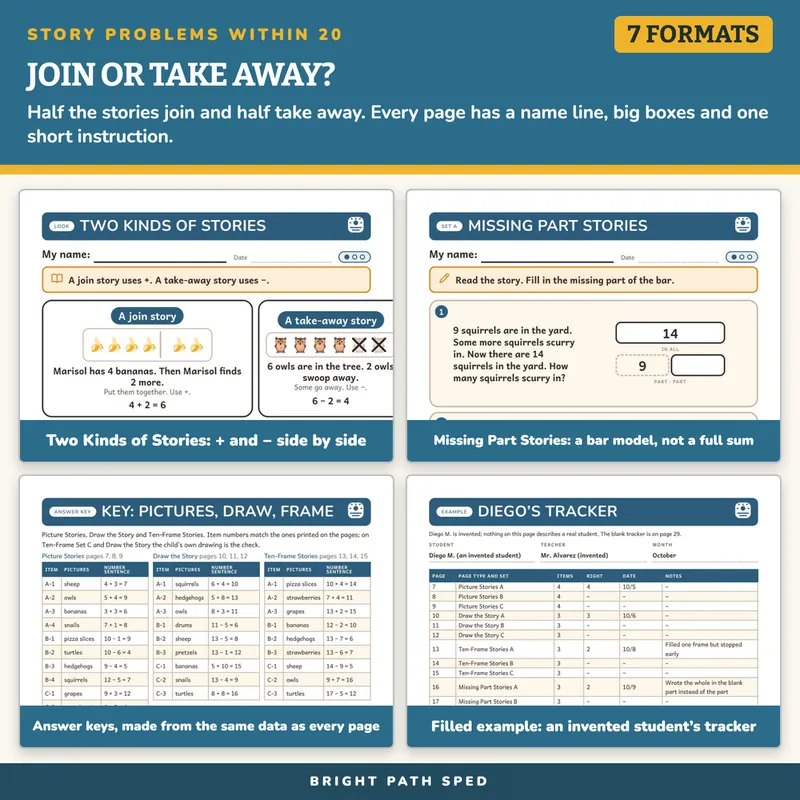
stories where every number is 20 or less, and the record-keeping around them. Half the stories join and half take
away, and the child has to say which. Every page has a big "My name" line, one short instruction, room to work and
answer boxes a young child can write in.
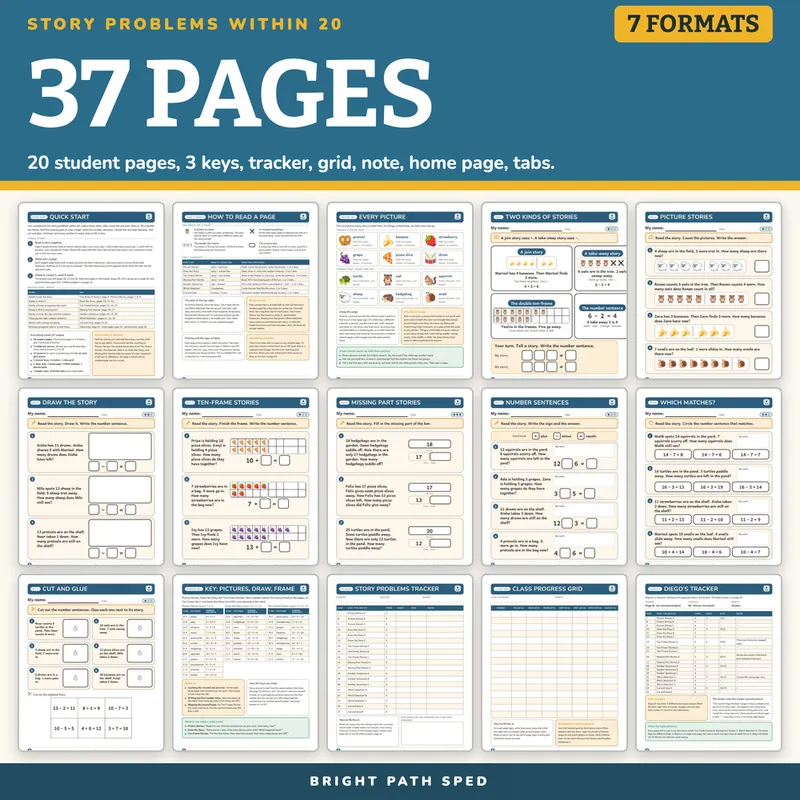
EVERYTHING INSIDE (37 pages)
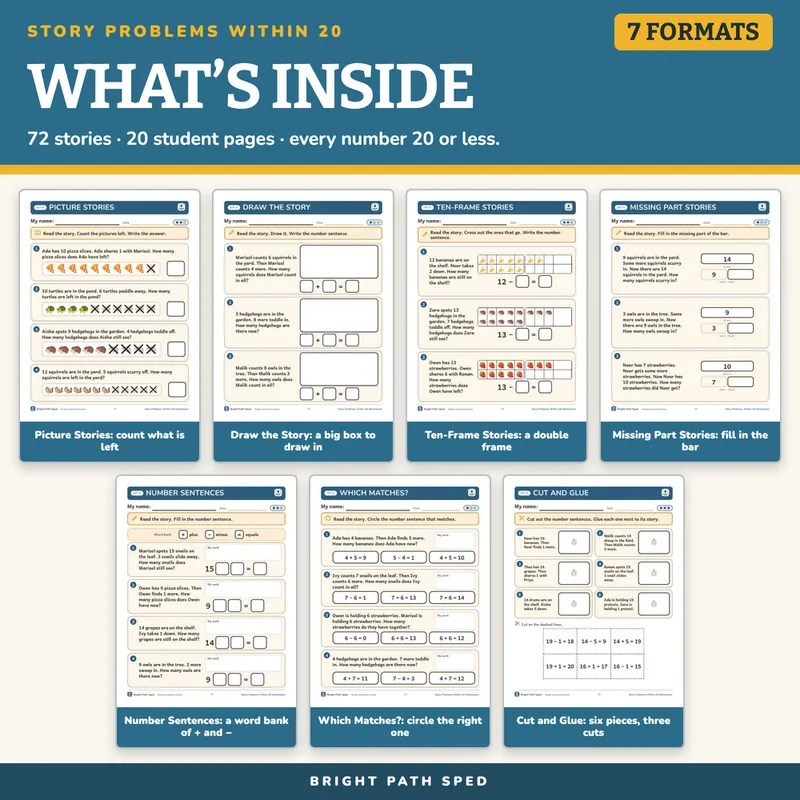
- 20 student pages: 19 practice pages in 7 formats, plus a Two Kinds of Stories page that shows a join story and a take-away story side by side
- 72 different stories, 36 that join and 36 that take away, with every answer from 1 to 20
- 12 pictures a young child names (pretzel, banana, strawberry, grape, pizza slice, drum, turtle, owl, squirrel, sheep, hedgehog, snail) and a picture key, each used in exactly 6 stories
- 12 cut-and-glue pieces in 2 sets of 6 (three straight cuts a page)
- 3 answer keys, made from the same data as the pages
- 1 tracker (19 pages, 72 items), 1 class progress grid
- 1 team note and 1 home page (four draw-it boxes with number-sentence boxes for a family to fill in)
- 1 filled example (an invented student), 1 phrase and story-talk bank (17 starters), 1 binder cover and 8 divider tabs with a spine label to cut out
- Start Here, a how-to-read-a-page page, and a "what's next" back page
The Seven Formats
1. Picture Stories (3 pages, 12 stories): read the story, count the drawn pictures (on the take-away pages the crossed-out ones are gone), and write the answer.
2. Draw the Story (3 pages, 9 stories): read, draw the story in a big box, then write the number sentence.
3. Ten-Frame Stories (3 pages, 9 stories): a DOUBLE ten-frame (two five-by-two blocks) so up to 20 fill in; finish it, cross out the ones that go away, or draw the whole story in an empty double frame, then write the number sentence.
4. Missing Part Stories (2 pages, 6 stories): a part-part-whole bar shows the whole on top and one part below; the child fills in the missing part, which is also the story's answer. New to this product.
5. Number Sentences (3 pages, 12 stories): fill in the sentence with a word bank of + and minus. The first page prints both numbers, the second only the first, the third none.
6. Which Matches? (3 pages, 12 stories): three number sentences under each story; circle the one that fits. One has the other sign and one has an answer that is one off, so only one fits.
7. Cut and Glue (2 pages, 12 pieces): glue each number sentence beside its story. Six pieces a page in a 3 by 2 block, every piece touching its neighbors. On the second page each pair of numbers appears in a join story and a take-away story, so the child has to read.
Dots at the top right of each page (not words) show the level: one dot, two dots, three dots (Missing Part Stories and Cut and Glue go from one dot straight to three).
Every Number Is 20 Or Less, On Purpose
Every number in every story and every answer choice is 20 or less, and every answer is between 1 and 20. Picture
Stories keeps its drawn objects to 12 or fewer per item so a loose counter never drops under 0.35 inch; every other
format carries the full 1-20 range. All of it is checked in code for every story, and the pictures are checked too:
on Picture Stories the pictures drawn equal the story's numbers, the crossed-out ones equal the number that goes
away, and each ten-frame block fills in reading order.
Built For The Child Holding The Page
A big "My name" line, one short instruction with a picture, large rounded numbers and boxes at least half an inch
tall. Draw the Story has a big draw box for each story; Number Sentences and Which Matches? have a "My work" box
beside each story; on Picture Stories the pictures are the work. Nothing on a student page is written for an adult,
and there are no scores and no timers. The pictures are Google Noto Emoji (Apache 2.0), each checked against a
black-and-white ink-saver set, so the pages print well on any printer.
Type In, Or Print
The name and date lines, the answer boxes, the tracker, the class grid, the team note and the home page are type-in
fields in any PDF reader. Every page also prints cleanly in black and white. This is a fillable PDF; it is not a
slideshow or a word-processor file.
Who This Is For
First grade classrooms, self-contained and resource rooms, and any teacher working with an older student who still
needs stories with pictures and a bar model before a bare equation. The home page sends the same job to a family;
the team note hands off what changed since the last meeting.
What This Is, And What It Is Not
Story problem practice within 20, with the record-keeping around it. It is not a probe, a goal bank or a score
sheet, it does not go past 20, and it makes no claim about any student's age or rate of progress.