Subitizing Practice Worksheets
- 23 pages
- K, 1st, 2nd
$2.00 $4.00 on Teachers Pay Teachers
Half the Teachers Pay Teachers price. The same PDF, sold direct.
DownloadOr get it with All-Access: pick any 20 resources a month for $7.
New here? Your first month of All-Access is half off with code TEACHERTOK
Already bought this, or a member?
Instant download. One teacher's license: colleagues need their own copy. Each file carries a license number.
Also on Teachers Pay Teachers: see the Bright Path Sped store
About this resource
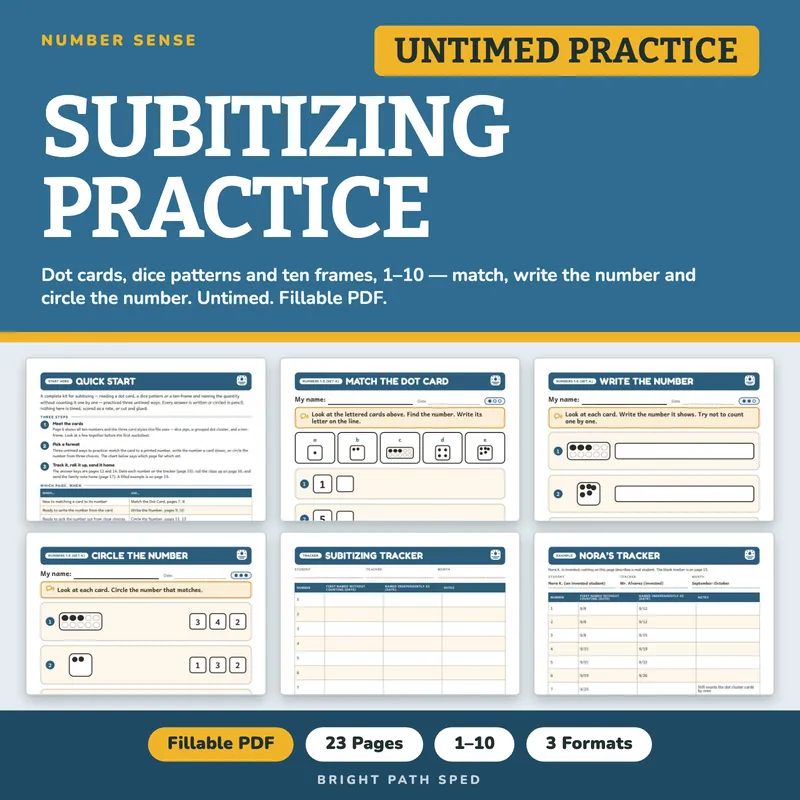
Flash cards and worksheets that just ask a child to count the dots skip the actual skill: a complete kit
teaches the three card styles that make up subitizing, practices reading them three different untimed
ways, and gives you somewhere to track, roll up and send home what you see. This is a complete kit for
reading a small quantity on sight, 1 through 10: a reference chart of every number and card style, three
untimed practice formats across two sets, a number-level tracker, a class roll-up, a family note and a
whole-group warm-up, so nothing has to be written from scratch.
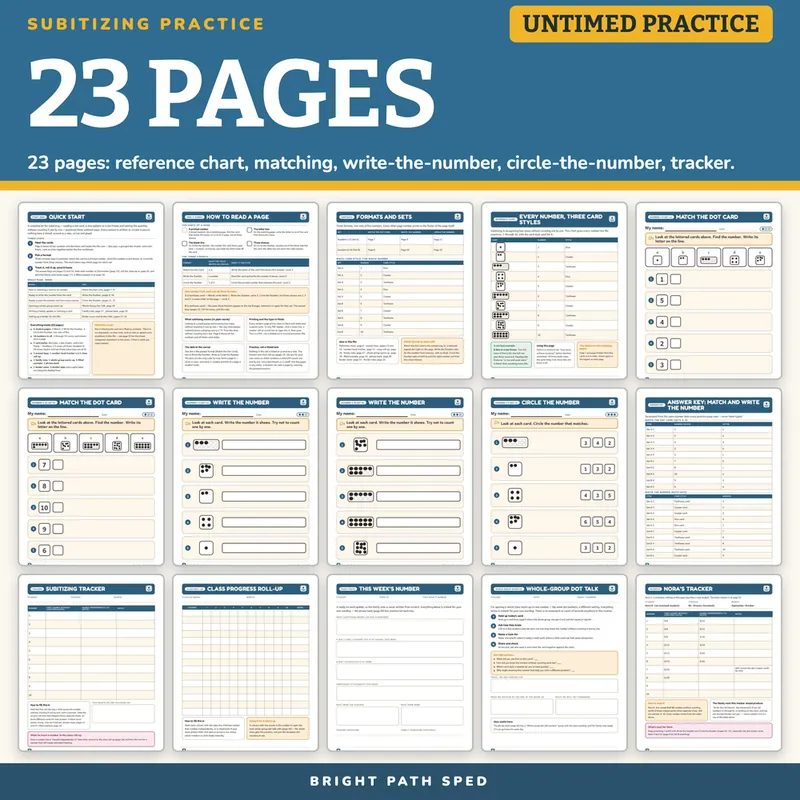
EVERYTHING INSIDE (23 pages)
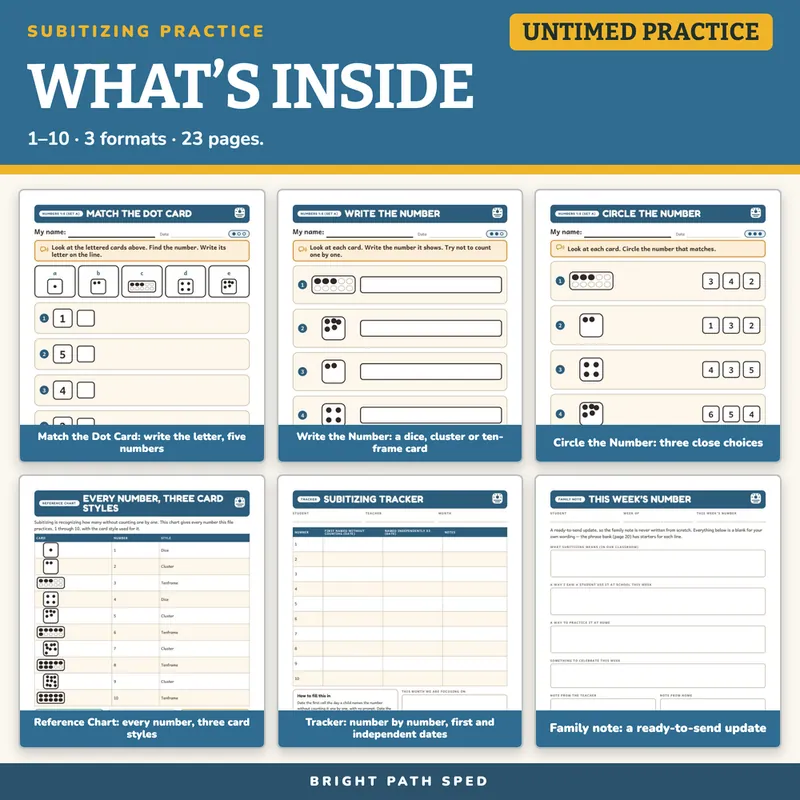
- 1 Reference Chart page: all ten numbers, 1 through 10, each shown in the card style used for it (dice
pips, a grouped dot cluster, or a ten-frame), with a plain explanation of what subitizing means
- 6 student pages in 3 formats, two sets each (Numbers 1-5, Numbers 6-10): Match the Dot Card (write the
letter to a lettered legend), Write the Number (no bank — read the card and write what it shows), and
Circle the Number (three printed choices, the two wrong ones never the card's real value)
- 3 card styles across the file — dice pips, a dot cluster, and a ten-frame — never one style
drilled alone per number range: Numbers 1-5 mixes all three (dice tops out at 6), Numbers 6-10
mixes dot cluster and ten-frame
- 2 answer keys, generated from the same number data as the student pages
- 1 number-level tracker (first named without counting / named independently x3, by number) and 1
whole-class progress roll-up
- 1 family note (a ready-to-send update) and 1 whole-group warm-up (a different setting — whole class,
not individual seatwork, and still untimed: no flash, no stopwatch, no count of seconds)
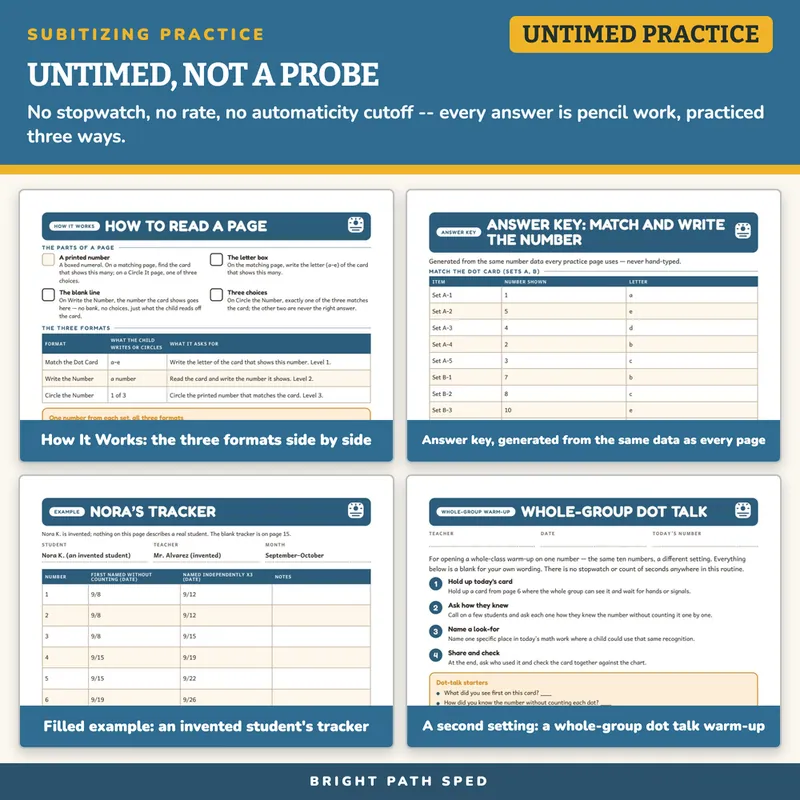
- 1 filled example (an invented student), 1 phrase bank (14 observable-language starters), 1 binder
cover, and 5 divider tabs with a spine label to cut out
- Start Here, a how-to-read-a-page page, and a contents page that gives every page number
The Three Formats, Easiest To Hardest
1. Match the Dot Card (starting) — five lettered cards (a–e) sit in a legend at the top of the page;
find the one that shows a printed number and write its letter. Two sets (A: 1-5, B: 6-10).
2. Write the Number (building) — a card with no bank or choices; write the number it shows.
3. Circle the Number (ready for more) — a card and three printed numbers; circle the one that matches.
The two wrong choices are always drawn from nearby numbers, never the card's own value.
Built For The Child Holding The Page
A big "My name" line, one short instruction, large rounded letters, real room to write or circle, and
dots (not words) to show which level a page is. Nothing on a student page is written for an adult.
Untimed, On Purpose
Every page in this file is pencil-and-paper practice. There is no stopwatch, no time limit printed
anywhere, and no rate or speed score. This is a different product from a timed fluency probe of the
same skill — if that is what you need instead, the back page names it.
Type In, Or Print
The name and date lines, the tracker, the class roll-up, the family note and the whole-group warm-up
are type-in fields in any PDF reader. The numbers and letters a student writes are pencil work. This is a
fillable PDF; it is not a Google Slides or PowerPoint file.
Who This Is For
Kindergarten and 1st grade classrooms, self-contained and resource rooms, and any teacher building
number sense into a math block or center, with 2nd grade practice for students who still need it. The
whole-group warm-up sends the same ten numbers to a whole-class setting; the family note sends them
home.
What This Is, And What It Is Not
An untimed number-recognition worksheet set with the record-keeping around it. It is not a timed probe,
a fluency screener, a clinical or diagnostic tool, or a claim about any student's age or rate of
progress. There is no IEP goal language or eligibility wording anywhere in the file.