Subtraction Within 10 Cut and Paste
- 26 pages
- PreK, Kindergarten, 1st, 2nd
$4.00
DownloadOr get it with All-Access: pick any 20 resources a month for $7.
New here? Your first month of All-Access is half off with code TEACHERTOK
Already bought this, or a member?
Instant download. One teacher's license: colleagues need their own copy. Each file carries a license number.
Also on Teachers Pay Teachers: see the Bright Path Sped store
About this resource
Five subtraction skills within 10. Every one of them printed three times, at three levels of
support, with a scripted lesson plan in front of each one so a teacher, a para, or a substitute
can pick the page up cold and run it.
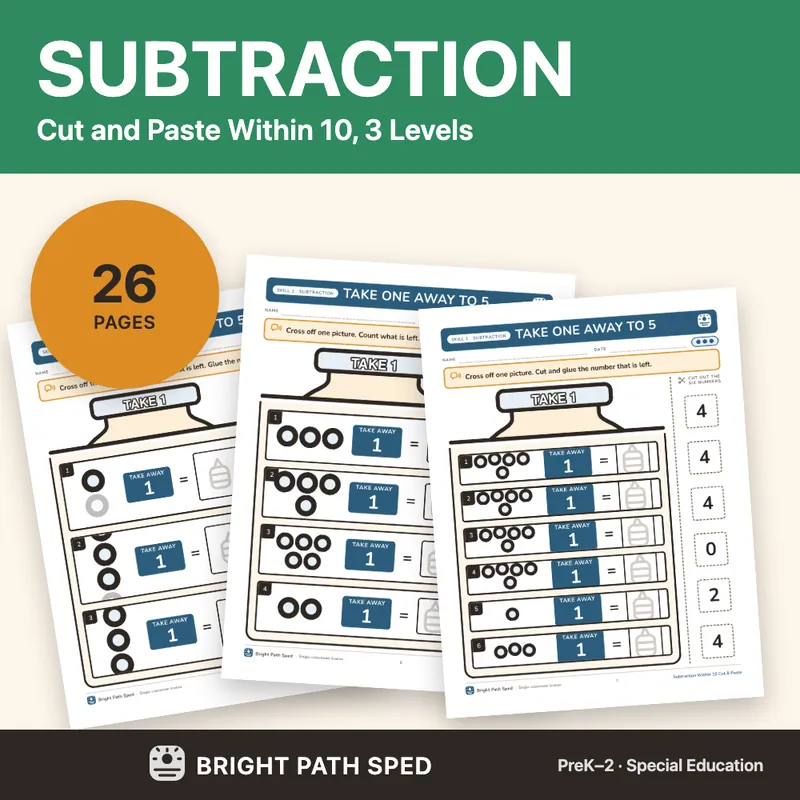
Fifteen cut-and-paste worksheets in one PDF, plus the five plan pages. The cut strip sits on the
same page as the work, so nothing gets separated on the way to the desk.
How The Three Levels Work
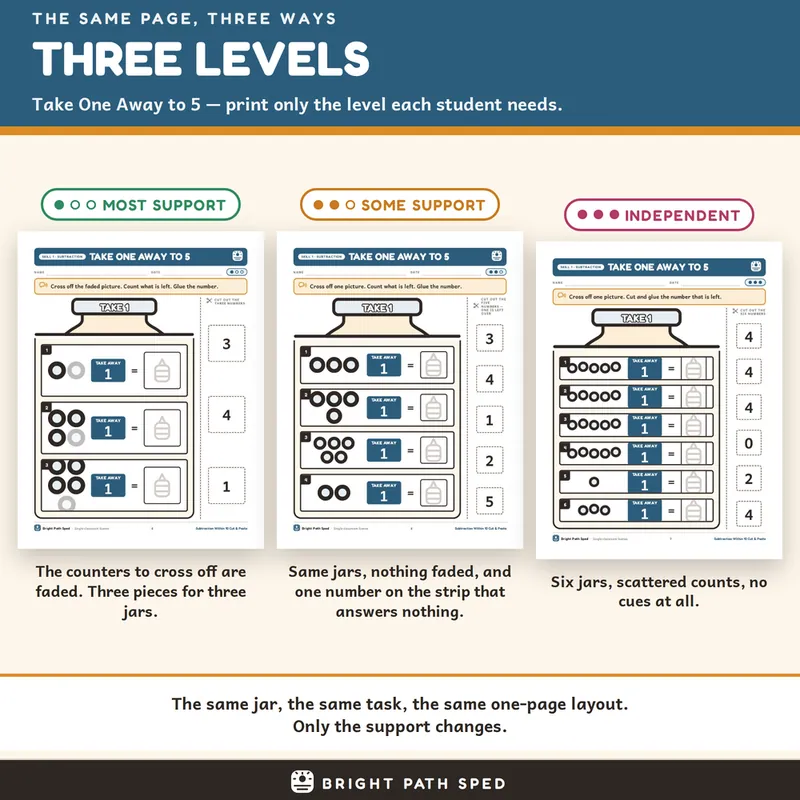
Level 1 — three rows. The pictures to cross off are already faded, so the student can see
exactly which ones go before they touch a pencil. There are exactly as many pieces on the strip as
there are boxes, so there is no wrong piece to pick up.
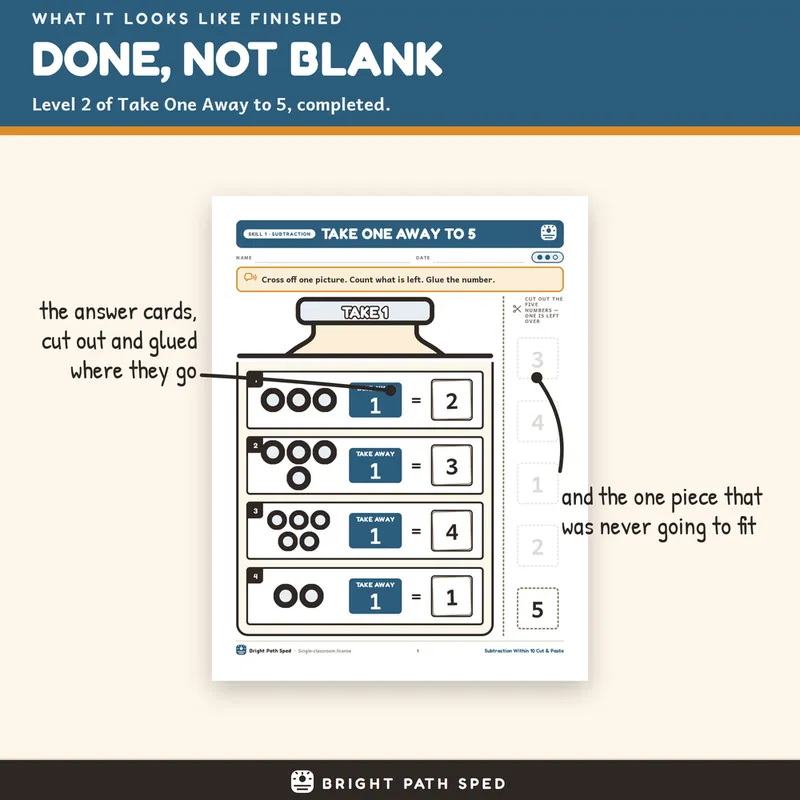
Level 2 — four rows, nothing faded. The student decides what to cross off and counts what is
left. One spare number rides along on the strip and belongs to nothing.
Level 3 — six rows, scattered and uneven, no cues at all. This is the progress-monitoring
page for the skill.
The level is shown on the child's sheet as a color tone and a row of dots and nothing else, so the
three levels look the same on the desk.
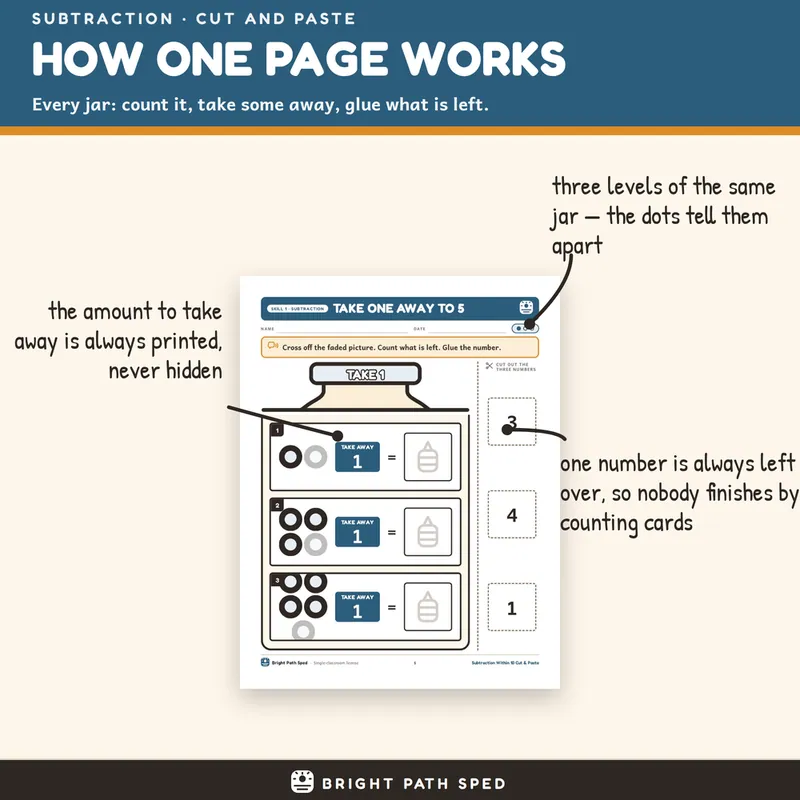
Every single take-away problem — pictures and plain number sentences alike — prints the amount to
take away as its own printed tag or number, at every level. The fading at Level 1 is a support for
finding which pictures to cross off; it is never the only place the number appears, so Level 1 is a
real subtraction page and not a counting page in disguise.
The Five Skills, In The Order Students Actually Learn Them
1. Take One Away to 5
2. Take Away to 5
3. Take Away to 10
4. Take Away All or Take Away None
5. Mixed Take-Away to 10 (the review/progress-monitoring skill)
Taking away one first, then a bigger amount within the same small sets, then bigger sets up to
ten, then the two rules that catch everyone (take away all, take away none), and only at the end a
mixed page that shuffles pictures and plain number sentences together.
What Is In The File
- 26 pages, one PDF
- 15 worksheets (5 skills x 3 levels)
- 5 scripted plan pages, one in front of every skill, each with a SAY THIS script in quotation
marks a person can read out loud verbatim
- 1-page teacher guide to the three levels, with what to do when a student is stuck
- 2 pages of answer keys, computed from the same data that draws the pages, with the spare Level 2
piece named on every line
- Name and date line and a scissors rule line on every worksheet
- Clear, child-friendly print throughout, every numeral a student reads set at cut-card size, and no page
that depends on color to be understood: the jar frame and the counters are drawn in heavy black line, so a
grayscale copy works exactly as well as a color one and there is no separate B&W file
- The level is shown on the child's sheet as a color tone and a row of dots and nothing else: no student page
says "Level 1" in words a child reads, so the three levels look the same on the desk
What A Page Looks Like
Every worksheet is one jar with the skill on its lid and the rows inside it, and the cut pieces stand
in a column beside the jar at a size a six-year-old can cut and hold. The TAKE AWAY tag on every row, the
answer box and the cards are all set at the same large size, so nothing a child has to read is small print.
Who This Is For
Self-contained, resource and life-skills classrooms, early intervention, and any elementary room
with a wide skill range in it. Pair it with the matching Subtraction Within 10 Progress Monitoring
Probes for the data side, or with Addition to 20 Cut and Paste if the room is working both
operations.
What This Is, And What It Is Not
This is a print-and-go worksheet set with a scripted plan page in front of every skill. It is not a
progress-monitoring probe (see the Subtraction Within 10 Progress Monitoring Probes for that) and
it makes no claim about how quickly a student should master any skill — write your own timeline
against your own students' data.