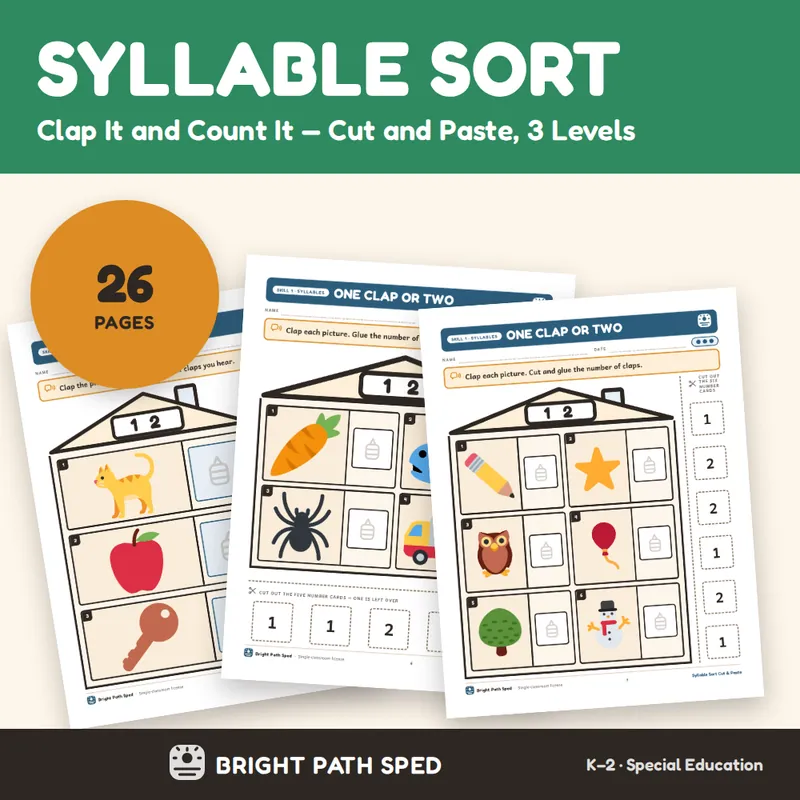
Syllable Sort Cut and Paste 3 Levels
- 26 pages
- PreK, Kindergarten, 1st, 2nd
$3.00
DownloadOr get it with All-Access: pick any 20 resources a month for $7.
New here? Your first month of All-Access is half off with code TEACHERTOK
Already bought this, or a member?
Instant download. One teacher's license: colleagues need their own copy. Each file carries a license number.
Also on Teachers Pay Teachers: see the Bright Path Sped store
About this resource
A first grader who can sound out cat, dog and ship stops dead at butterfly. Clapping syllables is
the one early literacy skill that needs no reading at all — which makes it the pack that works for
the student who is not decoding yet, today, on the first day you meet them.
Five skills, one syllable job each, three levels of every single one. The pack takes the skill in
steps: one clap or two first, then two or three, then all three at once, then the same job with the
word printed under the picture for students who are starting to read, and finally a sorting day
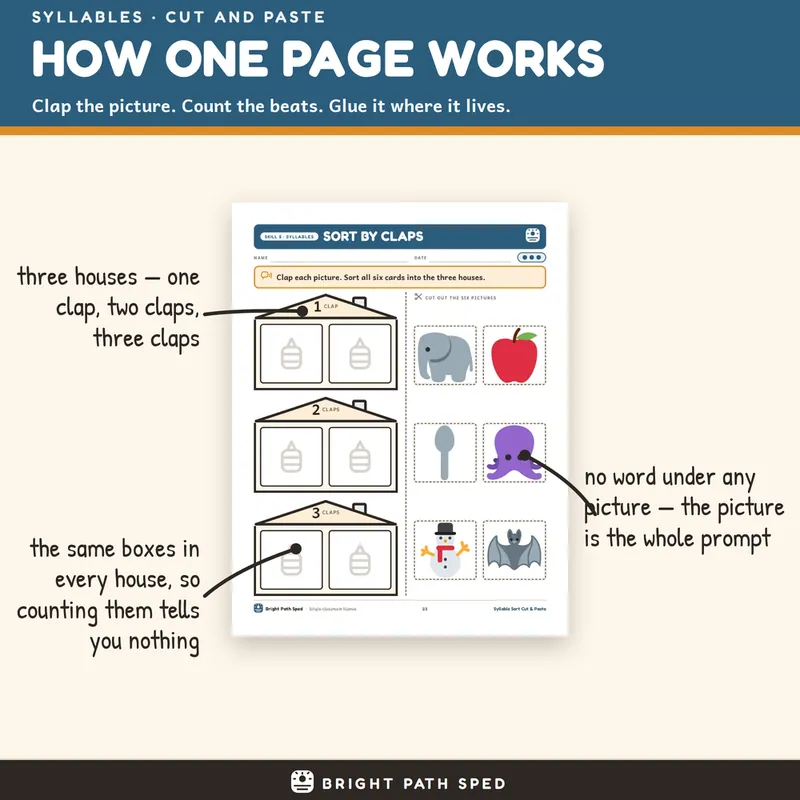
where picture cards go into three little houses — one clap, two claps, three claps.
Every page is the same house, so a student who has done one page knows what to do on the next one:
clap the picture, count the beats, glue the number.
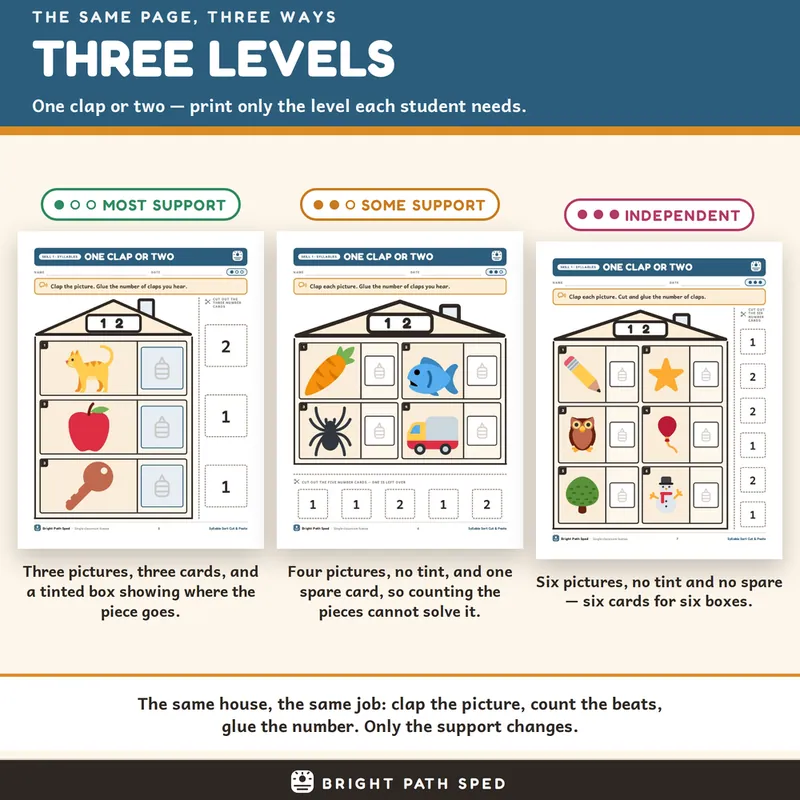
How The Three Levels Work
Level 1 — the fewest pictures, a tinted box showing exactly where the piece goes, and no spare
piece. Both numbers are still on the strip, because choosing between them is the skill; a strip of
identical pieces would be a page with the skill taken out of it.
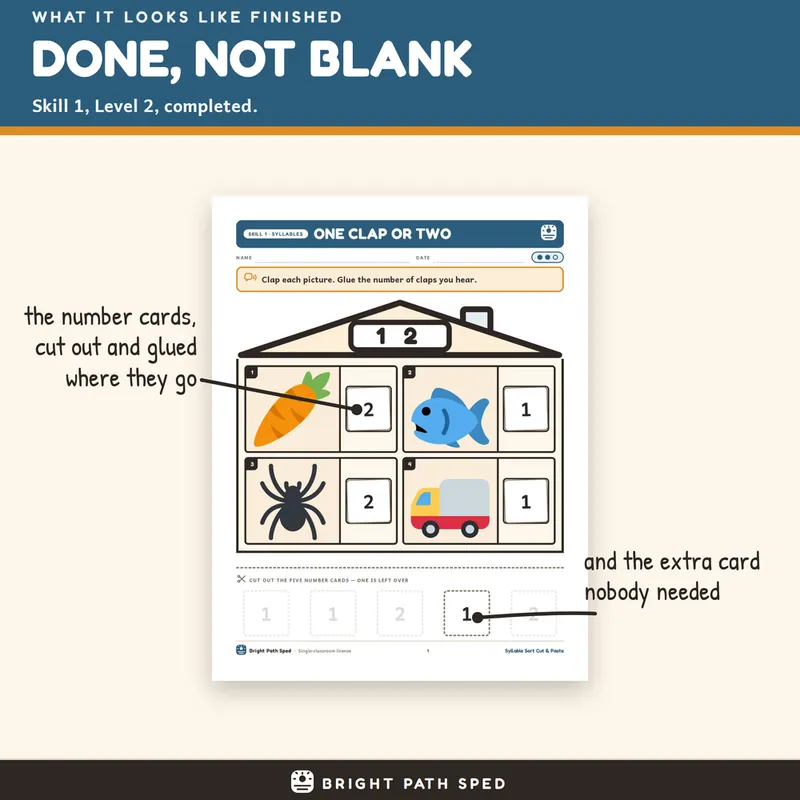
Level 2 — one more picture, no tint, and one spare piece. On the three clapping skills the spare is
a second copy of a number already in play, so a student who counts the pieces instead of clapping
gets the page wrong. On Read It and Clap It it is a number that no word on that page claps out. On
the sorting day it is a four-clap picture, and no house on the page has a four on its roof.
Level 3 — six pictures, no tint, nothing spare, and the pieces are never printed in the order the
boxes are answered in.
The Five Skills
1. One Clap or Two
2. Two Claps or Three
3. One, Two or Three Claps
4. Read It and Clap It — the word is printed under the picture and the number card goes under the word
5. Sort by Claps — picture cards into three houses, and at Level 2 one card that belongs in none of them
Every Picture Names Its Word — And On A Syllable Pack That Is A Harder Test
Pictures that name their word only when the word is printed beside them appear only on Read It and
Clap It, where the whole word is printed under the picture.
Every word in the pack is a real English word checked against a dictionary at build time, every
syllable count is the standard dictionary division written down in the source rather than guessed
from the spelling. Every picture is full-color, big enough to name across a table, inside a house frame
drawn in heavy black line, so the page still reads as a clean photocopy.
What Is In The File
- 26 pages, one PDF
- 5 scripted lesson plan pages — a script in quotation marks a substitute could read cold, three
level notes, three "if a student is stuck" tips with the likely cause named, a try-it-today idea
and a data box on every plan
- 15 student worksheets (5 skills x 3 levels)
- 2 pages of answer keys, recomputed from the same data that draws the worksheets
- 1-page "how to use this packet" guide
- A name and date line, a big direction line and a cut rule on every worksheet
- No level word and no teacher note anywhere on a student page: the three dots on the name line are
the only level code, and they are there for you, not for the child
Who This Is For
Self-contained, resource and early-intervention classrooms, and any K–2 room with students working
on phonological awareness — including the ones who cannot read a word yet. It sits in front of this
store's CVC Words Cut and Paste pack rather than beside it: syllables come before letters, and
nothing in this pack asks a student to read anything except on Skill 4.
What This Is, And What It Is Not
A print-and-cut worksheet packet with a scripted plan page in front of each skill. It is not a
fillable form, not a full curriculum, and not a claim about how quickly any student will hear a
syllable — every objective is written the way a classroom goal is written, with nothing clinical,
no timeline and no eligibility claim attached to it.