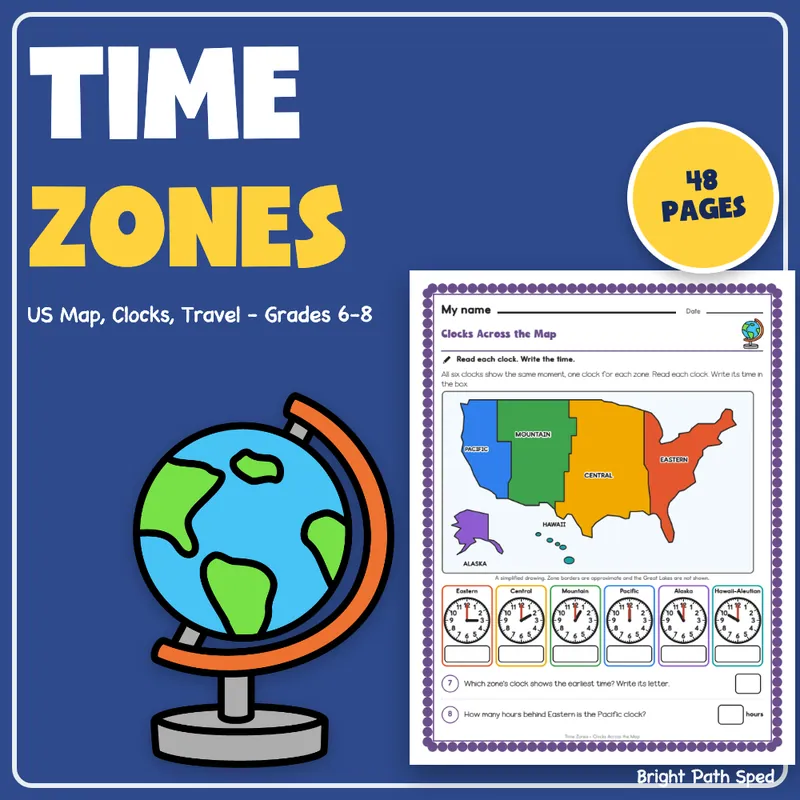
Time Zones Worksheets
- 48 pages
- 6th, 7th, 8th
$2.50 $5.00 on Teachers Pay Teachers
Half the Teachers Pay Teachers price. The same PDF, sold direct.
DownloadOr get it with All-Access: pick any 20 resources a month for $7.
New here? Your first month of All-Access is half off with code TEACHERTOK
Already bought this, or a member?
Instant download. One teacher's license: colleagues need their own copy. Each file carries a license number.
Also on Teachers Pay Teachers: see the Bright Path Sped store
About this resource
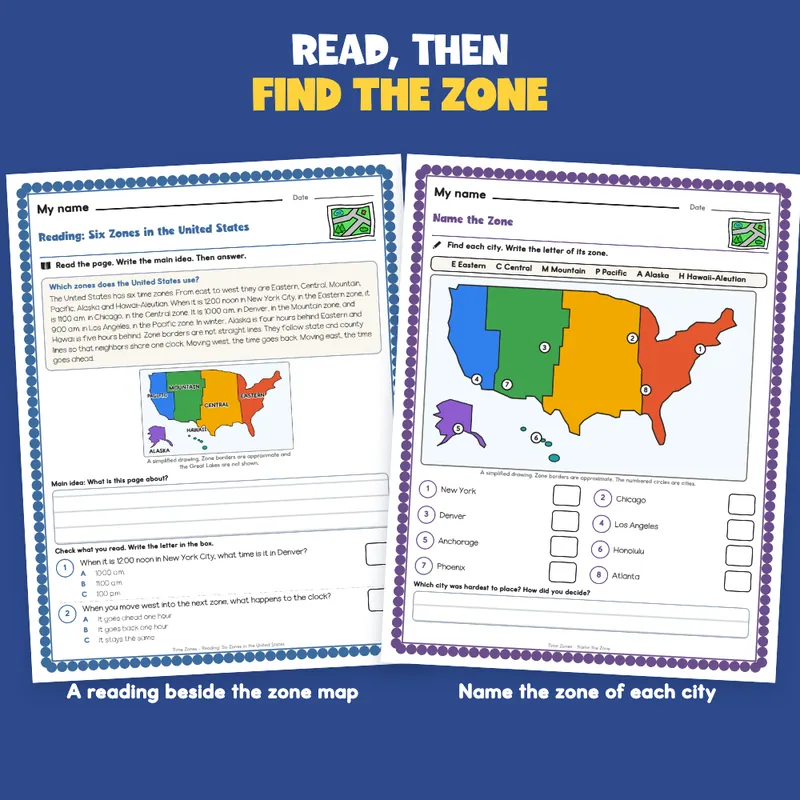
Teaching time zones and need pages students can actually work on? This is a complete set for grades 6-8: five short readings (why the Earth has time zones, longitude and the prime meridian, the six US zones, daylight saving time, and the International Date Line), each with a main idea box, a fact box and two checks to answer with a letter. Then students color a US zone map, name the zone of eight cities, read a clock for every zone, draw the hands on clocks, find the time in another zone, plan calls and a team meeting, work out when a made-up flight lands and how long a trip took, spring forward and fall back, compare winter and summer clocks in Denver, Phoenix, Honolulu, Los Angeles and New York, move across the date line with UTC, turn degrees into hours, take a two-part quiz and do three cut-and-paste mats. Answer keys give every answer, and the key for the color-the-zones page shows the finished map.
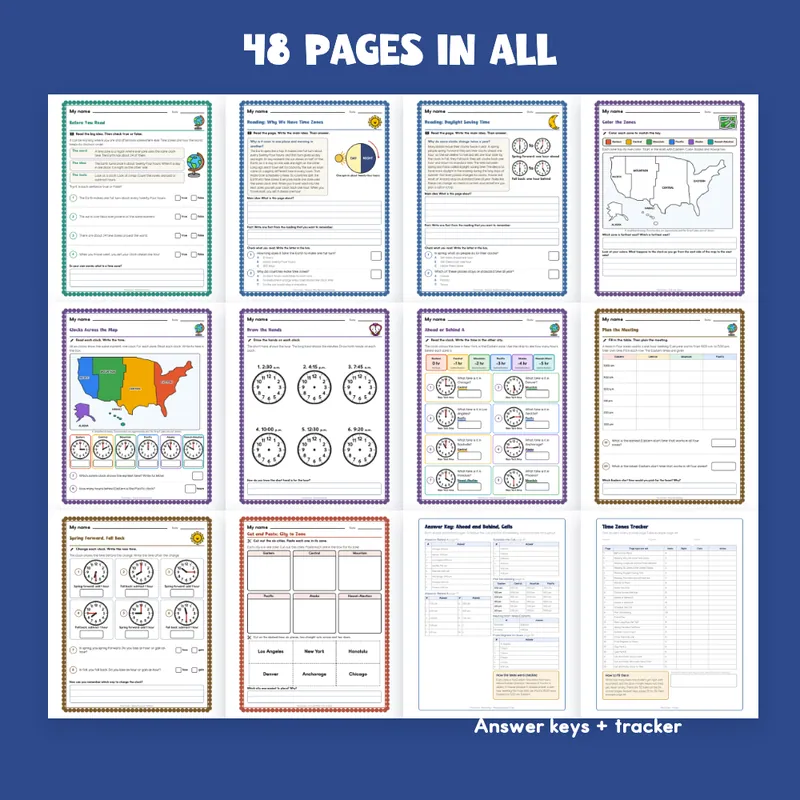
EVERYTHING INSIDE (48 pages)
- 30 student pages in sixteen kinds of page, each with a name line and one short instruction
- 152 scored items across 24 scored worksheets, every answer computed from the same zone data that draws the map and the clocks
- 5 readings of 102 to 117 words, one per idea, each with a main idea box (3 ruled lines) and 2 checks (10 checks in all); four of the five readings also have a fact box (2 ruled lines)
- 1 Before You Read page with 4 true-or-false items; 1 Words to Know page: match 8 words (time zone, prime meridian, longitude, UTC, rotation, International Date Line, standard time, daylight saving time) to their meanings
- 1 color-the-zones page (a blank zone map with a color key) and 1 name-the-zone page (8 numbered cities on a colored map)
- 1 Clocks Across the Map page: the colored map above a row of six zone clocks, 6 times to write plus 2 questions; 1 draw-the-hands page with 6 blank clock faces
- 2 Ahead or Behind pages: 8 clock problems from New York time, then 8 zone-to-zone problems plus 2 hours-ahead-or-behind blanks, with a zone strip on each
- 6 call-scheduling stories; a meeting planner with an 18-cell table and 2 questions; 1 claim-evidence-reasoning page about a call (all names invented)
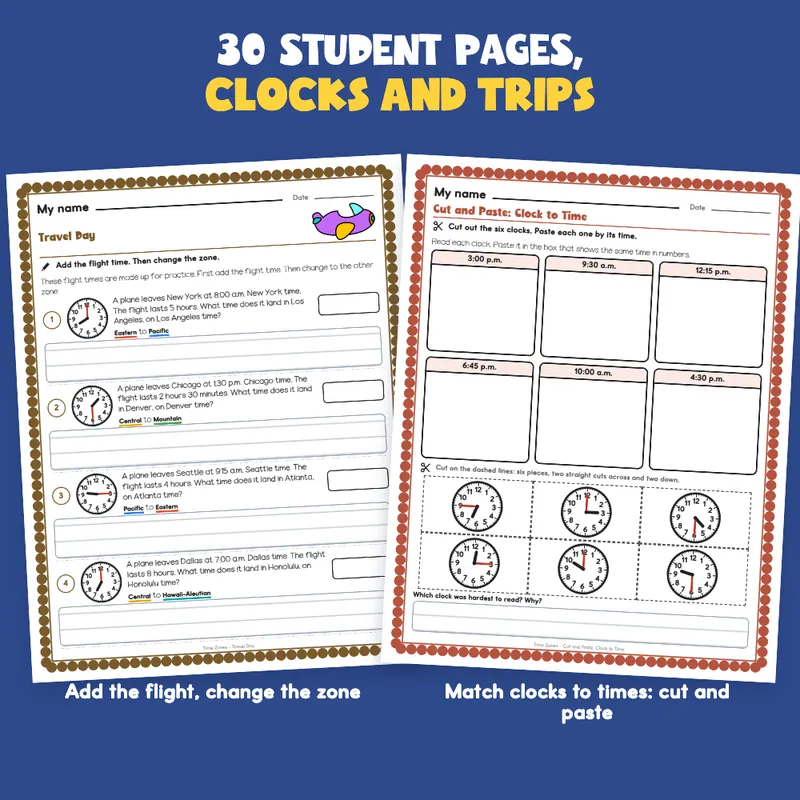
- 4 flight problems (add the flight, change the zone) and 4 trip-length problems (change the zone, find the elapsed time); all flight times are made up for practice
- 2 daylight saving pages: 6 spring-forward and fall-back clocks plus 2 questions, and a summer clock check for 4 places that fills 8 cells
- 1 date-line page (6 UTC offsets) and 1 degrees-to-hours page (6 questions)
- 6 short-answer questions across two pages, 4 ruled lines each; 12-item quiz across two pages (the second part uses a map); 1 self check (8 statements)
- 18 cut-and-paste pieces on 3 mats (city to zone, which zone gets noon first, clock to time), 6 pieces each in a 3 by 2 grid
- 5 answer keys; 1 tracker, 1 class grid, 1 team note, 1 family page
- 1 filled example (an invented student), 1 phrase bank (17 starters in 6 groups)
- A binder cover with type-in teacher and class fields, and a page of divider tabs (Readings, Map and Clocks, Ahead and Behind, Travel, Keys) with a spine label to cut out
- Start Here and a how-to-read-a-page page
Built For The Student Holding The Page
A "My name" line, one short instruction with a small picture cue, a plain scalloped border and big ruled boxes. Nothing on a student page is written for an adult: the keys and records are on separate teacher pages. The cut pages have six pieces in a strip-and-grid layout, edge to edge, so there are only a few straight cuts. Clip art is kept to a globe, a map, an airplane, luggage, a sun, a moon and a pencil; the zone map and the clocks are drawn for this file. Every zone is colored and also named on the page, and the file prints clean in black and white.
A Short Account, Not A Full Textbook
Each reading is a plain-words summary written for this file, with textbook ideas such as the Earth turning once in about twenty-four hours, 360 divided by 24 giving 15 degrees for each zone, the prime meridian and UTC, six US zones, clocks that spring forward and fall back, and the International Date Line near 180 degrees. The zone map is a simplified drawing: borders are approximate and the Great Lakes are not shown. All time problems use standard time unless the page says otherwise, and the daylight saving pages say that Hawaii and most of Arizona keep standard time and that rules like these can change. It does not quote any source and it is not tied to a particular standard. Check it against your own textbook. The only student in the file is an invented example, and it says so.
Type In, Or Print
The name line, every answer box, every check box, every table cell and every ruled work box are type-in fields in any PDF reader: click one, type, then save. The color-the-zones map and the draw-the-hands clocks are for a pencil or crayon: they print. This is a fillable PDF; it is not a Google Slides or PowerPoint file.
What This Is, And What It Is Not
A set of time zone readings and practice pages with the record-keeping around it. It is not a timed test, a screener, a clinical tool, or a claim about any student's age or rate of progress. There is no IEP goal language or eligibility wording anywhere in the file, and no claim of alignment to any standard.
If You Want More
Climate Zones Worksheets | Map, Sort, Compare, Write 6th-8th Grade; Forms of Energy Worksheets | Sort, Match, Energy Chains, Write 6th-8th Grade; Gravity Worksheets | Mass vs Weight, Reading, Practice, Keys Grades 6-8.