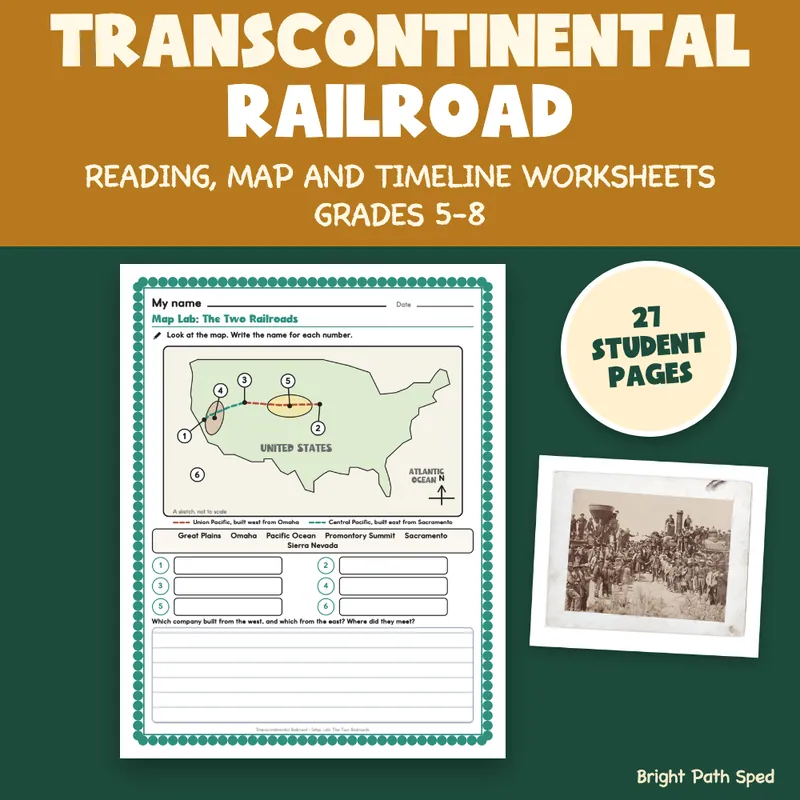
Transcontinental Railroad Worksheets
- 43 pages
- 5th, 6th, 7th, 8th
$2.50 $5.00 on Teachers Pay Teachers
Half the Teachers Pay Teachers price. The same PDF, sold direct.
DownloadOr get it with All-Access: pick any 20 resources a month for $7.
New here? Your first month of All-Access is half off with code TEACHERTOK
Already bought this, or a member?
Instant download. One teacher's license: colleagues need their own copy. Each file carries a license number.
Also on Teachers Pay Teachers: see the Bright Path Sped store
About this resource
Teaching the transcontinental railroad and want more than a one-page reading? This is a complete set for grades 5-8: six short readings, original to this file, on why leaders wanted a railroad across the country and the Pacific Railway Act, the Central Pacific and Union Pacific building toward each other, the Chinese and Irish workers who built it, the meeting at Promontory Summit in 1869, what the railroad meant for Native nations and the bison, and how it changed travel time and time zones. Each reading has a cause box and an effect box with room to write, and two checks to answer with a letter. Students label a map (a sketch with two railroad lines, cities as dots and two shaded regions), sort statements by company (Central Pacific, Union Pacific or both), put events in order on two timelines, say hard sentences in plain words, fill in a before-and-after chart, complete a cause and effect chain, write an imagined letter home as a railroad worker, check true or false and fix the false ones, sort by hand, answer short questions with room for four lines each, plan and write a claim-evidence-reasoning paragraph, and take a twelve-item quiz. Answer keys give the letters, the years, the map names, the sort answers and a sample for every open answer.
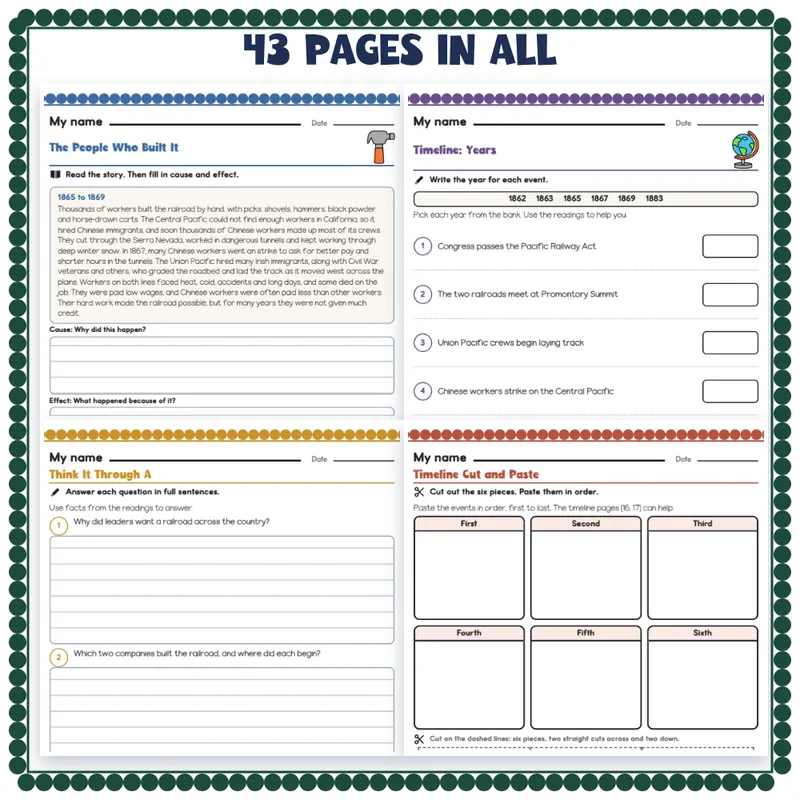
EVERYTHING INSIDE (43 in all, counted from the file)
- 27 student pages in sixteen kinds of page, each with a name line and one short instruction
- 80 scored items spread over seventeen pages, every answer taken from the same lists that print on the page
- 6 readings of about 155 to 165 words each, each with a cause box, an effect box (3 ruled lines each) and 2 checks (12 checks in all)
- 1 Before You Read page (the problem, the plan, the meeting, the road) with two write-in boxes
- 1 True or False? Fix It page: 6 statements, with a fix-it line for each false one
- 1 Words to Know page: match 8 words (transcontinental, railroad, immigrant, locomotive, telegraph, bison, reservation, time zone) to their meanings
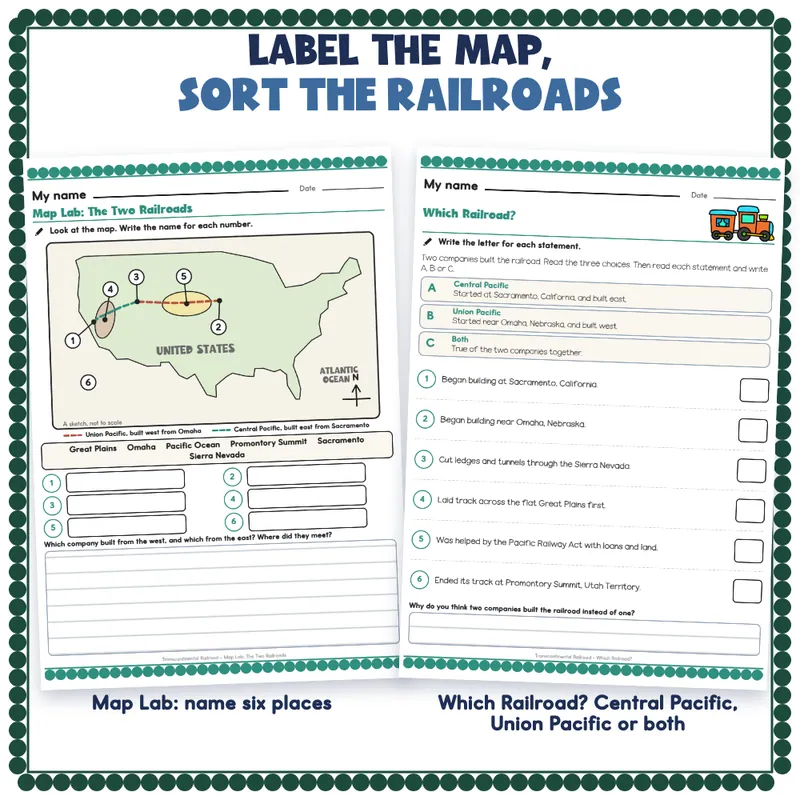
- 1 Map Lab page: name 6 numbered places (Sacramento, Omaha, Promontory Summit, Sierra Nevada, Great Plains, Pacific Ocean) on a sketch map of the United States with the two lines
- 1 Which Railroad? page: 3 choices (Central Pacific, Union Pacific, both) and 6 statements to sort with a letter
- Two timeline pages: write the year for 6 events, then number 6 mixed-up events from 1 to 6
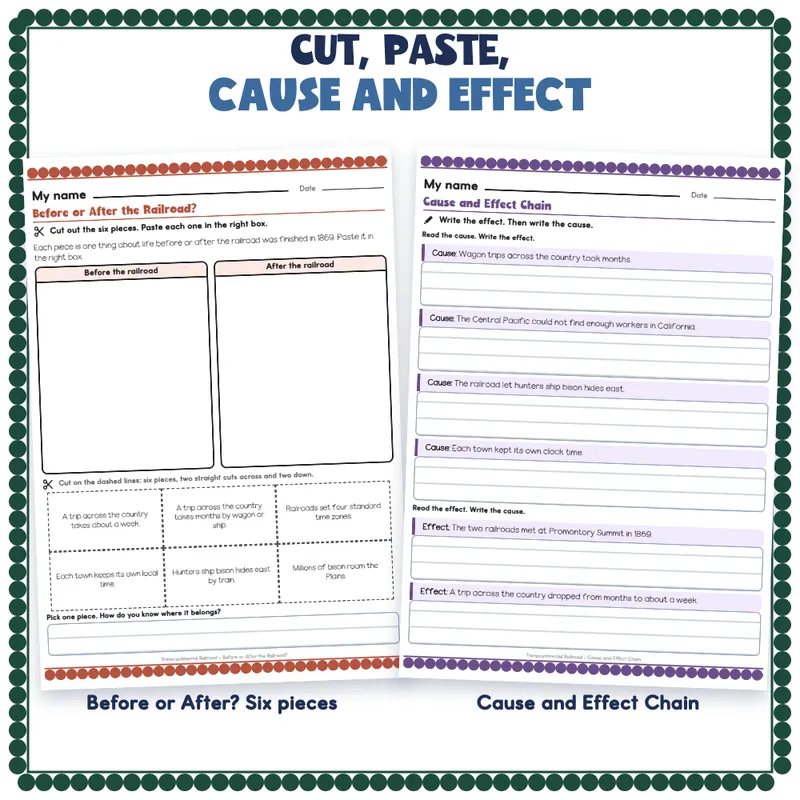
- 1 Say It in Plain Words page (6 hard sentences), 1 Before and After chart (5 rows) and 1 Cause and Effect Chain page (4 causes to finish, 2 effects to explain)
- 1 A Worker's Letter Home page: what the readings say about the work, writing starters and a ruled letter
- 6 short-answer questions across two pages, 4 ruled lines each
- 2 claim-evidence-reasoning pages: an organizer and an 18-line paragraph page
- 12-item quiz across two pages; 1 self check (8 statements)
- 18 cut-and-paste pieces on 3 sort mats (before or after the railroad; Central Pacific worker, Union Pacific worker or Plains family; and a timeline sequence), 6 pieces each in a 3 by 2 grid
- 5 answer keys with a sample for every open answer; 1 tracker, 1 class grid, 1 team note, 1 family page
- 1 filled example (an invented student), 1 phrase bank (17 starters in 6 groups)
- Start Here and a how-to-read-a-page page
The Workers And The Native Nations, Told Plainly
The readings stick to facts found in standard grade 5-8 history sources. They name the Chinese workers who made up most of the Central Pacific crews, the 1867 strike for better pay and shorter hours, the Irish immigrants and Civil War veterans on the Union Pacific, and the fact that Chinese workers were paid less. They also say what the railroad meant for the Lakota, Cheyenne, Arapaho, Pawnee and Shoshone and for the bison herds, and that Native nations resisted and continue to live and lead today. The letter page and the who-would-say-it sort use practice wording written for this file; nothing is a quotation and no source is invented. The pages do not tell students what to conclude.
Built For The Student Holding The Page
A "My name" line, one short instruction with a small picture cue, a plain scalloped border and big ruled boxes. Nothing on a student page is written for an adult: the keys and records are on separate teacher pages. The cut pages have six pieces in a strip-and-grid layout, edge to edge, so there are only a few straight cuts. The map is a plain sketch, not to scale, and the pages use a train, a map, a globe, a hammer and a mountain rather than drawn people. The file prints clean in black and white.
A Short Account, Not A Full Textbook
Each reading is a plain-words summary of one part of the story, written for this file. It is not tied to a particular standard, and it points you to add your own textbook or source for more depth than a short reading can give. The only student in the file is an invented example, and it says so.
Type In, Or Print
The name line, every answer box, every check box and every ruled work box are type-in fields in any PDF reader: click one, type, then save. This is a fillable PDF; it is not a Google Slides or PowerPoint file.
What This Is, And What It Is Not
A set of history readings and practice pages with the record-keeping around it. It is not a timed test, a screener, a clinical tool, or a claim about any student's age or rate of progress. There is no IEP goal language or eligibility wording anywhere in the file, and no claim of alignment to any standard.
Who This Is For
Teachers of social studies in grades 5-8, special education and resource teachers who co-teach it, and families who want a clear, low-prep set on the transcontinental railroad and the growth of the United States after the Civil War.
If You Want More
Westward Expansion Worksheets | Sort, Match, Timeline 6th 7th 8th Grade; Reconstruction Worksheets | Sort, Match, Timeline 6th 7th 8th Grade; Gilded Age Worksheets (the years after the railroad).