Treaty of Paris 1783 Worksheets
- 46 pages
- 6th, 7th, 8th
$2.50 $5.00 on Teachers Pay Teachers
Half the Teachers Pay Teachers price. The same PDF, sold direct.
DownloadOr get it with All-Access: pick any 20 resources a month for $7.
New here? Your first month of All-Access is half off with code TEACHERTOK
Already bought this, or a member?
Instant download. One teacher's license: colleagues need their own copy. Each file carries a license number.
Also on Teachers Pay Teachers: see the Bright Path Sped store
About this resource
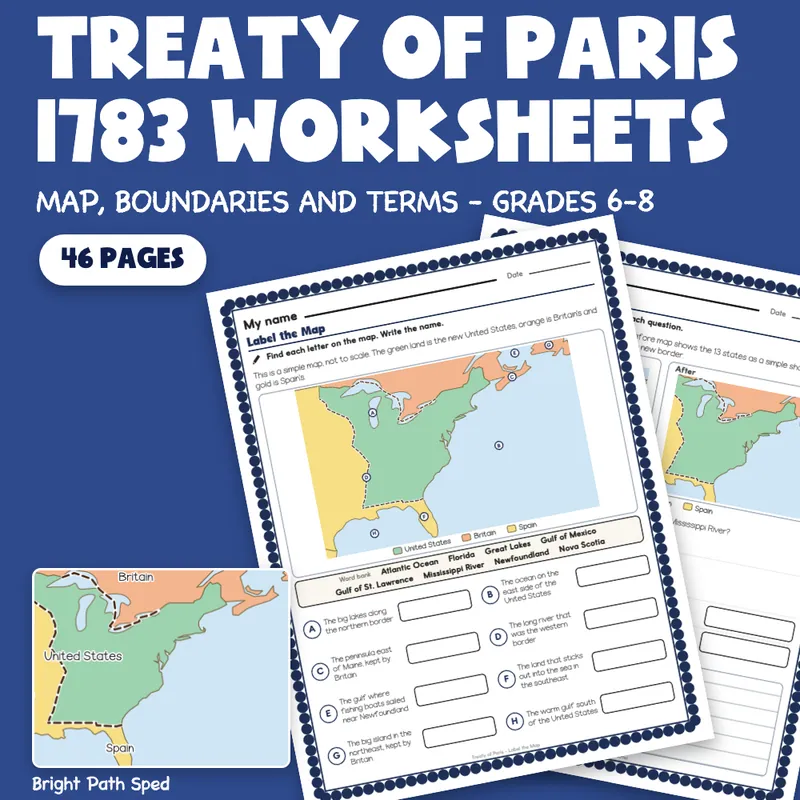
Teaching the Treaty of Paris and need pages students can actually work on? This is a complete unit for grades 6-8: six short original readings on why the treaty was needed, the talks in Paris, the new borders, the other terms, Loyalists and what came after, four map pages that show the boundaries before and after, source checks, cause and effect, and four cut pages. Every map is drawn in the file, and the answer keys, a tracker and a filled example are included.
EVERYTHING INSIDE (46 pages)
- Student pages: 27, in thirteen page types, each with a name line and one short instruction
- 165 scored items on the student pages that have questions (26 of the 27)
- A Treaty Words page: 8 words to match (treaty, independence, boundary, territory, Loyalist, negotiate, debt, ratify)
- 6 reading passages, 5 questions each, 30 in all
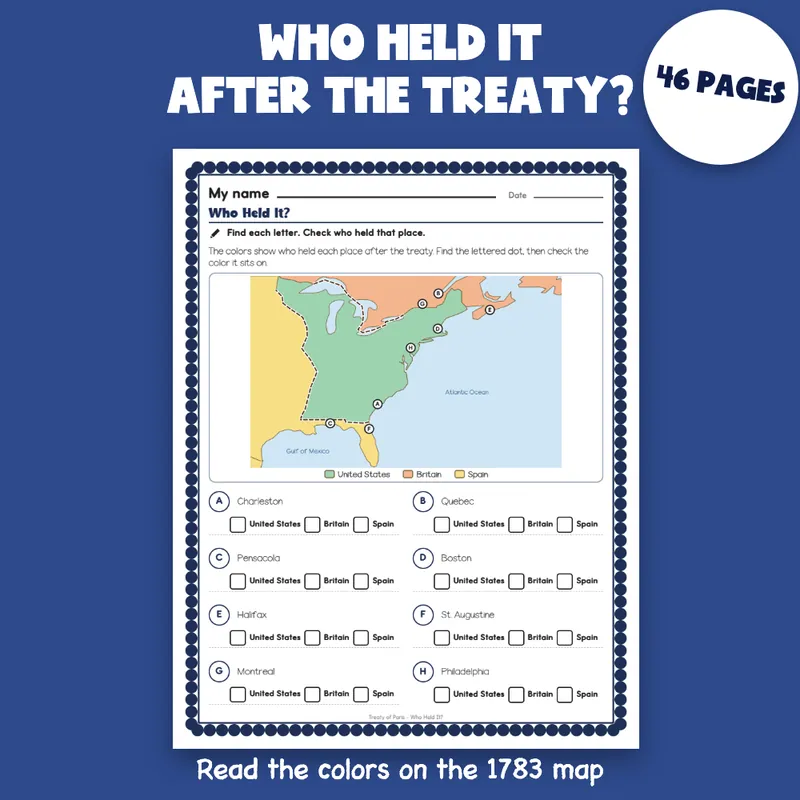
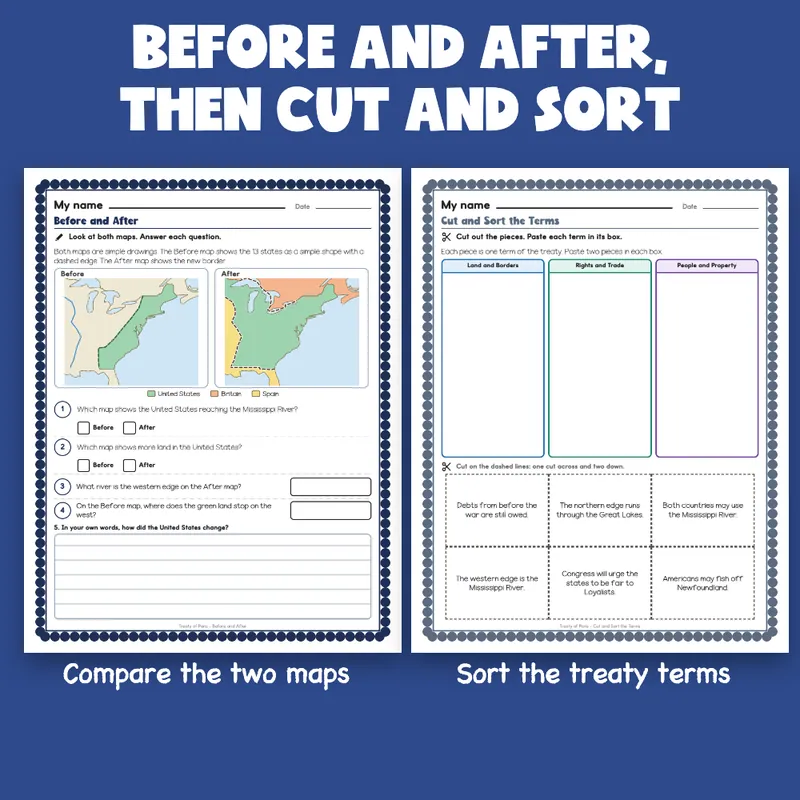
- 4 map pages, 28 items: label eight features on the 1783 map, say who held eight places (United States, Britain or Spain), compare a Before map and an After map, and trace the three borders (north, west, south)
- 1 worked example (who held a place) with a Your Turn
- Who Is It? 8 clues about five groups (United States, Britain, France, Spain, Loyalists)
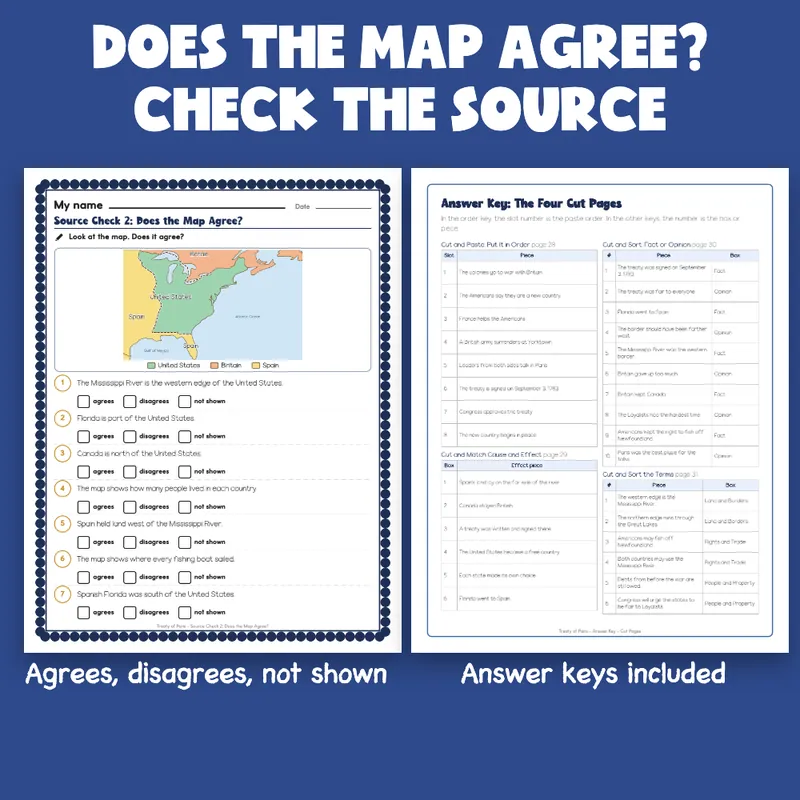
- 2 source checks, 15 items: is each sentence in a plain-words summary of the treaty, and does the map agree, disagree or not show it
- 10 cause and effect items across two sheets: write the effect, then write the cause
- Gain or Cost evidence cards (7 facts), then Make Your Case, with a claim, two pieces of evidence, reasoning and the other side (unscored, opinion, with a model in the key)
- 6 Fix It statements (3 false, 3 true), 2 claim, evidence, reasoning panels (6 items), a 10-item quiz and 5 short-answer questions with sample answers
- 30 cut pieces across four cut pages: an 8-piece order strip, a 6-piece cause and effect match, a 10-piece fact or opinion sort and a 6-piece sort of the treaty terms
- 6 answer keys; a tracker, a class grid, a team note and a family sheet
- 1 filled example (an invented student), 1 phrase bank (17 starters in 6 groups), 1 binder cover and 6 divider tabs with a spine label to cut out
- Start Here and a Teacher Notes page
Built For The Student Holding The Page
A "My name" line, one short instruction with a small picture cue, and a plain scalloped border. Nothing on a student page is written for an adult: the keys and records are on separate teacher pages. The maps use plain colors and lettered or numbered marks, and a key names every color, so a black and white copy reads too. The outlines are public-domain Natural Earth data; the Great Lakes, boundary lines and marks are drawn in the file. There are no portraits, flags or drawings of people.
History, Kept Plain
The only date is the signing, September 3, 1783. The readings cover the terms in plain words: Britain accepts that the United States is free and independent, the borders (the Great Lakes on the north, the Mississippi River on the west, a line near Florida on the south), fishing off Newfoundland, debts, prisoners, use of the Mississippi River by both countries, and a recommendation about Loyalist property. They also say who was not at the table: Britain made separate agreements with France and Spain, and Native nations were not part of the talks. The boundary lines are simple teaching lines, not exact surveys, and every map page says so. The Make Your Case page is an opinion page, so any side is accepted when the student backs it with two facts.
Type In, Or Print
The name line, every answer box, every check box and every ruled work box are type-in fields in any PDF reader: click one, type, then save. The cut pages are for scissors and glue. This is a fillable PDF; it is not a Google Slides or PowerPoint file.
What This Is, And What It Is Not
A unit on the Treaty of Paris of 1783: why it was needed, who negotiated, the borders and terms, and what it left unsettled, with the record-keeping around it. It is not a full American Revolution unit, a primary-source (document-based) set, a true to-scale map, a timed test or a screener. The summary of the treaty inside is ours, in plain words, and not the treaty's own wording. Use your own textbook for anything beyond these pages.
If You Want More
Causes of the American Revolution Worksheets | Reading Sort Timeline Grades 6-8; 13 Colony Map Worksheets | Blank Map, Regions Sort, Readings Grades 6-8; Articles of the Constitution Worksheets | Seven Articles, Match, Sort Grades 6-8.