Types of Rocks Worksheets
- 40 pages
- 6th, 7th, 8th
$2.50 $5.00 on Teachers Pay Teachers
Half the Teachers Pay Teachers price. The same PDF, sold direct.
DownloadOr get it with All-Access: pick any 20 resources a month for $7.
New here? Your first month of All-Access is half off with code TEACHERTOK
Already bought this, or a member?
Instant download. One teacher's license: colleagues need their own copy. Each file carries a license number.
Also on Teachers Pay Teachers: see the Bright Path Sped store
About this resource
EVERYTHING INSIDE (40 pages)
- 22 student pages in 14 kinds of sheet, each with a name line and one short instruction
- 112 scored items on 20 sheets, with every class and Yes or No path computed from each sample's own data
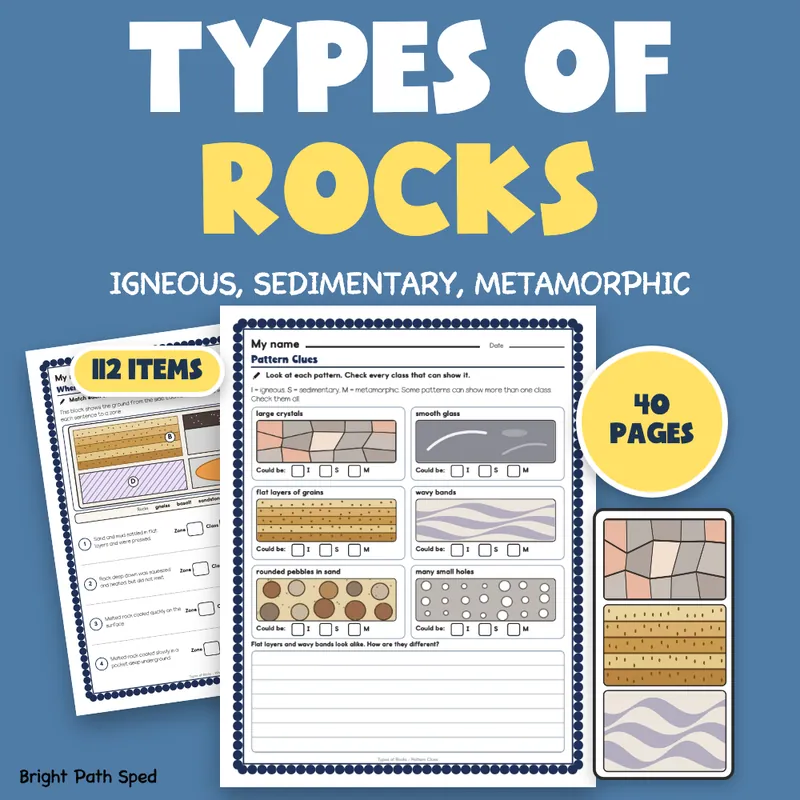
- 1 reference page: three formation chains, a clue table, and flat layers beside wavy bands
- 1 rock fact file: 12 rocks (granite, basalt, obsidian, pumice, sandstone, limestone, shale, conglomerate, marble, slate, quartzite, gneiss), each with its class, how it formed and a clue
- 1 key words page: 6 words to match
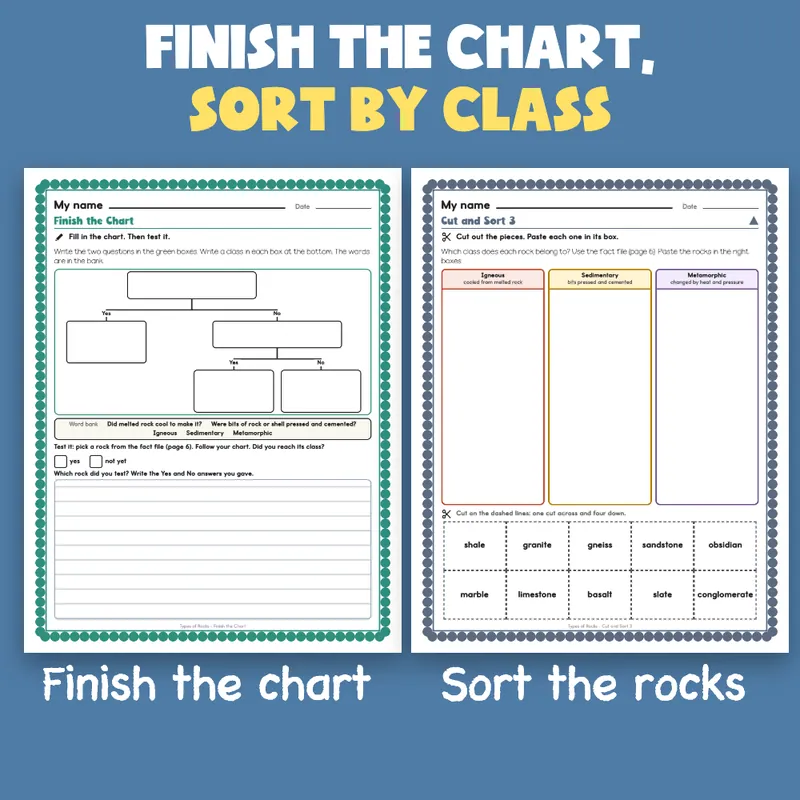
- 1 worked example with a Your Turn (2 items) and 1 blank key to finish and test (5 boxes)
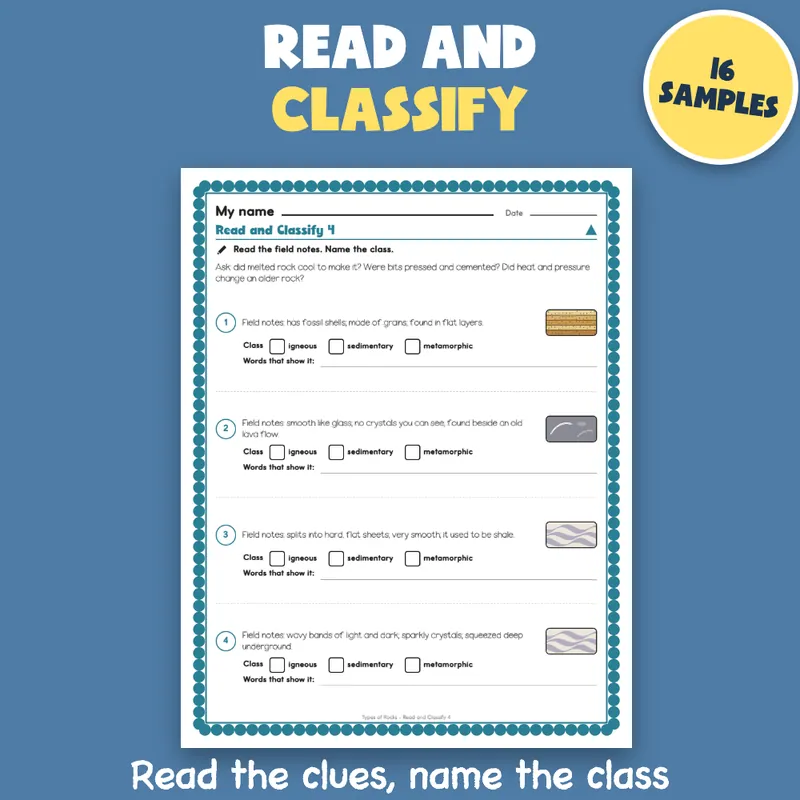
- 4 read-and-classify pages, 16 samples in all (4 on each page): written samples, then field notes
- 1 pattern page (6 patterns drawn in the file) and 1 block-of-ground page (4 zones)
- 1 compare page: granite and basalt, sandstone and quartzite (7 rows)
- 2 fix-it pages, 12 items (6 and 6): 6 sentences with reasons to check and fix, 6 clues to mark as helping or not
- 4 claim, evidence, reasoning panels across two sheets, 12 items
- 10 quiz items and 5 short-answer questions with sample answers
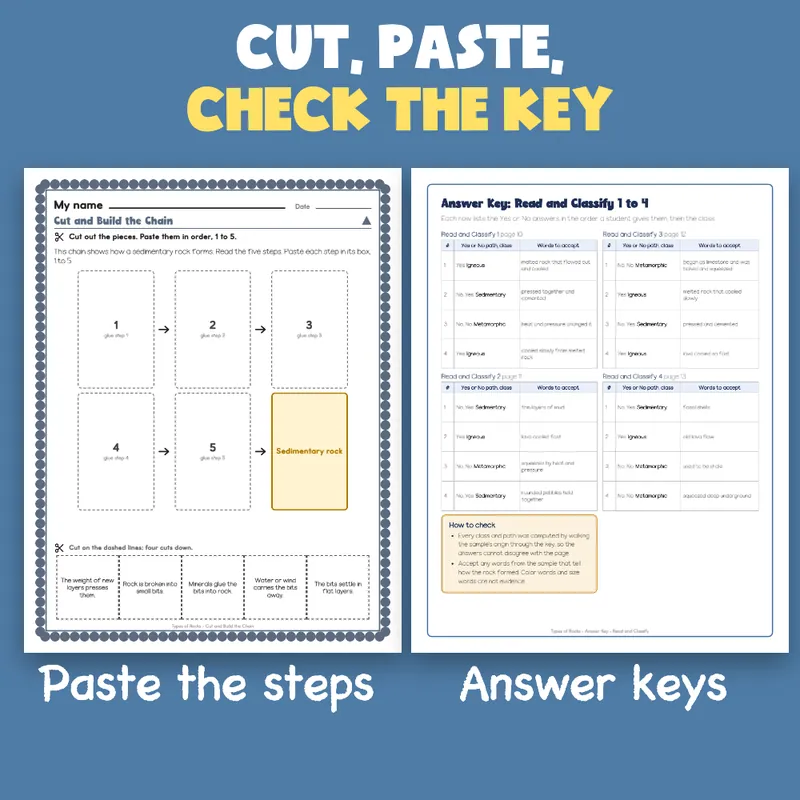
- 27 cut-and-paste pieces on four pages: two three-way mats of 6 pieces each (how it formed; a clue you read), 10 rock names on a three-way mat, and 5 steps to paste in order
- 5 answer keys, one for every page that has an answer; 1 tracker, 1 class grid, 1 team note, 1 family page
- 1 filled example (an invented student), 1 phrase bank (17 starters in 6 groups), 1 binder cover and 6 divider tabs with a spine label to cut out
- Start Here and a Teacher Notes page
Built For The Student Holding The Page
A "My name" line, one short instruction with a small picture cue, and a plain scalloped border. Nothing on a student page is written for an adult: the keys and records are on separate teacher pages. Three steps are marked by a circle, a square and a triangle so students do not compare. Every picture is a diagram drawn in the file from lines, boxes and flat color, and every box also carries its words, so a black and white copy reads too.
Invented Examples
The student in the filled example is made up and says so, and so are the numbers on the claim pages. The rocks and clues are simple and typical on purpose. There are no photographs, lab procedure, safety advice, standard code or invented data about real rock samples anywhere in the file.
Type In, Or Print
The name line, every answer box, every check box, every question box on the chart page and every ruled work box are type-in fields in any PDF reader: click one, type, then save. The cut-and-paste pages are for scissors and glue. This is a fillable PDF; it is not a Google Slides or PowerPoint file.
What This Is, And What It Is Not
A unit on how to name the class of a rock from how it formed, how to tell a clue that helps from one that does not, and how to back a claim with a number or a clue, with the record-keeping around it. It does not cover the full rock cycle, minerals, or how weathering and erosion make the bits in sedimentary rock (the last cut page shows the five steps only). It is not a timed test, a screener, a clinical tool, or a claim about any student's age or rate of progress. There is no IEP goal language or eligibility wording anywhere in the file.
If You Want More
Rock Cycle Worksheets; Weathering, Erosion and Deposition Worksheets; Fossils Worksheets (the same three covers appear on the last page of the file).