Valentine Math K-1 Cut and Paste
- 44 pages
$4.00
DownloadOr get it with All-Access: pick any 20 resources a month for $7.
New here? Your first month of All-Access is half off with code TEACHERTOK
Already bought this, or a member?
Instant download. One teacher's license: colleagues need their own copy. Each file carries a license number.
Also on Teachers Pay Teachers: see the Bright Path Sped store
About this resource
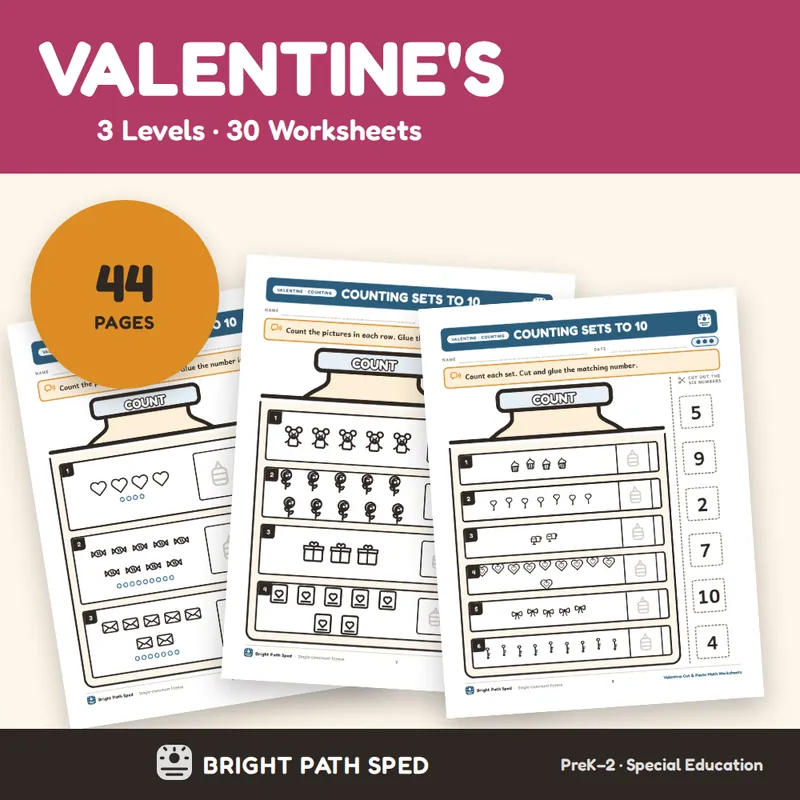
Ten math skills. Every one of them printed three times, at three levels of support, with the same pictures and the same direction line, so the whole room works the same page at the same time and nobody's paper looks like the "easy" one.
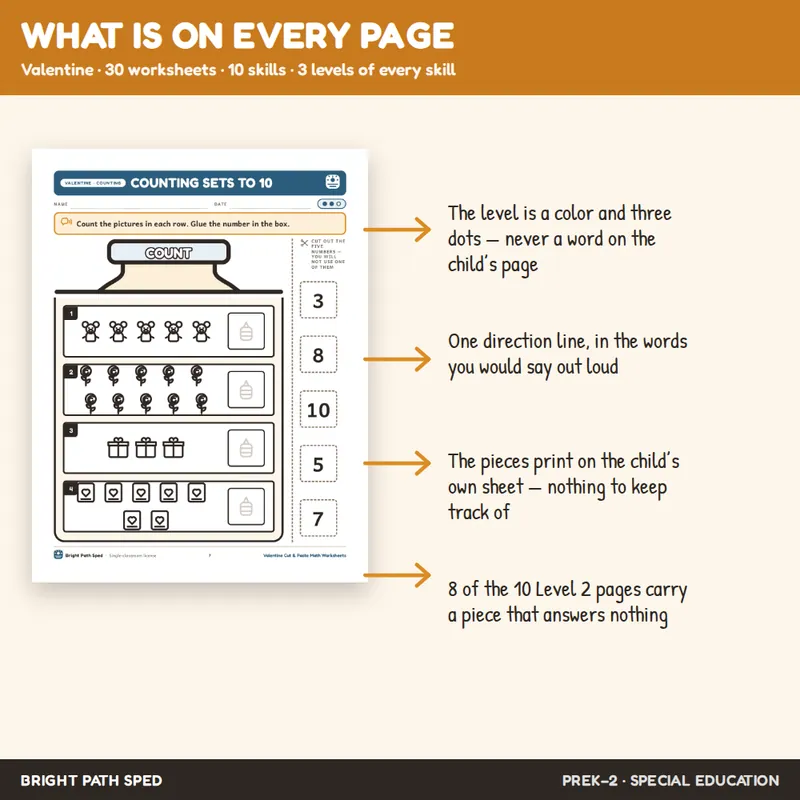
Thirty cut-and-paste worksheets, 44 pages, no prep beyond scissors and a glue stick. The cut pieces print on the child's own sheet, so nothing gets separated on the way to the desk.
The Ten Skills
Counting sets to 10 | Counting sets to 20 | Number identification and matching | Addition with pictures, building to addition to 20 | Subtraction with cross-out, building to subtraction to 20 | More and less, building to greater than and less than | Patterns, from AB to ABC and ABCD | Sorting by attribute | 2D shape identification | Valentine picture graph
What A Page Looks Like
Every page is built around one frame a child recognizes before reading a word. The counting, matching, adding and taking-away pages are a jar with the skill on its lid and the sets inside it. More and less puts both sets side by side on a board. Patterns run along a strip board. Sorting goes into little houses, one per mat. The shape page is a house whose windows hold the shapes, and the picture graph is a bar frame the columns stack up inside, from the bottom. A child who has done one page knows what to do on the next one.
The pictures are heavy black line drawings, big enough to name across a table, and the cut pieces are card-sized so a six-year-old can cut and hold them. On the picture take-away pages the amount to cross out prints as a tag on the row at the same size as the cards, not as a line of small print beside the set.
How The Three Levels Work
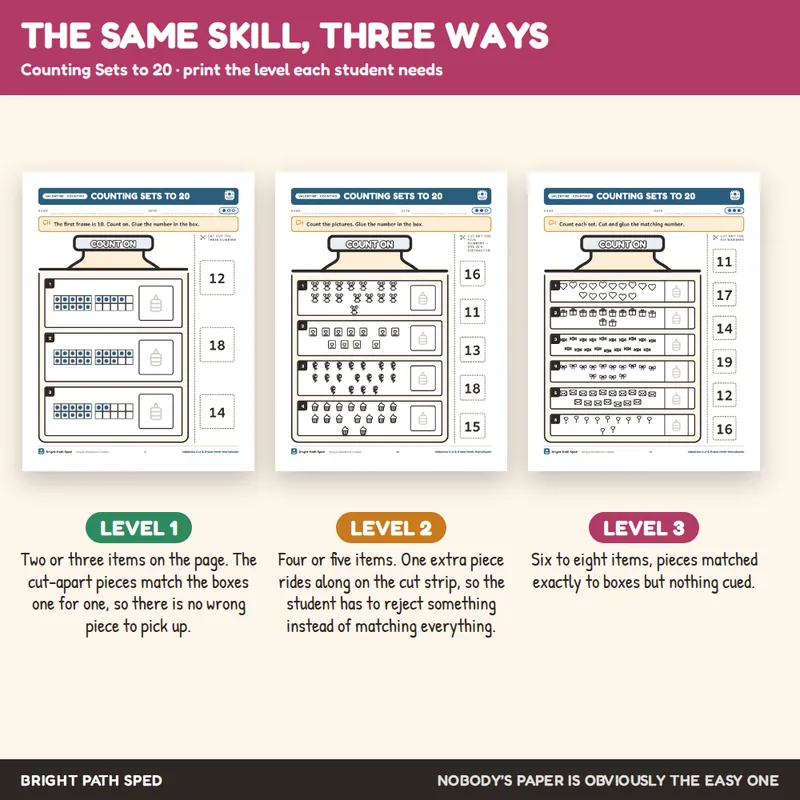
Level 1: errorless. Two or three items. Everything is drawn, sets carry touch dots or sit in a ten-frame, and the cut-apart pieces match the boxes one for one. There is no wrong piece to pick up.
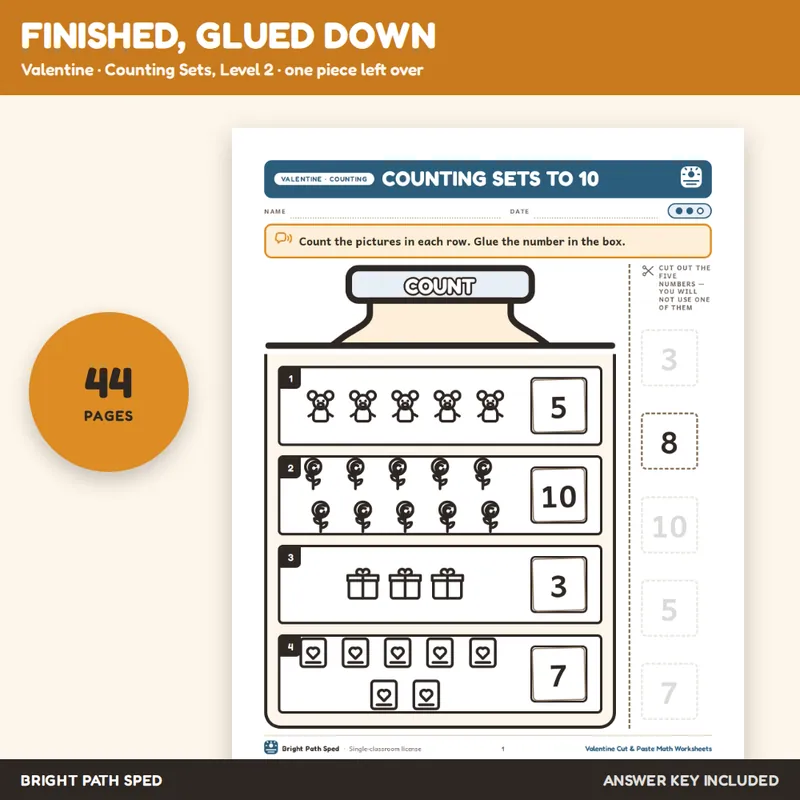
Level 2: moderate. Four or five items. Sets are still drawn but the counting cue is gone, and on seven of the ten Level 2 pages one spare piece rides along on the strip that belongs to nothing, so the student has to reject something instead of matching everything.
Level 3: independent. Six to eight items. Addition, subtraction and comparing are numerals only, with nothing drawn; counting sets are scattered in uneven rows so they cannot be counted by shape; the shapes are turned. Every piece is used exactly once, so a student who solves five can reason out the sixth.
The level is printed on the child's sheet as a color tone and a row of dots and nothing else. No student page says "Level 1" in words a child reads, so the three levels look the same on the desk. Print one skill at three levels and hand out all three.
Friendship, Not Romance
Hearts, envelopes, cards, mailboxes, roses, teddy bears, candy, cupcakes, gifts, bows and balloons. There are no couples, no cupids aiming at anyone and nothing a family could object to, so these pages work as a February classroom-friendship theme and clear the usual district restrictions.
All-New Problems
If you already own the fall, Halloween, Thanksgiving or winter pack, none of this is a reprint. Every number pair, set size, pattern and sorting mat in this pack was checked against the earlier packs by script. Not one addition, subtraction or comparison problem repeats.
What Else Is In The File
- One-page teacher guide to the three levels, with what to do when a student is stuck
- Contents page and six section dividers for your binder
- Three pages of answer keys, with the spare piece named on every Level 2 page that has one
- Name and date line on every worksheet
- A scissors line on every worksheet so the pieces come off cleanly
- Clear, child-friendly print throughout, and no page depends on color to be understood: the frames and the pictures are drawn in heavy black line, so a grayscale copy works exactly as well as a color one and there is no separate B&W file to hunt for
How A Week Runs
Pick one skill on Monday and print all three levels of it. Everybody gets the same pictures and the same direction line, so you teach it once to the whole group and then walk the room. Thirty worksheets is roughly six weeks of one-skill-a-week. The answer key at the back means a para or a sub can check the work without finding you first.
Who This Is For
Self-contained, resource and life-skills classrooms, early intervention, and any elementary room with a wide skill range in it. Also useful as a fine-motor task: cutting the strip is a legitimate goal on its own.