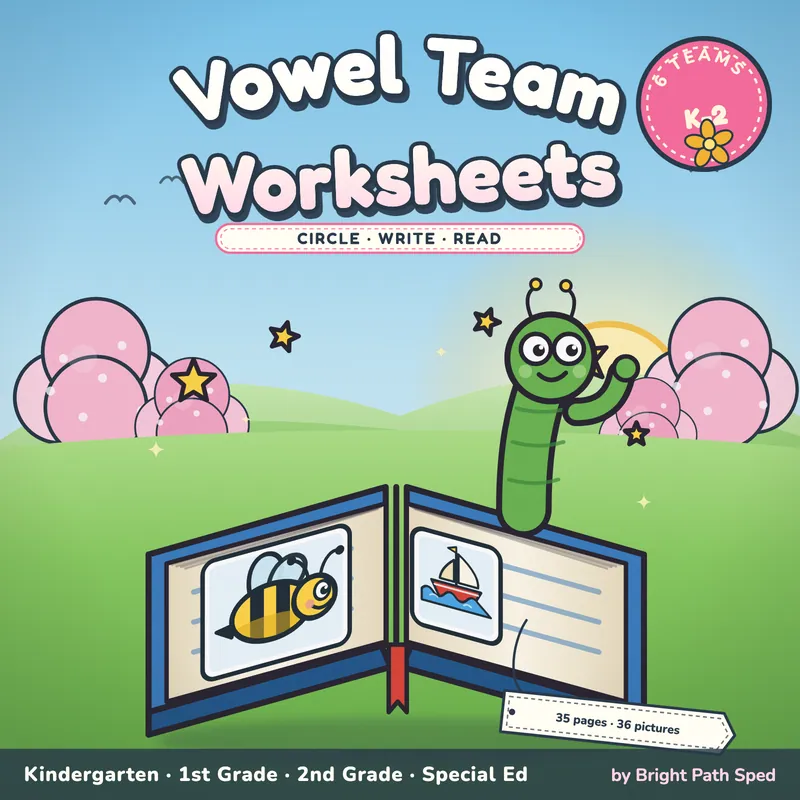
Vowel Team Worksheets
- 35 pages
- Kindergarten, 1st, 2nd
$4.00
DownloadOr get it with All-Access: pick any 20 resources a month for $7.
New here? Your first month of All-Access is half off with code TEACHERTOK
Already bought this, or a member?
Instant download. One teacher's license: colleagues need their own copy. Each file carries a license number.
Also on Teachers Pay Teachers: see the Bright Path Sped store
About this resource
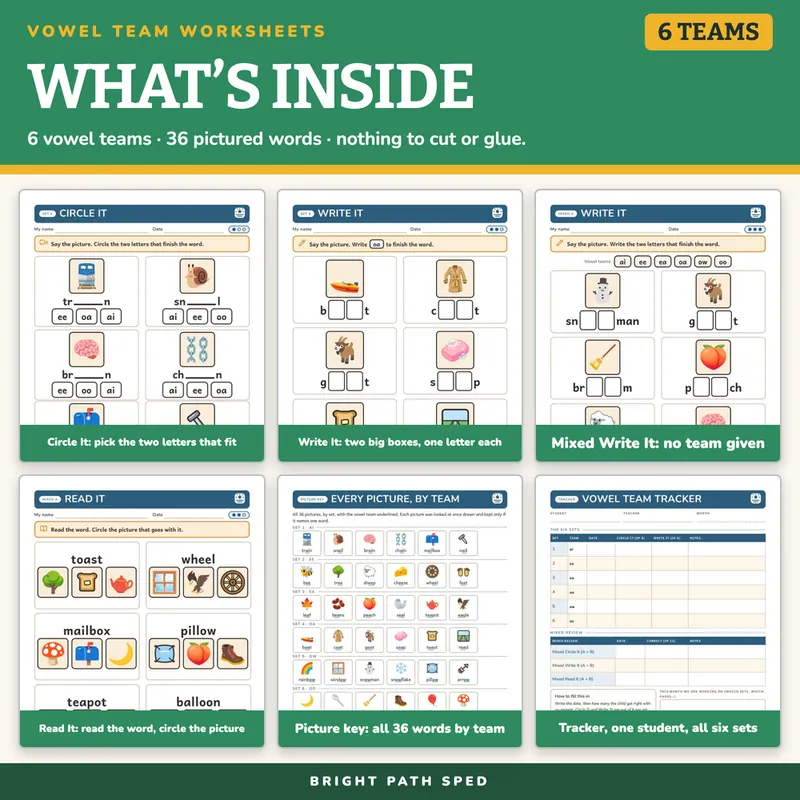
Picture on the page, two letters missing from the word. The child says the picture, then circles the
two letters that fit, writes them in two big boxes, or, on the Read It pages, reads the word and
circles the picture. Six vowel teams, six pictured words each, and nothing to cut or glue.
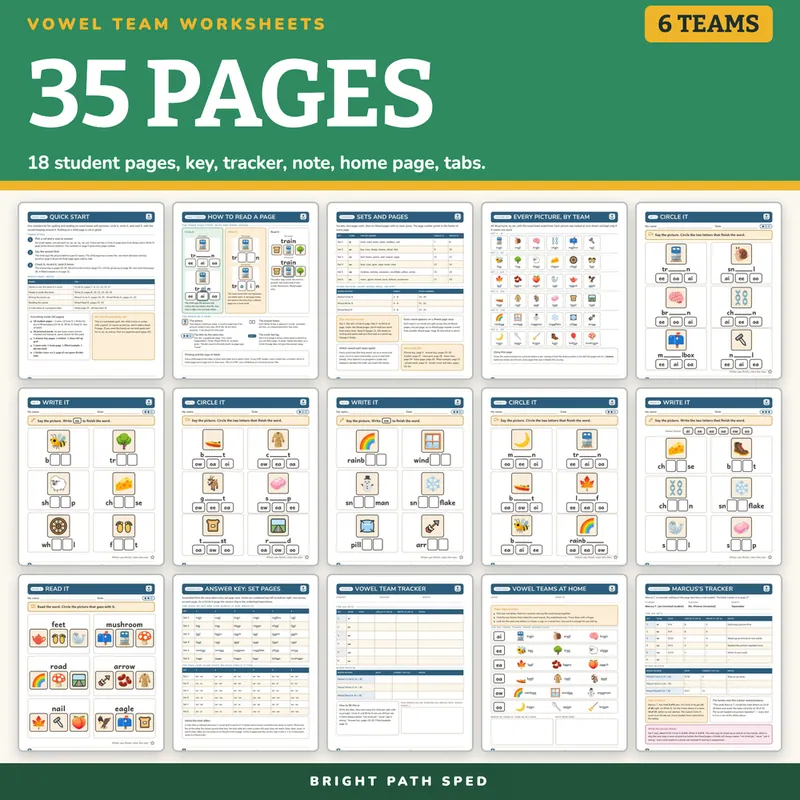
EVERYTHING INSIDE (35 pages)
- 18 student pages: 6 sets (ai, ee, ea, oa, ow, oo) x 2 pages (Circle It, Write It) = 12, plus 6 Mixed
pages with no team given (Mixed Circle It x 2, Mixed Write It x 2, Mixed Read It x 2)
- 36 pictured words, six per team. Every picture was looked at once drawn and kept only if it names
one word; 29 are Google Noto pictures and 7 (nail, feet, road, toast, pillow, arrow, wheel) are drawn
for this pack
- Every child page has a "My name" line, one short direction with a small icon (a speech bubble on
Circle It, a pencil on Write It, a book on Read It), big letters and pictures, and a star to color
when finished. No adult text on a child page. Only the 8 Write It pages (6 set pages and 2 Mixed
pages) have write boxes: two per word, about 0.7 in tall, one letter each. The 8 Circle It pages and
the 2 Read It pages are circle-only, with nothing to write
- 2 answer-key pages (generated from the same data as the worksheets), 1 picture key of all 36 words
- 1 tracker (one student, six sets plus Mixed), 1 class progress grid (16 rows), 1 team note page,
1 home page (the six teams, three pictured words each), 1 filled example, 1 phrase bank
- 1 binder cover with spine label and 1 page of six cut-apart divider tabs plus a label (7 pieces,
edge to edge, so each cut is one straight line)
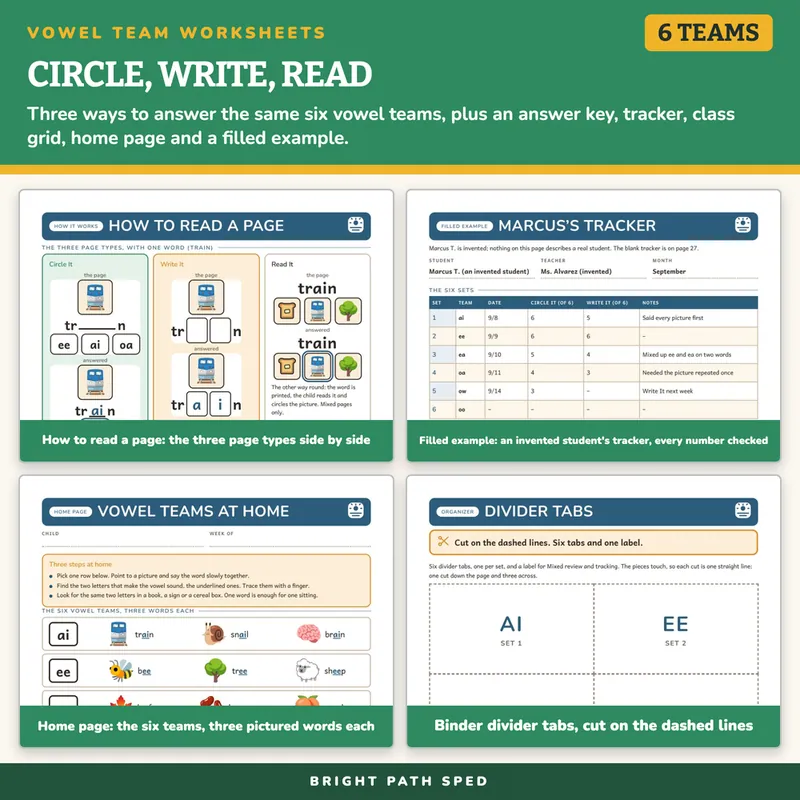
- Start Here, a how-to-read-a-page page with all three page types shown blank and answered, a
contents page that gives every page number, and a "What's next" back page
The Three Page Types
1. Circle It: the picture, the word with a gap, three chips. One chip is the right team; two are
look-alikes. A look-alike is never allowed to spell a word a K-2 reader knows (moon would become
moan), so the choice is about the team, not a trick.
2. Write It: the same kind of word with two big boxes, one letter each. On a set page the direction
names the team; on the Mixed page a team bank sits above the pictures and nothing is given.
3. Read It: the other way round. The word is printed and the child reads it and circles the picture.
The wrong pictures come from other teams and start with the same letter where possible.
The Six Teams
ai (train, snail, brain, chain, mailbox, nail) · ee (bee, tree, sheep, cheese, wheel, feet) ·
ea (leaf, beans, peach, seal, teapot, eagle) · oa (boat, coat, goat, soap, toast, road) ·
ow (rainbow, window, snowman, snowflake, pillow, arrow) · oo (moon, spoon, broom, boot, balloon,
mushroom). Every word uses the long sound: ow as in snow (not cow), oo as in moon (not book), ea as
in leaf (not bread).
How This Is Different From The Cut-And-Paste Vowel Teams Sort
Type In, Or Print
The name and date lines, the tracker, the class grid, the team note and the home page are type-in
fields in any PDF reader. The circles and the letters students write are pencil work, and every
child page prints clean in black and white. This is a fillable PDF; it is not a Google Slides or
PowerPoint file.
Who This Is For
Kindergarten through second-grade classrooms, self-contained and resource rooms, and any teacher
with a student who is ready for vowel sounds spelled with two letters. Your district's or program's
scope and sequence decides which team comes first.
What This Is, And What It Is Not
Vowel team practice paper with the record-keeping around it. It is not a reading assessment and not
a claim about any student's age or rate of progress. The invented student in the example is
labeled as invented.