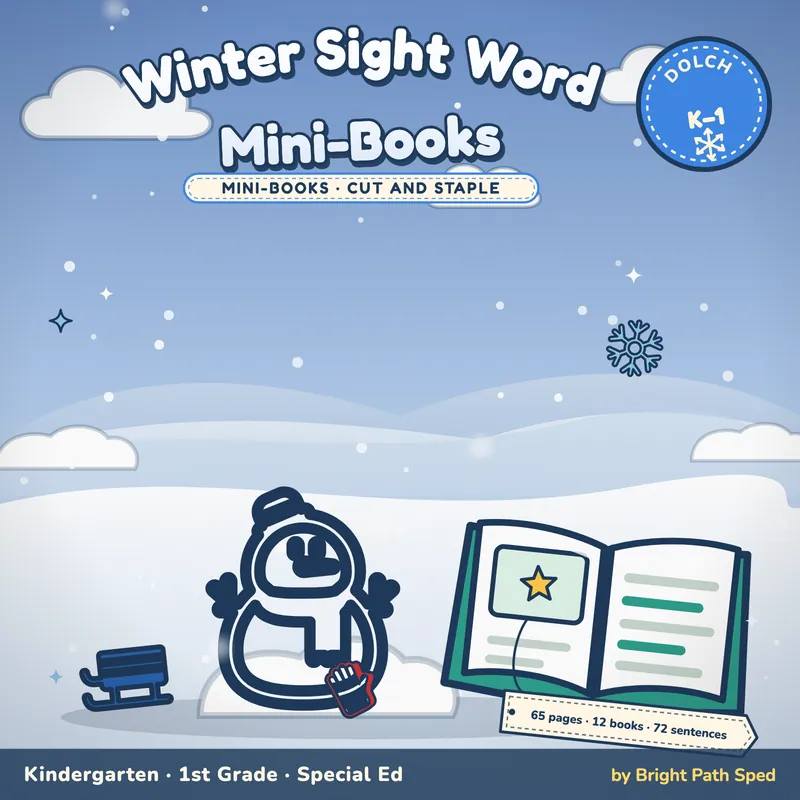
Winter Sight Word Worksheets
- 65 pages
- Kindergarten, 1st
$4.00
DownloadOr get it with All-Access: pick any 20 resources a month for $7.
New here? Your first month of All-Access is half off with code TEACHERTOK
Already bought this, or a member?
Instant download. One teacher's license: colleagues need their own copy. Each file carries a license number.
Also on Teachers Pay Teachers: see the Bright Path Sped store
About this resource
A child who reads Dolch sight words by sight is ready for a book made only of words they already know by
heart, plus one new picture word to learn a page at a time. These are twelve little books, one per topic
(pets, farm animals, ocean animals, snacks and more), eight mini-pages each, cut and stapled from ONE sheet
of paper: four straight cuts, stack the numbered pages, staple on the left. Every sentence is built from
exactly two kinds of words — a Dolch Pre-Primer or Primer sight word, or the one pictured word the page is
teaching — checked in code, never a guess.
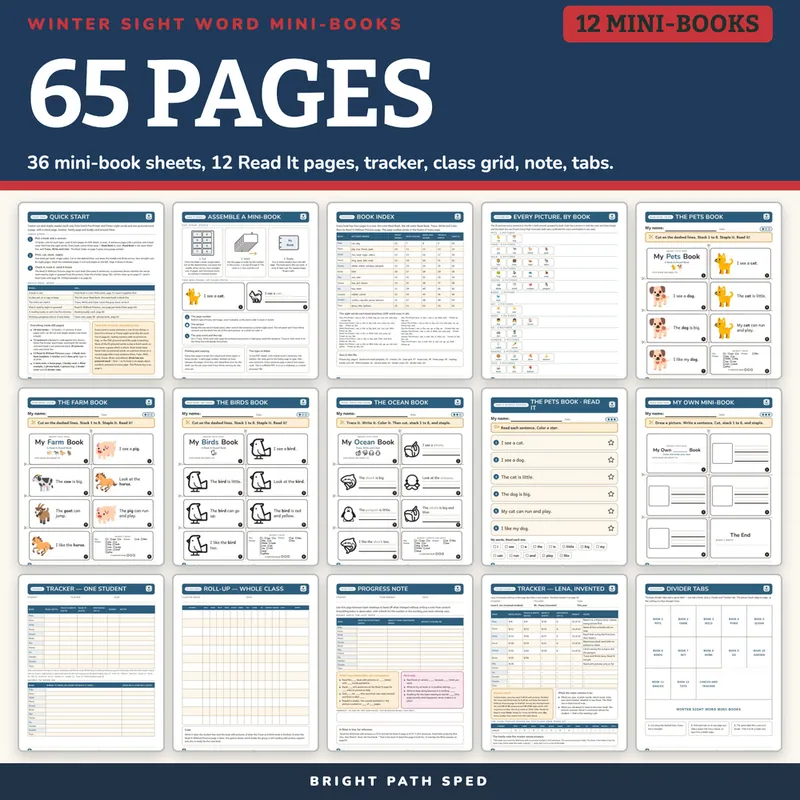
EVERYTHING INSIDE (65 pages)
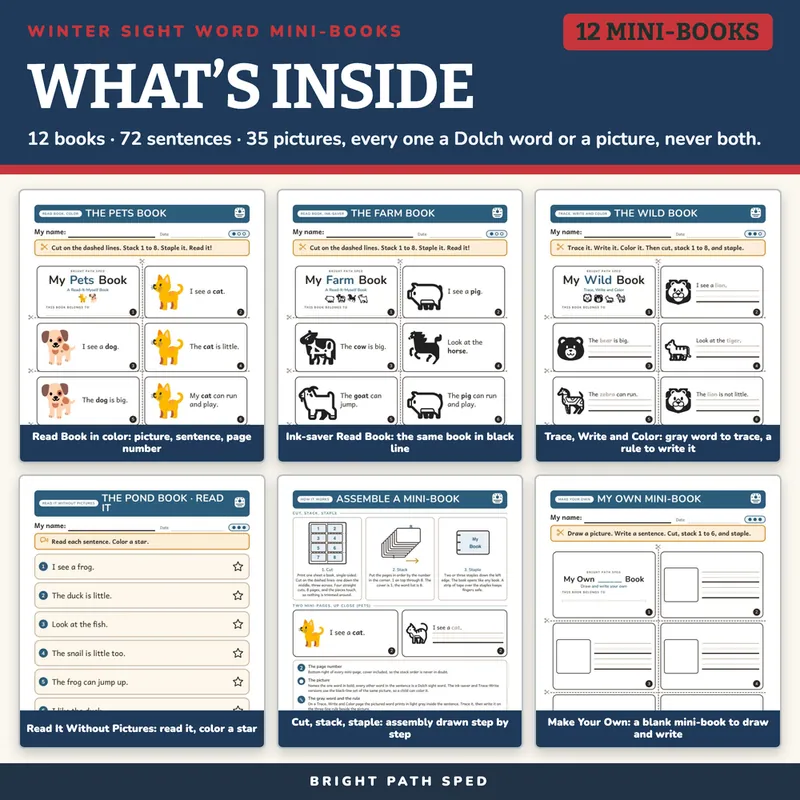
- 36 mini-books: 12 books x 3 versions, 8 mini-pages each, one cut-and-staple sheet each. A cover with a "This
book belongs to" line, 6 sentence pages, and a back cover that lists the book's Dolch sight words
- The 12 books: Pets (cat, dog); Farm (pig, cow, horse, goat); Wild Animals (lion, bear, tiger, zebra); Pond
(frog, duck, fish, snail); Ocean (whale, shark, octopus, penguin); Backyard Birds (bird); Sky (sun, star);
Home (boy, girl, house); On the Go (bus, train); Garden (rabbit, carrot); Snacks (cookie, cupcake, pizza,
banana); Toys (drum, kite, balloon)
- Read Book in color, the classroom copy (Noto pictures)
- Read Book in ink-saver black line, the class set (Fluent black-line pictures of the same words)
- Trace, Write and Color: the pictured word prints in light gray inside the sentence to trace, with a
three-line rule beside the picture to write it, and the black-line picture to color
- 72 sentences, 6 per book, and 35 pictures, each confirmed in both the color and black-line sets
- 155 sight-word uses across the twelve books (each book's own Dolch Pre-Primer and Primer words, listed on
its back cover and on the Book Index; word counts range from 11 to 16 a book)
- 12 Read It Without Pictures pages, one per book: the same six sentences with no pictures, a star to color
for each one, and the book's sight words listed to read
- 1 blank My Own Mini-Book template (6 pieces: cover, four draw-and-write pages, The End)
- 1 tracker (one student, all twelve books) and 1 class grid (whole class), type-in or print
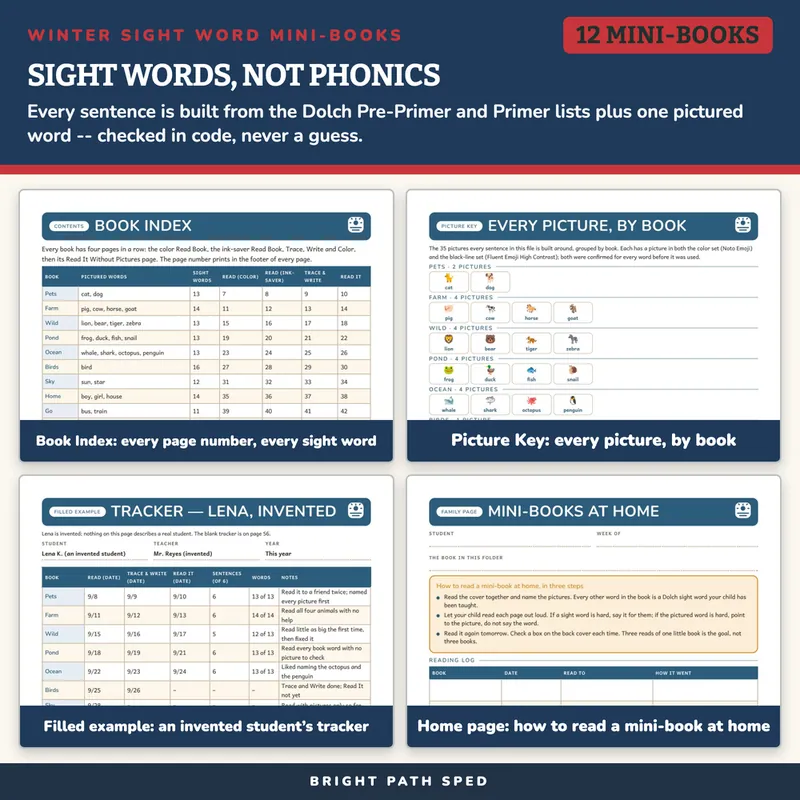
- 1 team note (a hand-off page with blanks), 1 home page (how to read a mini-book at home, a reading log)
and 1 reading buddy card (a five-minute routine for a paraprofessional or volunteer)
- 1 filled example: an invented student's tracker, every number read off its own table
- 1 phrase bank (17 starters and prompts: progress note, family note, next step, and say-it-first)
- 1 picture key, 1 binder cover, and 13 divider tabs with a spine label to cut out
- Start Here, an assembly page (cut, stack, staple drawn step by step) and a Book Index that gives every
page number
How A Book Goes Together
One sheet per book, printed single-sided. Cut on the dashed lines: one down the middle and three across, four
straight cuts for eight pages. The pages touch edge to edge, so nothing is trimmed around. Stack by the number
in the corner of every mini-page, 1 on top through 8, and put two or three staples down the left edge. The
assembly page draws all three steps.
Three Versions Of Every Book
1. Read Book, color: read it together first, then the child reads it.
2. Read Book, ink-saver: the same book in black line, for a class set or a copy to keep.
3. Trace, Write and Color: trace the gray word, write it, color the picture.
Then the check: the Read It Without Pictures page puts the same six sentences in front of the child with no
picture at all, so you can see whether the words were read by sight or guessed from the picture. The child
colors a star for each sentence read; the counts you take go on the tracker.
Built For The Child Holding The Page
A big "My name" line, one short instruction with a picture, large rounded type, and dots (not words) to show
which version a page is. Nothing on a student page is written for an adult.
Two Kinds Of Words, Said Plainly
Every word in every sentence is either a Dolch Pre-Primer or Primer sight word (the 92-word list this store's
own progress-monitoring probes also use) or the one pictured word for that page — never both, and never a third
kind of word. Most books have fewer than six pictured nouns, so a picture repeats on a second page with a new
sentence. Backyard Birds has ONE pictured word — bird — so its book is six pages about one bird, pictured on
every page. The Picture Key says the same thing plainly.
Type In, Or Print
The name line on every mini-book cover, the name and date lines on every student page, the tracker, the class
grid, the team note, the home page and the reading log are type-in fields in any PDF reader. The sentence pages
are pencil, crayon and scissors work. This is a fillable PDF; it is not a Google Slides, Google Docs or
PowerPoint file.
Who This Is For
Kindergarten and first grade classrooms, self-contained and resource rooms, small groups, and any teacher with
an older student who still needs sight word reading practice in a book instead of a flashcard. The home page
sends a book home to a family; the reading buddy card hands the same five minutes to a paraprofessional or
volunteer; the team note hands off what changed since the last meeting.