Word Families Cut and Paste 3 Levels
- 26 pages
- PreK, Kindergarten, 1st, 2nd
$4.00
DownloadOr get it with All-Access: pick any 20 resources a month for $7.
New here? Your first month of All-Access is half off with code TEACHERTOK
Already bought this, or a member?
Instant download. One teacher's license: colleagues need their own copy. Each file carries a license number.
Also on Teachers Pay Teachers: see the Bright Path Sped store
About this resource
The first day a child stops sounding out every letter and starts reading by pattern instead. -at,
-an, -ap, -ig and -op: read the ending once, then just change the front. It sits on this store's
shelf exactly between CVC Words Cut and Paste (one sound at a time) and Blends Cut and Paste (two
consonants glued into one sound).
Five days, each with a scripted plan page and three student levels: fifteen worksheets and five
lesson plans in one PDF. The cut pieces print on the child's own sheet, so nothing gets separated
on the way to the desk.
What A Page Looks Like
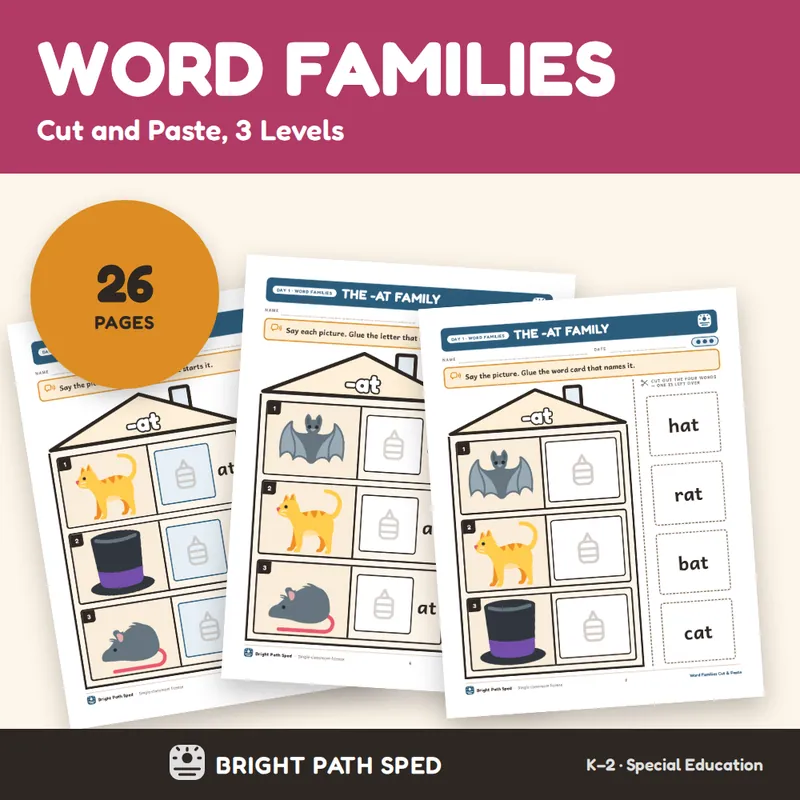
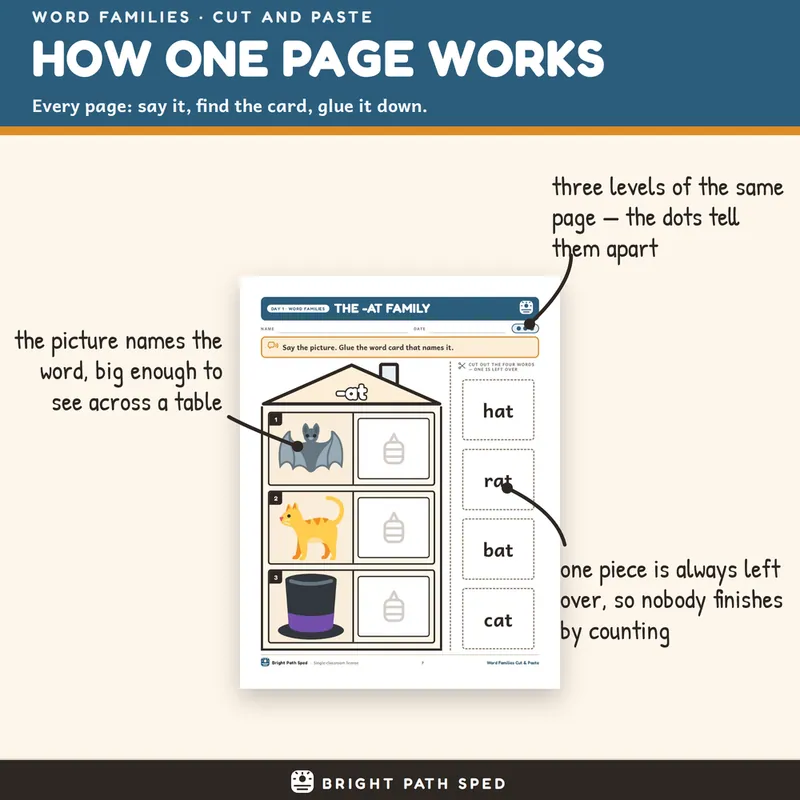
Every worksheet is a house. The day's ending sits on the roof in big letters, each picture sits in
its own window with the answer slot beside it, and the cut pieces stand in a column next to the
house at a size a five-year-old can cut and hold. The pictures are full-color, big enough to name
across a table, and every picture is a picture of exactly the word it stands for. A child who has
done one page knows what to do on the next one: say the picture, glue the letter.
How The Three Levels Work
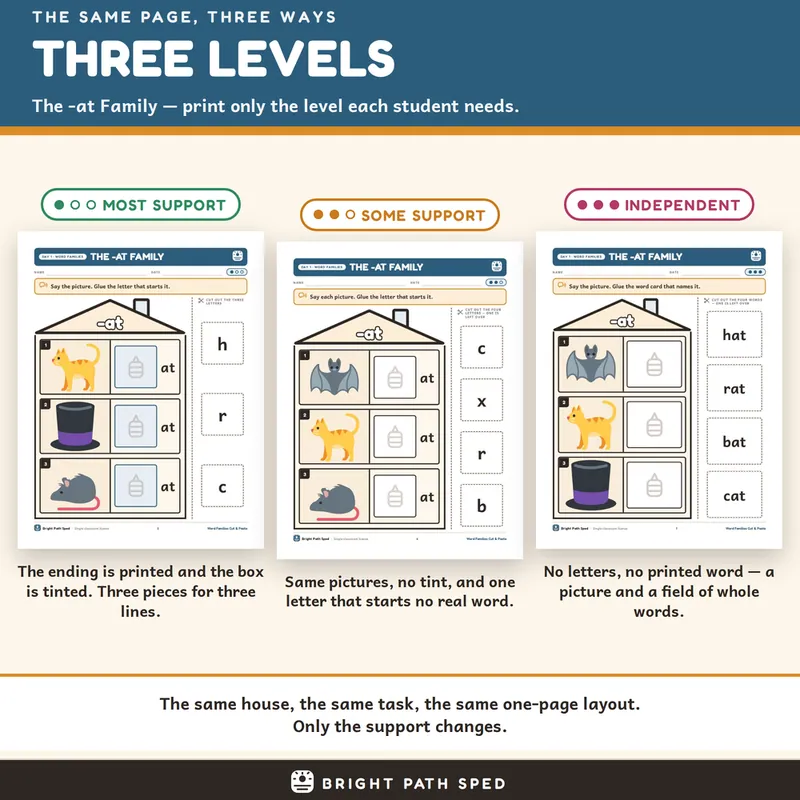
Level 1: the ending is already printed and the first-letter box is tinted, so the only decision is
the sound at the very front. Pieces match slots one for one: there is no wrong piece to pick up.
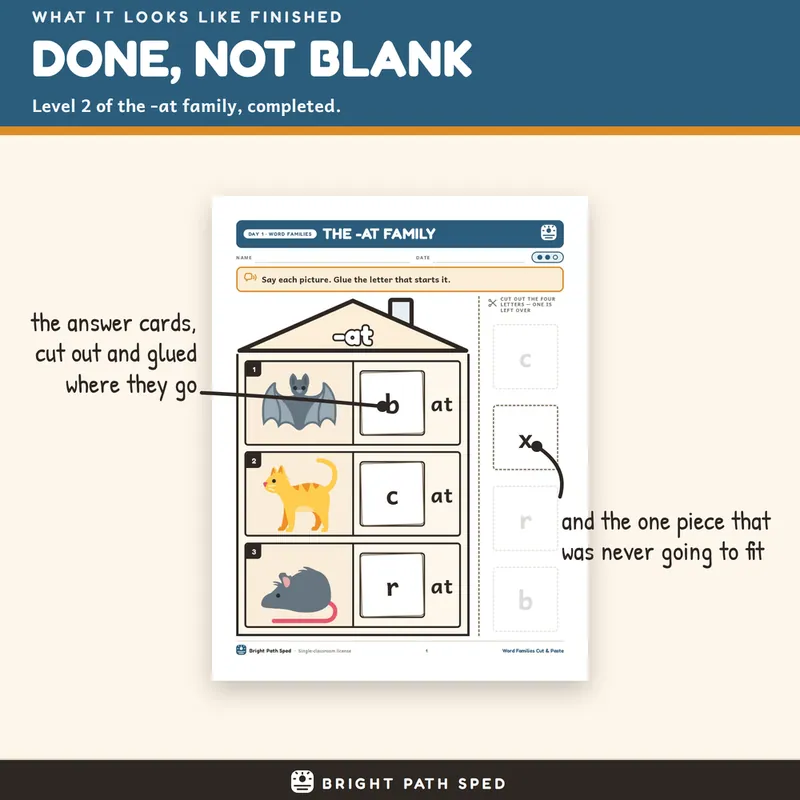
Level 2: no tint, and one extra letter on the strip that starts no real word with that day's
ending.
Level 3: independent. No letters, no printed word at all: a picture only, and a field of whole-word
cards that includes a genuine look-alike (map next to mop, van next to fan and pan, rat next to
bat, cat and hat). Reading the whole word is a harder, different skill than building it, and this
is the page that checks it.
The level is shown on the child's sheet as a color tone and a row of dots and nothing else. No
student page says "Level 1" in words a child reads, so the three levels look the same on the desk.
Five Days, One Family Each
1. The -at Family
2. The -an Family
3. The -ap Family
4. The -ig Family
5. The -op Family
Every Picture Names Its Word, Not A Guess At One
-ap and -op each run two pictures, not six. Cap and map; mop and top. That is not a shortcut: it
is every real, everyday noun in either family a picture can show without guessing at what it is.
-ig runs one picture (pig) plus four more real -ig words (dig, big, fig, jig, rig) that you say out
loud and the child builds by ear, because none of them has a picture that names it. On those lines
the window shows a listening mark instead of a picture. Rat has no picture either; on the -at
family it is the extra word card at Level 3, never a picture. A title that says "six words" on a
page that can only honestly draw two is a bigger problem than a page that says two and means it.
What Is In The File
- 26 pages, one PDF
- 5 scripted lesson plan pages: a real script in quotation marks a substitute could read cold, three
level notes, three "if a student is stuck" tips, and a data box on every plan
- 15 student worksheets (5 skills x 3 levels)
- 2 pages of answer keys, with every Level 2 spare letter named
- 1-page "how to use this packet" guide
- Name and date line and a scissors line on every worksheet
- Clear, child-friendly print throughout; the house frame is drawn in heavy black line, so a grayscale
copy still works and there is no separate B&W file because you do not need one
Who This Is For
Self-contained, resource and early-intervention classrooms, and any K-2 room ready to move a student
from single sounds into whole-chunk reading. Works alongside this store's CVC and Blends packs, or on
its own once a student reliably blends a three-sound word.
What This Is, And What It Is Not
This is a print-and-cut worksheet packet with a scripted plan page in front of each skill. It is not
a fillable form, not a full curriculum, and not a claim about how quickly any student will read by
pattern: every objective on a plan page is written the way a classroom goal is written, with nothing
clinical, no timeline and no eligibility claim attached to it.