Word Problem Key Words Anchor Chart and Worksheets
- 21 pages
- 1st, 2nd
$4.00
DownloadOr get it with All-Access: pick any 20 resources a month for $7.
New here? Your first month of All-Access is half off with code TEACHERTOK
Already bought this, or a member?
Instant download. One teacher's license: colleagues need their own copy. Each file carries a license number.
Also on Teachers Pay Teachers: see the Bright Path Sped store
About this resource
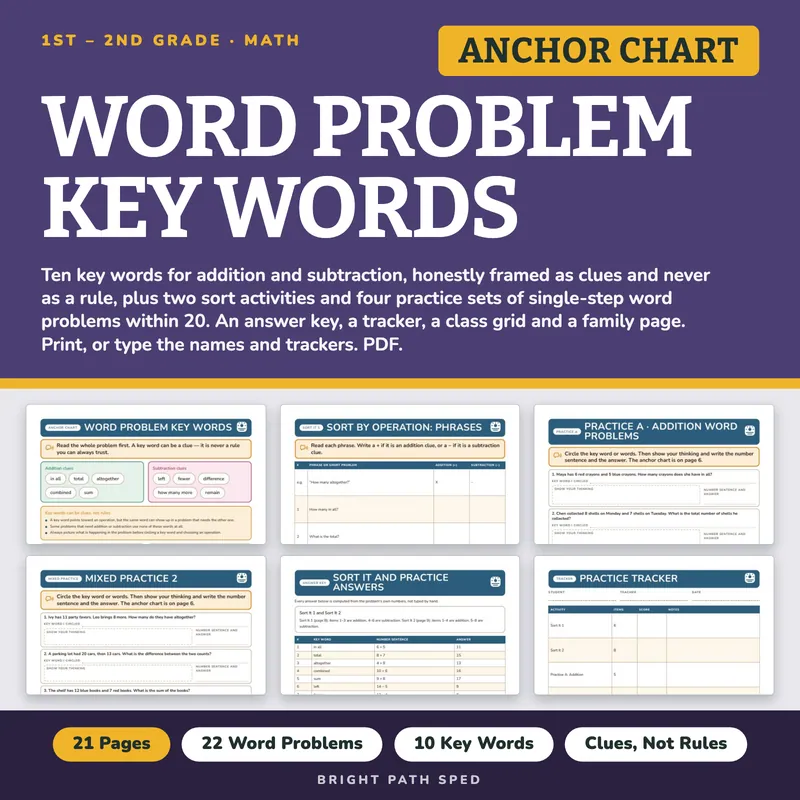
A student who is taught that "in all" always means add will get the next problem wrong the moment that word
shows up in a story that needs subtraction. This file teaches the ten most common K-2 word-problem key words —
five for addition, five for subtraction — as clues to check against the story, never as a shortcut around
reading it, and then gives two ways to practice spotting them and four sets of real word problems to solve.
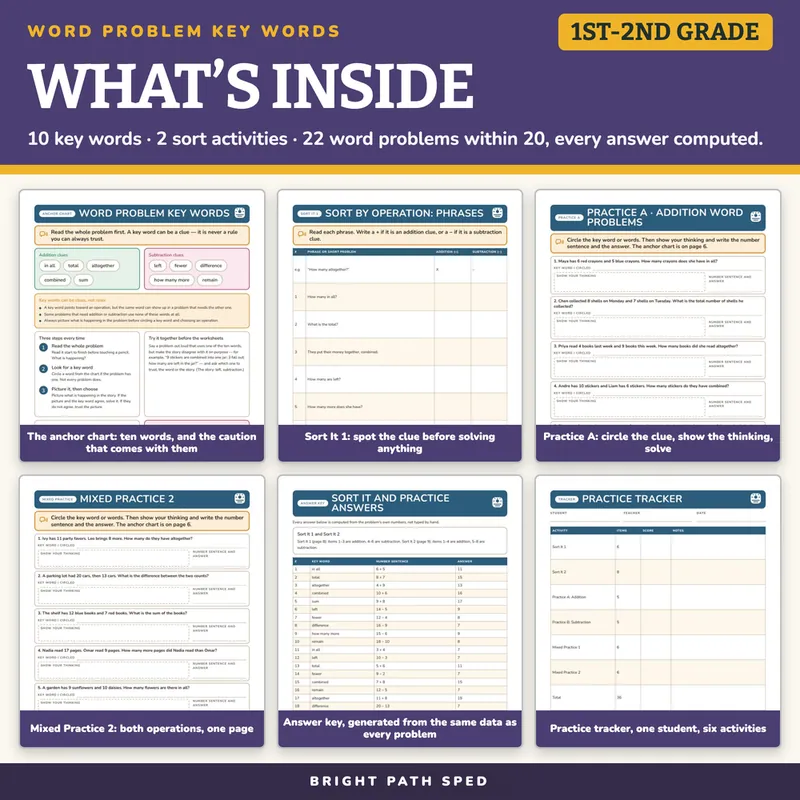
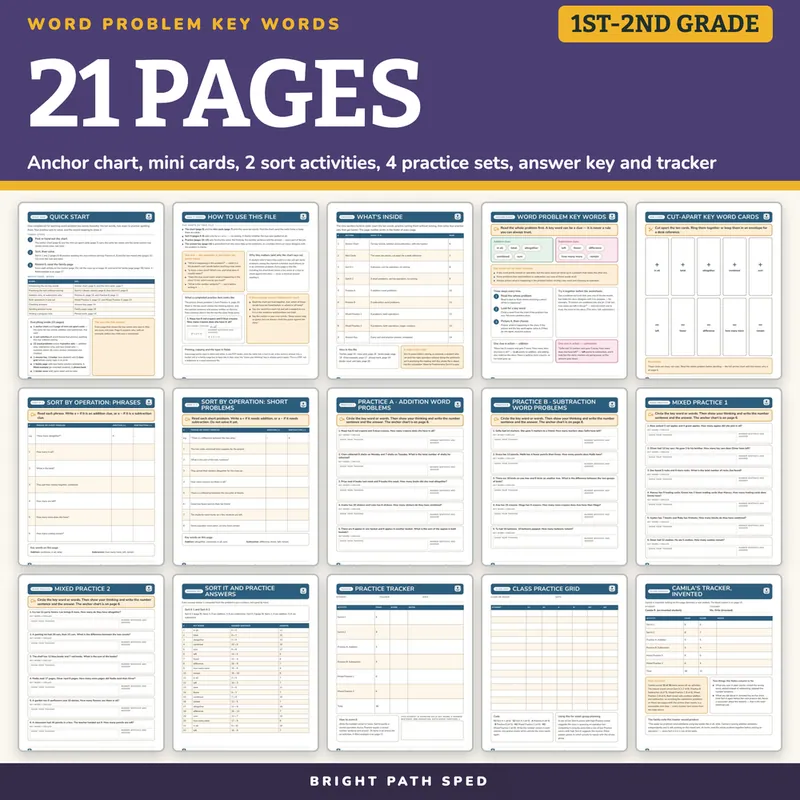
EVERYTHING INSIDE (21 pages)
- 1 anchor chart — the ten key words, addition and subtraction, with the caution stated as the page's own
headline and two worked examples (one addition, one subtraction) showing the word checked against the story
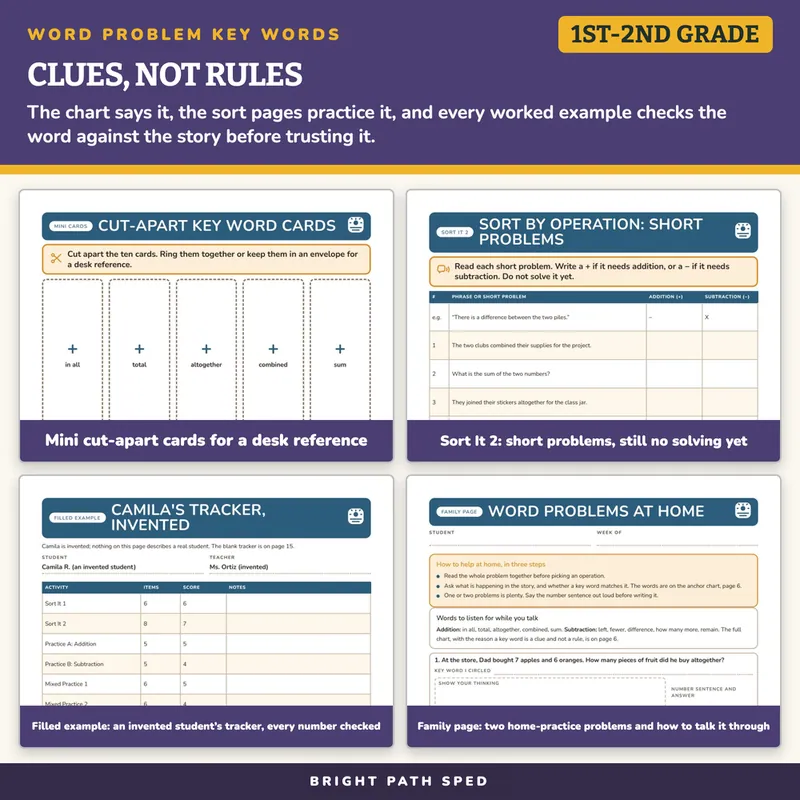
- 1 page of mini cut-apart cards — the same ten words, one per card, for a desk reference or to send home
- 2 sort activities (6 and 8 items) — read a phrase or a short problem and write + or − for the operation; no
solving yet, so the page checks the reading skill on its own
- 22 word problems across 4 practice sets — addition only, subtraction only, and two mixed sets — numbers
within 20, single step, every answer computed by the file's own code and checked against the problem, never
typed by hand
- 1 answer key, generated from the same data as every problem and every sort item
- 1 practice tracker (one student, six activities) and 1 class grid (whole class), type-in or print
- 1 family page — two home-practice problems (one addition, one subtraction), three steps for home, and a note
box each way
- 1 filled example — an invented student's tracker, every number on it read off its own table
- 1 phrase bank — progress-note, family-note and next-step starters, plus the talk-first questions to ask
before the pencil moves
- 1 binder cover with a spine label and six divider tabs
- Start Here, a how-it-works page (with a worked demo of a completed practice item), and a contents page that
gives every page number
The Ten Key Words
Addition: in all, total, altogether, combined, sum. Subtraction: left, fewer, difference, how many more,
remain. Every word appears at least once in the sort activities and at least once in the word problems, so a
student sees each one solved, not just listed.
Key Words Are Clues, Not Rules
The anchor chart's own headline states the caution the line brief requires: a key word points toward an
operation, but the same word can appear in a problem that needs the other one, and some problems use none of
these words at all. Every page that teaches the ten words also carries this caution, and the how-it-works page
explains why with a worked example.
Four Practice Sets, Easiest To Hardest
Practice A (addition only, 5 problems) and Practice B (subtraction only, 5 problems) isolate one operation at a
time. Mixed Practice 1 (6 problems) and Mixed Practice 2 (6 problems, larger numbers) combine both, so a
student has to read for the clue instead of assuming the page's operation. Every problem asks the student to
circle the key word, show their thinking in a work box, and write the number sentence and answer.
Type In, Or Print
The name and date lines, the Sort It cells, the key-word and answer lines, the tracker, the class grid and the
family page are type-in fields in any PDF reader; the "show your thinking" box is always pencil space. This is
a fillable PDF; it is not a Google Slides or PowerPoint file.
Who This Is For
First and second grade classrooms, self-contained and resource rooms, and any small group working on word
problems below or above grade level. The talk-first questions on the how-it-works page are written for a
paraprofessional or a volunteer to run a table; the family page sends the same skill home.
What This Is, And What It Is Not
An anchor chart and a set of practice worksheets for one specific, honestly-framed strategy, with the
record-keeping around it. It is not a full word-problem curriculum, not an assessment, and not a claim about
any student's age, grade level or rate of progress. The tracker has a blank line for your own scoring criteria.