Yes/No Question Responding Progress Monitoring Probes
- 16 pages
- PreK, Kindergarten, 1st, 2nd
$1.50 $3.00 on Teachers Pay Teachers
Half the Teachers Pay Teachers price. The same PDF, sold direct.
DownloadOr get it with All-Access: pick any 20 resources a month for $7.
New here? Your first month of All-Access is half off with code TEACHERTOK
Already bought this, or a member?
Instant download. One teacher's license: colleagues need their own copy. Each file carries a license number.
Also on Teachers Pay Teachers: see the Bright Path Sped store
About this resource
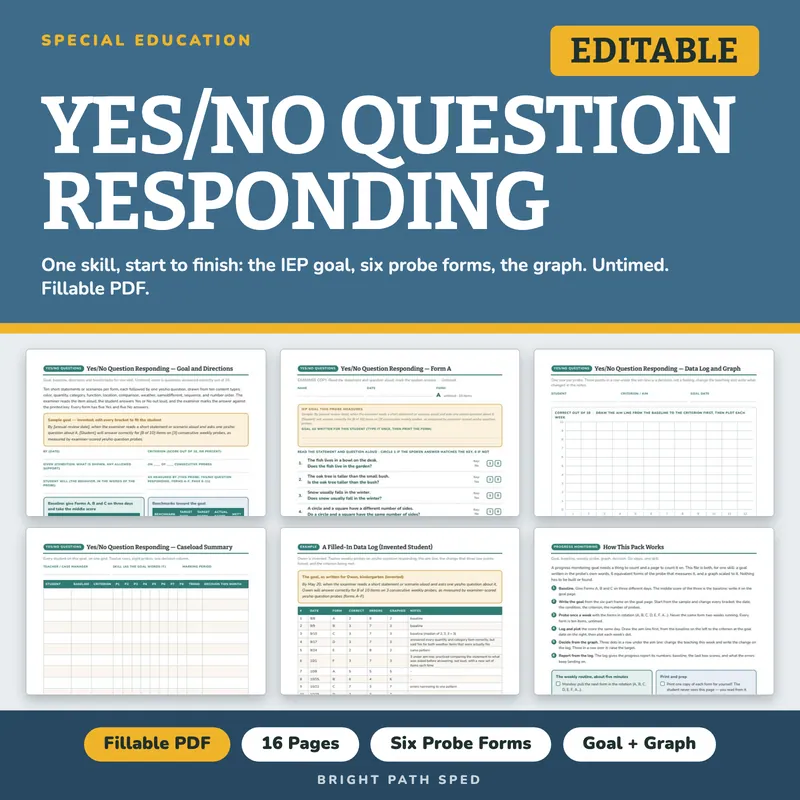
One skill, start to finish. A yes/no question responding IEP goal, six equivalent probe forms that measure it, and a graph scaled to the probe. Baseline on Monday, goal written by Tuesday, first data point on Friday.
This is not the store's Yes/No Question Picture Cards (printed flashcards, no scored forms, no goal page) and not the store's WH Questions probe (a text probe a reader holds and writes a short answer on). Here the examiner reads a short statement or scenario aloud, then asks one yes/no question about it; the student answers Yes or No out loud; the examiner marks the spoken answer against the printed key. Nothing is shown to or written by the student, so the probe measures listening and yes/no judgment, not reading or writing.
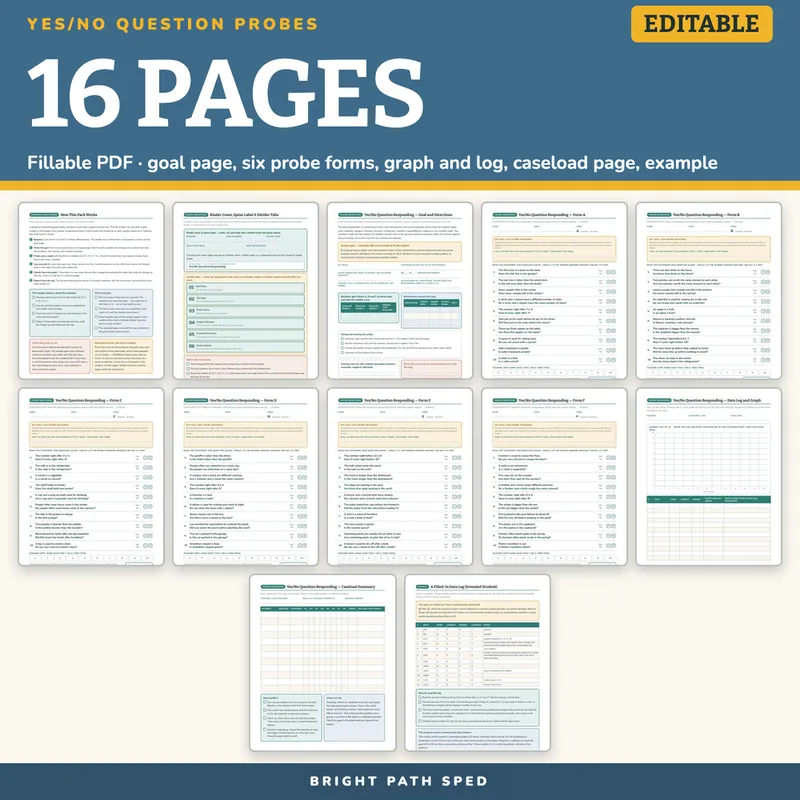
WHAT IS INCLUDED - 16 pages, six probe forms, 313 type-in fields, a binder cover and divider tabs, a family update page
A Binder Cover And Divider Tabs
- A binder cover with student, case manager and school year fields, cut and slide into a binder front or folder tab
- Six divider tabs, one per section of this file, print and cut
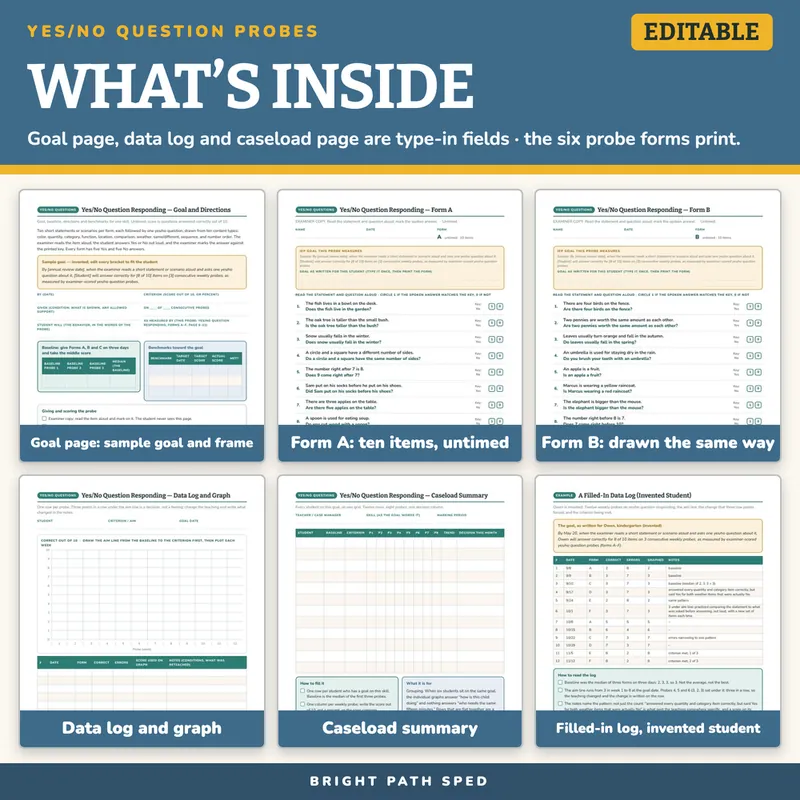
The Goal Page
- What the probe measures, in one paragraph
- A sample goal, invented, with every bracket meant to be edited by the team
- The six-part goal frame as type-in fields: by (date), given, student will, criterion, on ___ of ___ consecutive probes, as measured by
- A baseline table: three probes and the median
- Three benchmark rows with target date, target score, actual score and met
- The administration and scoring directions
- Lines for this student's own scoring rules, and a box for what the errors say to reteach
Six Probe Forms, A Through F
- Ten items per form: one short statement or scenario and one yes/no question each, drawn from ten content types -- color, quantity, category, function, location, comparison, weather, same/different, sequence, and number order
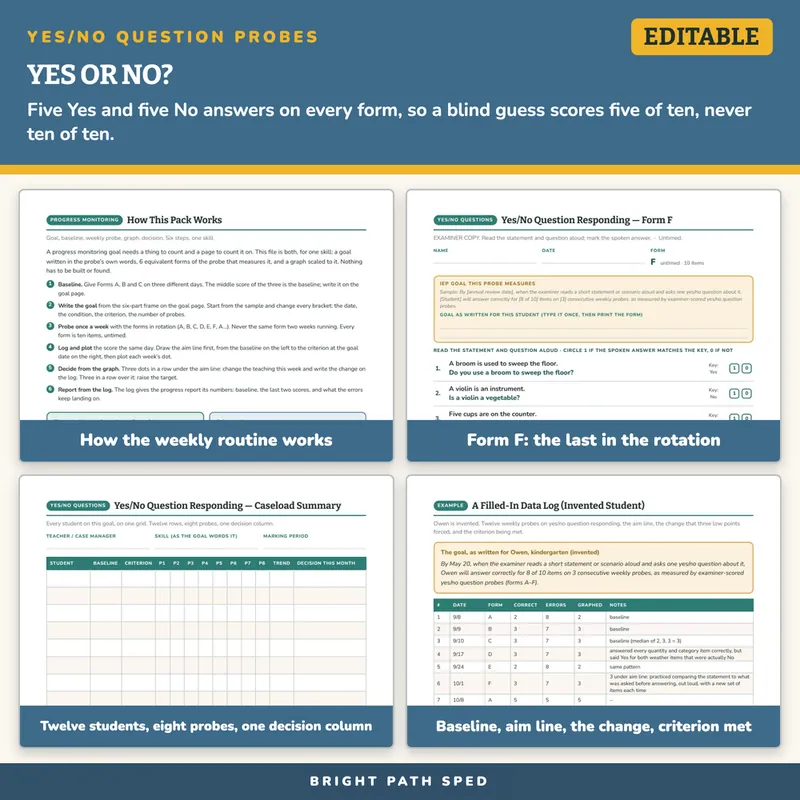
- Every form carries exactly five Yes and five No answers, so a student who always answers the same way scores five of ten, never ten of ten
- No run of more than two identical answers in a row on any form
- The examiner's own copy, with the key printed right on the page: the student never sees or holds it, so one printed set lasts the year
- Sixty different statements across the six forms, none repeated
- Every form carries the goal it measures: the sample goal, plus a type-in box for the goal as written for this student, so the goal prints on the sheet the person giving the probe is holding
- A teacher scoring strip, 1 to 10, and a Correct ___ / 10 box at the foot of every form
- Name, date and form letter at the top
The Data Log And Graph
- A y-axis already scaled 0 to 10, twelve probe columns, and the instruction to draw the aim line from the baseline to the criterion first
- A twelve-row log: date, form, correct, errors, the score used on the graph, and notes
The Caseload Summary
- Twelve student rows, baseline and criterion, eight probe columns, a trend column and a decision column
- For the data meeting: rows that are flat together are a group, a row that is flat alone is a different question
A Worked Example
- Owen, kindergarten, invented. Twelve weekly probes: the baseline taken as a median, the aim line, three points under it forcing a teaching change (practiced comparing the statement to what was asked before answering, out loud, with a new set of items each time), the criterion met, and the progress-report sentence the log produces. Every number in that sentence is on the log.
A Family Update And Team Handoff Page
- A family update with blanks for this week's score and how it compares to the goal, ready to send home or read at a conference
- A team handoff checklist for a substitute, a new provider or a shift change, so whoever gives the probe that week knows exactly what to do
- A meeting summary sentence with blanks for the two numbers off the log, ready to drop into the progress report
What This Is, And What It Is Not
It is a fillable PDF. The goal page, the goal box on every probe form, the data log and the caseload page are type-in fields: open the file in a PDF reader, click a line or a cell, type, and Save As once per student. Print one copy of each form for yourself. The student never sees this page — you read from it and mark on it — so one set lasts the year. It works offline with no account or subscription. It does not calculate percents or draw the graph.
It is not a norm-referenced assessment and it carries no benchmark score or "typical" rate. The criteria in the sample goal are in brackets because your team sets them from the baseline and the student's IEP. Every probe is untimed on purpose; the goal page says so, so the condition stays the same all year.
Who This Is For
PreK through 2nd grade special education teachers and case managers writing listening-comprehension or yes/no responding goals for any age student, speech-language pathologists, and the paraprofessionals who give the weekly probe.