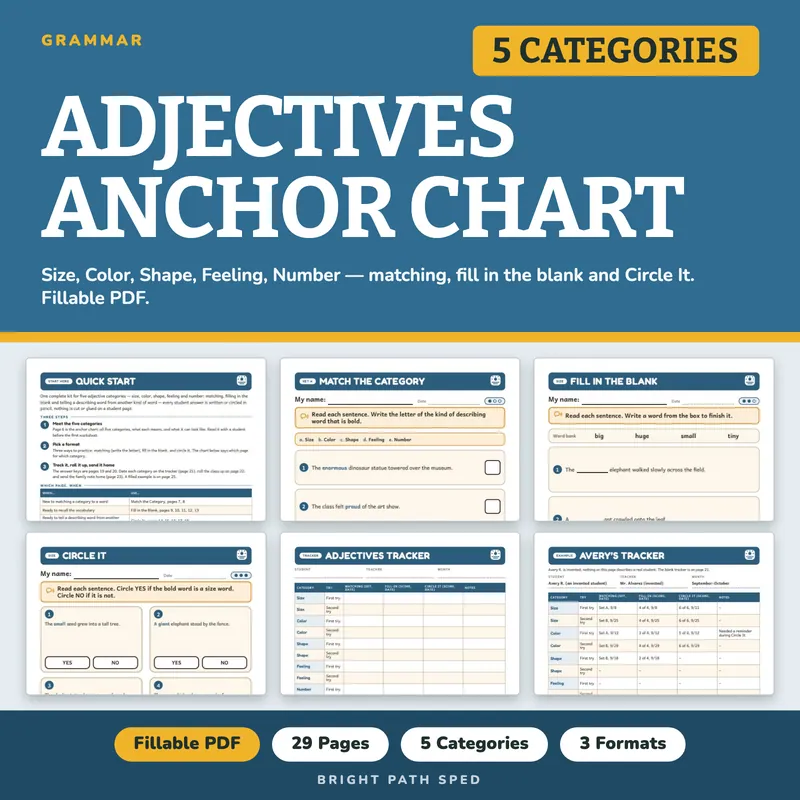
Adjectives Anchor Chart
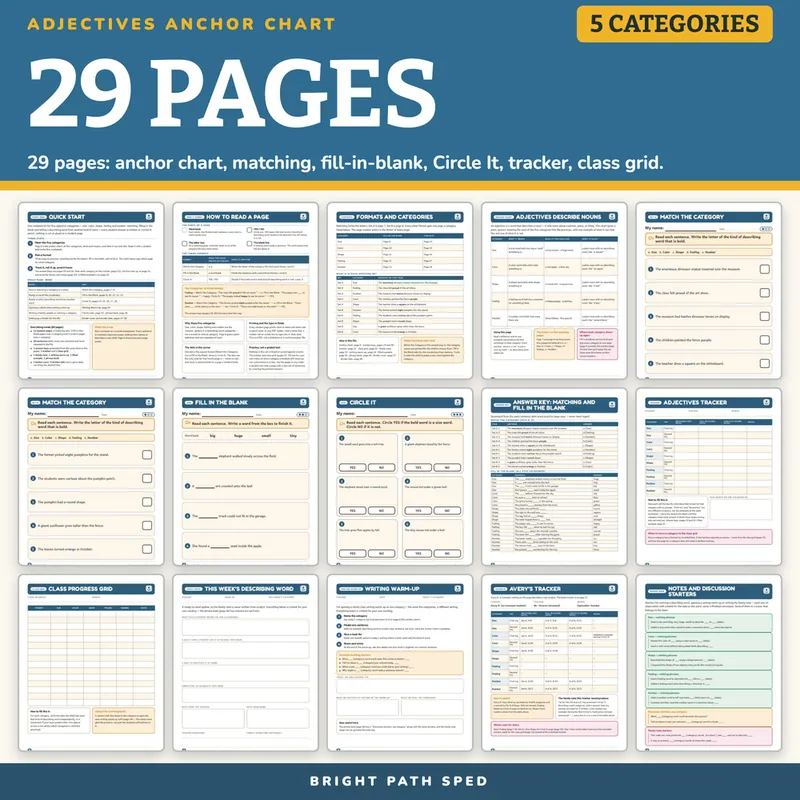
- 29 pages
- Kindergarten, 1st, 2nd
$2.00 $4.00 on Teachers Pay Teachers
Half the Teachers Pay Teachers price. The same PDF, sold direct.
DownloadOr get it with All-Access: pick any 20 resources a month for $7.
New here? Your first month of All-Access is half off with code TEACHERTOK
Already bought this, or a member?
Instant download. One teacher's license: colleagues need their own copy. Each file carries a license number.
Also on Teachers Pay Teachers: see the Bright Path Sped store
About this resource
A poster names the categories, but a child learns an adjective by using it — matching it, filling it in,
and telling it apart from a plain noun. This is a complete kit for all five K-2 describing-word
categories: a true anchor-chart reference page, three different ways to practice each category, a
tracker, a class grid, a family note and a writing warm-up, so nothing has to be written from scratch.
EVERYTHING INSIDE (29 pages)
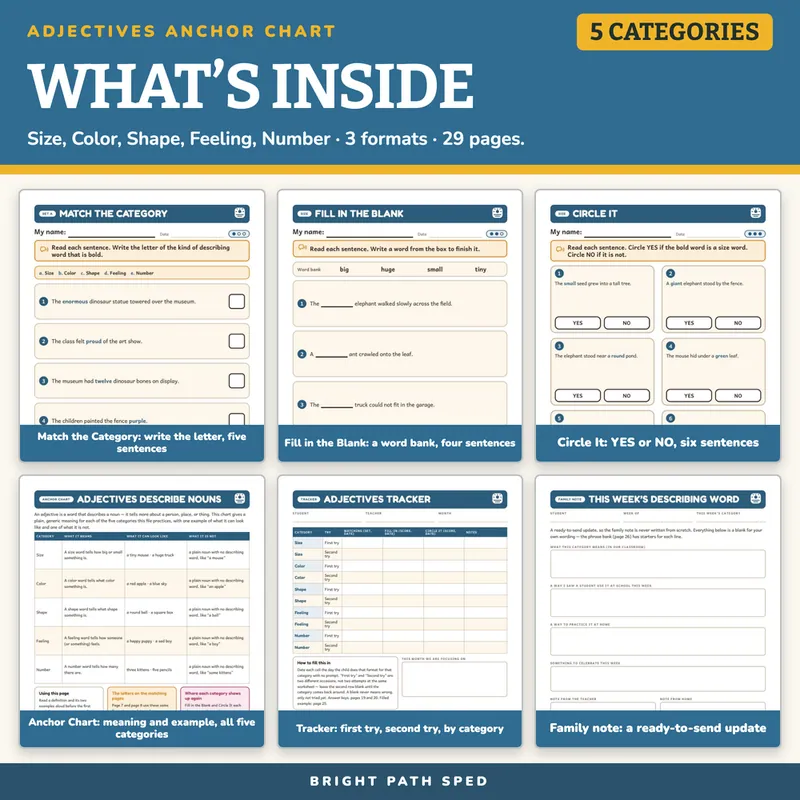
- 1 Adjectives Anchor Chart page: what an adjective is, plus a plain meaning, two examples, and a
non-example for every one of the five categories
- 12 student pages in 3 formats: 2 Match the Category pages (5 sentences each, write the letter), 5 Fill
in the Blank pages (one a category, a 4-word bank), 5 Circle It pages (one a category, 6 sentences
each)
- 60 invented sentences in all, never repeated anywhere in the file
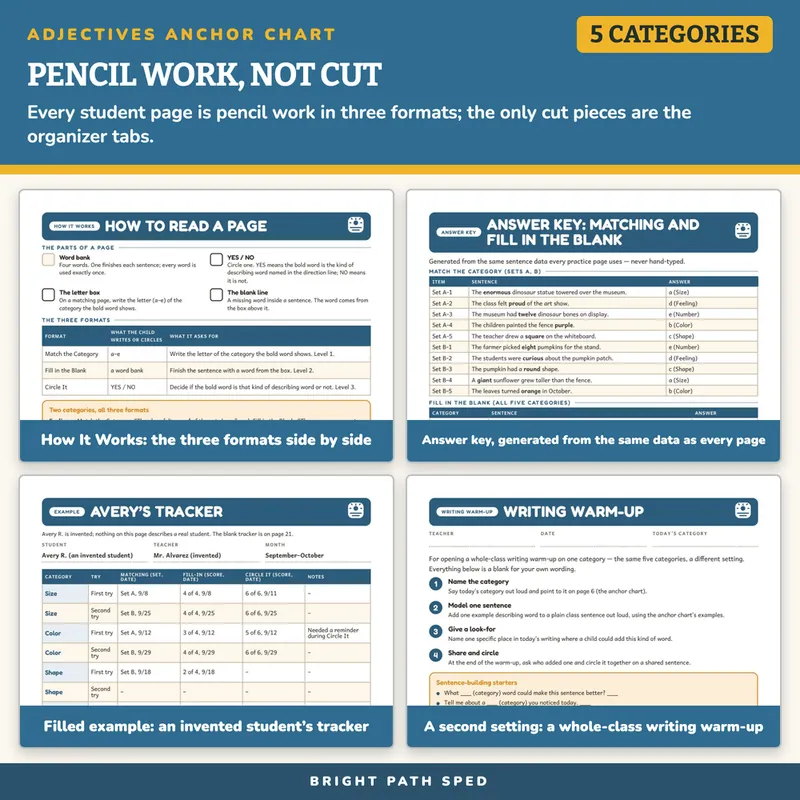
- 2 answer keys, generated from the same sentence data as the student pages
- 1 tracker (first try / second try, by category) and 1 whole-class progress grid
- 1 family note (a ready-to-send update) and 1 writing warm-up (a different setting — whole class, not
individual seatwork)
- 1 filled example (an invented student), 1 phrase bank (14 observable-language starters), 1 binder
cover, and 5 divider tabs with a spine label to cut out
- Start Here, a how-to-read-a-page page, and a contents page that gives every page number
The Three Formats, Easiest To Hardest
1. Match the Category (starting) — five short sentences on a page, each with one bold word; write the
letter (a–e) of the category that word shows. Two full sets (A, B), so all five categories appear on
both pages in a different order.
2. Fill in the Blank (building) — a four-word bank and four sentences about one category; one page a
category.
3. Circle It (ready for more) — six short sentences about one category, three where the bold word shows
it and three where it does not, shuffled; circle YES or NO.
Built For The Child Holding The Page
A big "My name" line, one short instruction, large rounded letters, real room to write or circle, and
dots (not words) to show which level a page is. Nothing on a student page is written for an adult.
Every Sentence Is Invented
Every sentence is generic, concrete K-2 classroom prose — never a real child's name, never a diagnosis,
never a claim about a real student. The filled example names an invented student and says so on the
page.
Type In, Or Print
The name and date lines, the tracker, the class grid, the family note and the writing warm-up are
type-in fields in any PDF reader. The letters and words a student writes are pencil work. This is a
fillable PDF; it is not a Google Slides or PowerPoint file.
Who This Is For
Kindergarten, first and second grade classrooms, self-contained and resource rooms, and any teacher
building adjective vocabulary into a writing block or center. The writing warm-up sends the same five
categories to a whole-class setting; the family note sends them home.
What This Is, And What It Is Not
A grammar worksheet set with the record-keeping around it. It is not a screener, a clinical or
diagnostic tool, or a claim about any student's age or rate of progress. There is no IEP goal language
or eligibility wording anywhere in the file.