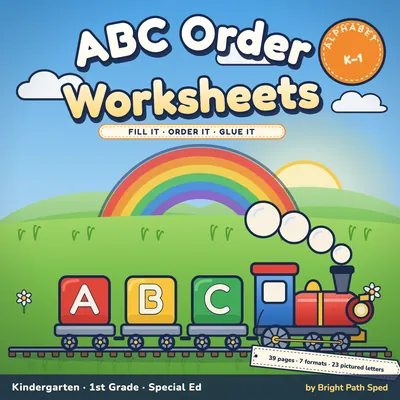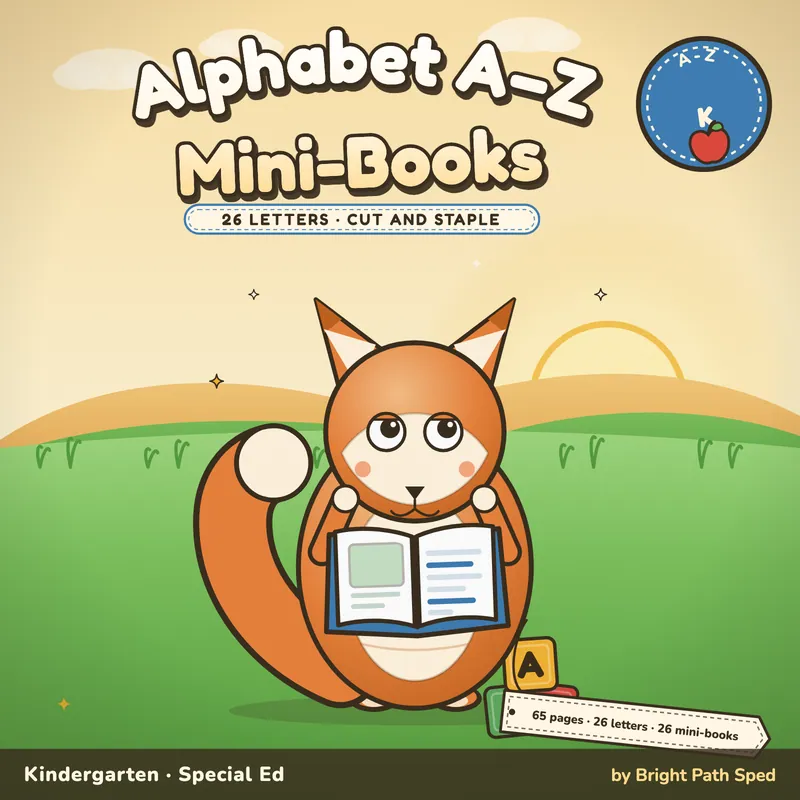
Alphabet Worksheets A-Z Mini-Books
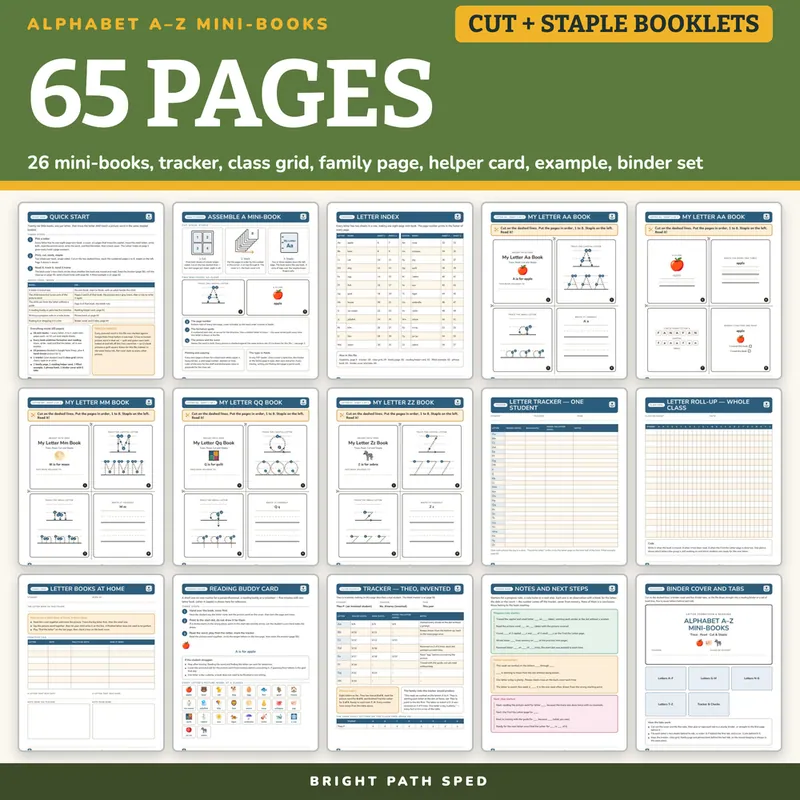
- 65 pages
- PreK, Kindergarten, 1st
$4.00
DownloadOr get it with All-Access: pick any 20 resources a month for $7.
New here? Your first month of All-Access is half off with code TEACHERTOK
Already bought this, or a member?
Instant download. One teacher's license: colleagues need their own copy. Each file carries a license number.
Also on Teachers Pay Teachers: see the Bright Path Sped store
About this resource
A letter book that does two jobs a teacher usually buys separately: it teaches how to FORM the letter,
and it teaches a picture word that starts with it — stapled into one little book a child keeps. Twenty-six
mini-books, one per letter, eight mini-pages each, printed two sheets per book: cut on two dashed lines,
stack the numbered pages, staple on the left.
EVERYTHING INSIDE (65 pages)
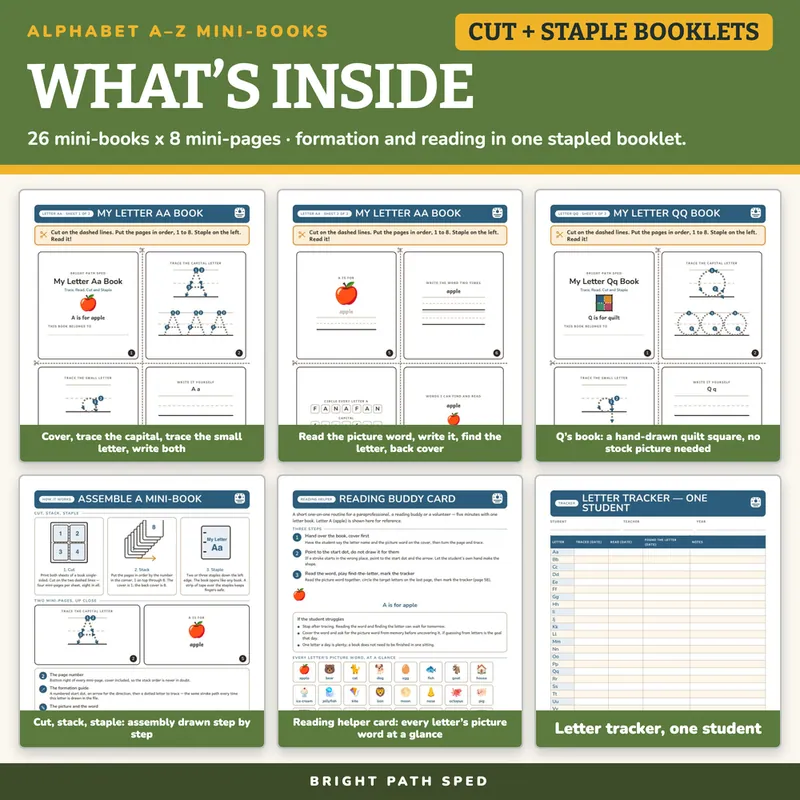
- 26 mini-books, A to Z, 8 mini-pages each, on 52 cut-and-staple sheets (2 sheets per book): a cover with
a name line and the picture word, six activity pages, and a back cover with two check boxes
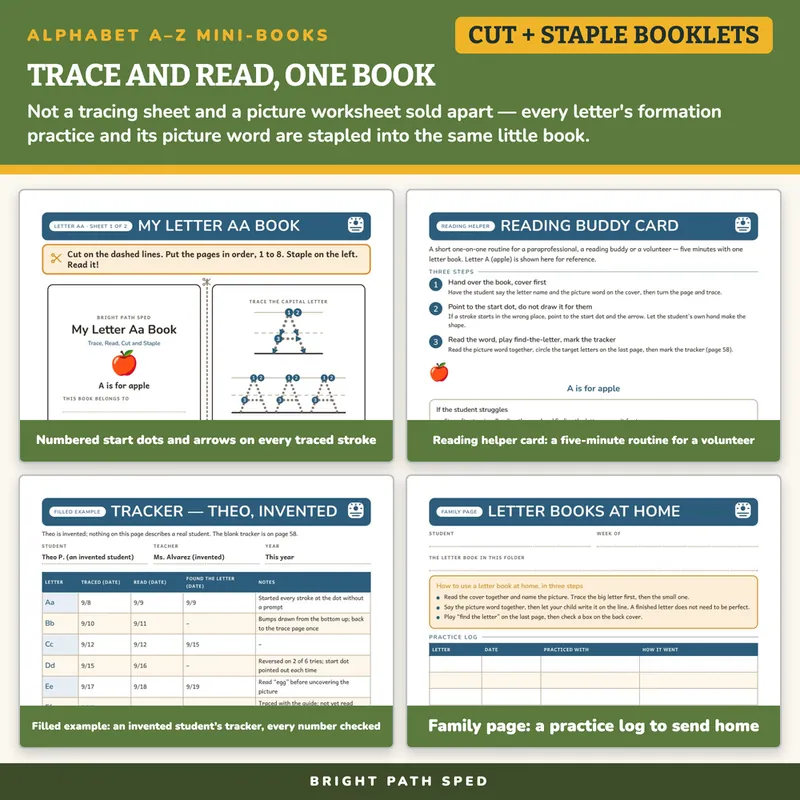
- Every book combines formation AND reading in this order: trace the capital letter (numbered start dot,
direction arrow, dotted trace), trace the small letter, write both from memory, read the picture word
(the word prints in light gray to trace, under the picture), write the word twice, then find the letter
(circle it among two repeating distractor letters, capital and small)
- 25 pictures, every one checked against Google Noto Emoji before use, plus 1 hand-drawn picture: Q has
no honest picture word in this line's word list (quilt and queen were both looked at and left off), so
Q's book pictures a quilt square drawn for this file in the same heavy-ink, flat-color style
- 1 letter tracker (one student, all 26 letters: traced / read / found the letter, with notes) and 1 class
grid (whole class, type-in or print)
- 1 family page (a three-step how-to, a practice log, a note from the teacher and a note from home)
- 1 reading helper card (a five-minute routine for a paraprofessional or volunteer) with a full
quick-reference grid of all 26 pictures and their words
- 1 filled example — an invented student's tracker, every number read off its own table
- 1 phrase bank — progress-note, family-note and next-step starters, each an observation with a blank
- 1 binder cover and 5 divider tabs (Letters A-F, G-M, N-S, T-Z, Tracker and Checks)
- Start Here, an assembly page (cut, stack, staple drawn step by step) and a Letter Index that gives
every book's page numbers
How A Book Goes Together
Two sheets per book, single-sided. Cut on the two dashed lines (four mini-pages per sheet). Stack by the
number printed in the corner of every mini-page, 1 on top through 8. Two or three staples down the left
edge. The assembly page draws all three steps.
Why Q Is Different — Said Plainly
Every pictured word in this file was checked against Google Noto Emoji before it was kept. Q has no
honest picture word in that set for a K classroom, so its book pictures a quilt square drawn for this
file instead — outlined in heavy ink with plain flat-color fills, the same convention as every other
picture. Start Here and the assembly page both say so.
Type In, Or Print
The name line on every mini-book cover, the tracker, the class grid and the family page are type-in
fields in any PDF reader. The tracing, writing and letter-finding mini-pages are pencil work. This is a
fillable PDF; it is not a Google Slides, Google Docs or PowerPoint file.
Who This Is For
Self-contained, resource and early-intervention rooms, and any PreK-1st classroom teaching letter
formation and letter sounds together instead of as two separate units. Pairs with this store's Letter
Formation Handwriting Tracing Practice A-Z (the same stroke paths at full size, three levels) and CVC
Word Family Decodable Mini-Books (the next step, cut-and-staple books built from words a beginning
reader can sound out).
What This Is, And What It Is Not
A print-and-assemble set of letter mini-books with the record-keeping around it. It is not a reading
curriculum, not a handwriting curriculum, and not a claim about any student's age or rate of progress.