Appropriate vs Inappropriate Behaviors Sort Cards
- 23 pages
- Not Grade Specific
$3.50
DownloadOr get it with All-Access: pick any 20 resources a month for $7.
New here? Your first month of All-Access is half off with code TEACHERTOK
Already bought this, or a member?
Instant download. One teacher's license: colleagues need their own copy. Each file carries a license number.
Also on Teachers Pay Teachers: see the Bright Path Sped store
About this resource
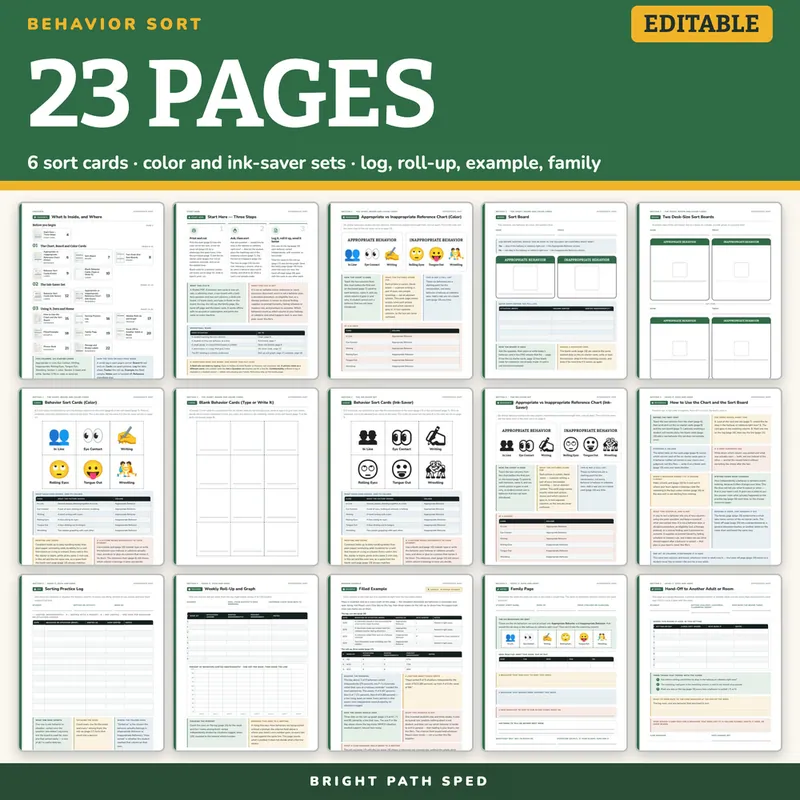
EVERYTHING INSIDE — 23 pages, 221 type-in fields
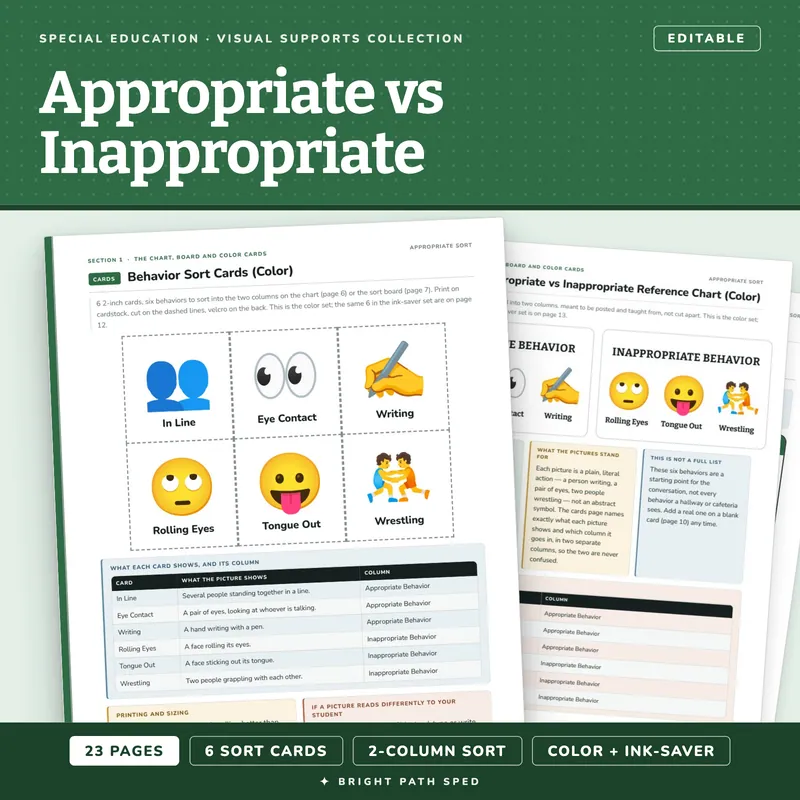
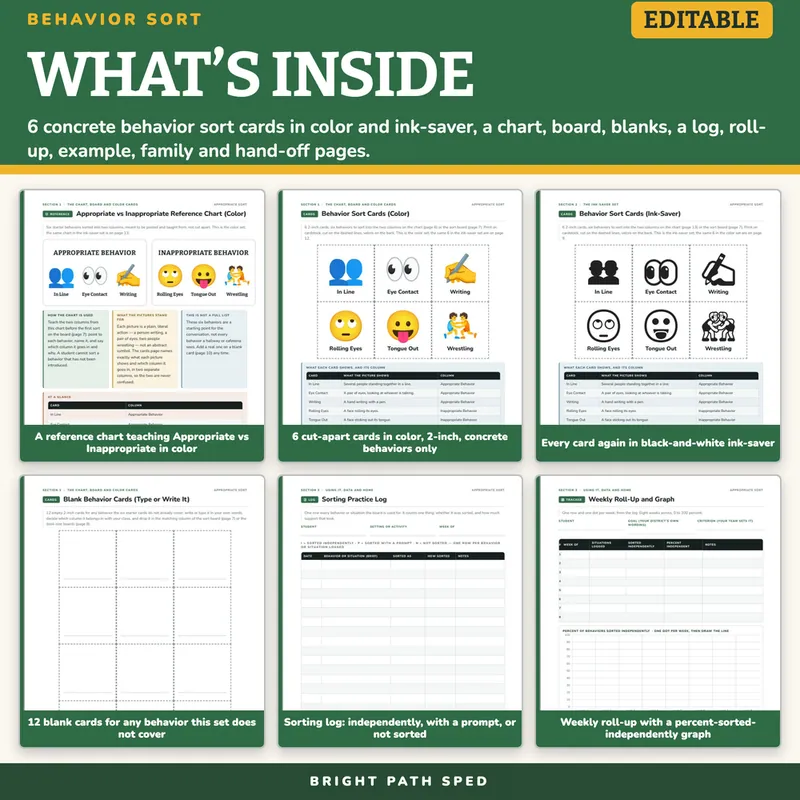
- A reference chart teaching two columns, Appropriate Behavior and Inappropriate Behavior, with 3 concrete behaviors sorted under each
- A sort board with a one-question check ("Would this be okay in the hallway or cafeteria right now?"), two sort columns, and a quick-sorts table
- Two desk-size copies of the sort board on one sheet, for a folder or small group
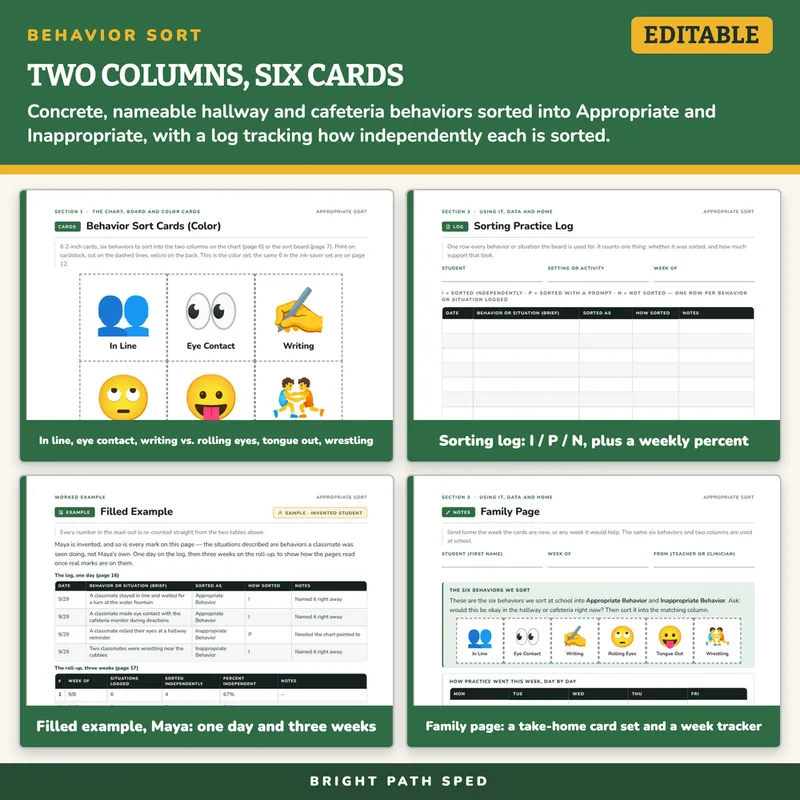
- 6 cut-apart behavior cards, 2 inches square: In Line, Eye Contact, Writing (Appropriate) and Rolling Eyes, Tongue Out, Wrestling (Inappropriate)
- Every card and the chart twice: a full-color set and a black-and-white ink-saver set for the photocopier
- 12 blank behavior cards with a type-in line, for any real hallway or cafeteria behavior this starter set does not cover
- A how-to page: before the first sort, the three moves every time, choosing a column, when a sort surprises you, what the log marks mean
- A Sorting Practice Log (16 rows: date, behavior or situation, column sorted, how sorted, notes)
- A weekly roll-up (8 weeks) with a percent-sorted-independently graph
- A filled example — an invented student, one day on the log and three weeks on the roll-up, every percent re-counted from its own row
- A family page with a small take-home version of all six cards and a week of tracking
- A hand-off page so a paraprofessional or another classroom runs the same chart and board the same way
- A phrase bank: 22 lines in 6 groups (spoken lines for each sort, written starters for the log, the roll-up and the note home)
- A storage and binder label sheet
- Start Here, a contents page with page thumbnails, and a "what's next" back page
A two-column sort, not an abstract symbol chart: every behavior is a concrete, nameable action a child names in one word or a short phrase — people standing in a line, a pair of eyes, a hand writing, a face rolling its eyes, a face sticking out its tongue, two people wrestling — never a zipper-mouth face, a thumbs-down or an hourglass standing in for a judgment no one can name on sight. This set is built for the hallway and cafeteria conduct a teacher actually names "appropriate" or "inappropriate," not the classroom-routine framing a different sort in this collection already covers, so none of its six behaviors repeat another single's word-and-picture pair. The chart teaches the two columns before the first sort; the board, the cards and the log turn "can this student tell an appropriate behavior from an inappropriate one" into a line on a page a case manager can bring to a meeting.
The Six Starter Cards
Appropriate Behavior — In Line (people standing together, in a line), Eye Contact (a pair of eyes, looking at the speaker), Writing (a hand writing with a pen)
Inappropriate Behavior — Rolling Eyes (a face rolling its eyes), Tongue Out (a face sticking out its tongue), Wrestling (two people grappling with each other)
Every picture was chosen to be named in one short phrase by a young child, cold, in color AND in the black-and-white ink-saver set. The card is labeled for the literal action a child sees (In Line, Rolling Eyes, Wrestling), not for the judgment it stands for; the cards page's own reference table names which column each one goes in, the same "label the picture, not the concept" rule this collection uses everywhere. In Line and Eye Contact reuse pictures this collection already uses elsewhere for a related meaning (lining up, looking at a speaker), under fresh captions, so the pictures never carry two conflicting meanings across the store. These six are a starting point for a class discussion, not a closed or exhaustive list — 12 blank cards let a teacher add a real behavior their own hallway or cafeteria sees.
What This Is, And What It Is Not
It is a fillable PDF: type into the log, the roll-up, the family page, the hand-off page and the blank cards, or print and use a pen. The chart and card pages print on cardstock or plain paper and cut along dashed lines. It works offline with no account or subscription. It is NOT an editable online slideshow or word-processor document.
It is a way to sort a behavior into one of two columns using one plain question, and a place to record how independently that sorting happens. It is not a behavior plan, a discipline procedure, an eligibility tool, a therapy protocol, or a clinical finding, and it supplies no prompt hierarchy, fading schedule or mastery rule. It promises no outcome; which behaviors count as which column in a real hallway or cafeteria, and what happens after one is sorted, is your team's own plan. The goal line and the criterion field on the roll-up are blanks for your district's own wording and your team's own number. Every situation on the filled example describes a classmate's behavior being sorted for practice, never a real student's own conduct being tracked for a discipline record.
Who This Is For
Special education teachers and paraprofessionals teaching the appropriate/inappropriate behavior discrimination skill for the hallway, cafeteria and other shared spaces, case managers who need that work to show up as data, and the families who get the home page sent home.
More In The Collection
Part of the Visual Supports Collection alongside Expected vs Unexpected Behavior Sort Cards, Safe Body and Safe Hands Sort Cards and Lesson, and Manners and Polite Language Cue Cards; more picture-card sets are being added to the collection regularly, all on the same cards-plus-data shape.
Pictures (color pages): Noto Emoji by Google, Apache License 2.0. Pictures (ink-saver pages): Fluent Emoji, Copyright (c) Microsoft Corporation, MIT License.