Area and Perimeter Game
- 20 pages
- 3rd, 4th
$1.75 $3.50 on Teachers Pay Teachers
Half the Teachers Pay Teachers price. The same PDF, sold direct.
DownloadOr get it with All-Access: pick any 20 resources a month for $7.
New here? Your first month of All-Access is half off with code TEACHERTOK
Already bought this, or a member?
Instant download. One teacher's license: colleagues need their own copy. Each file carries a license number.
Also on Teachers Pay Teachers: see the Bright Path Sped store
About this resource
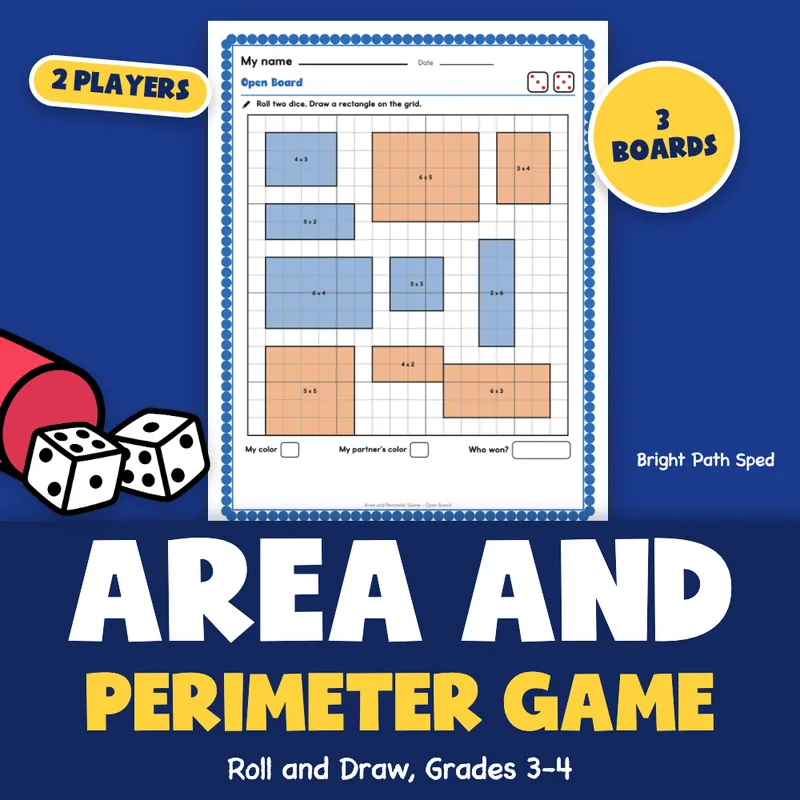
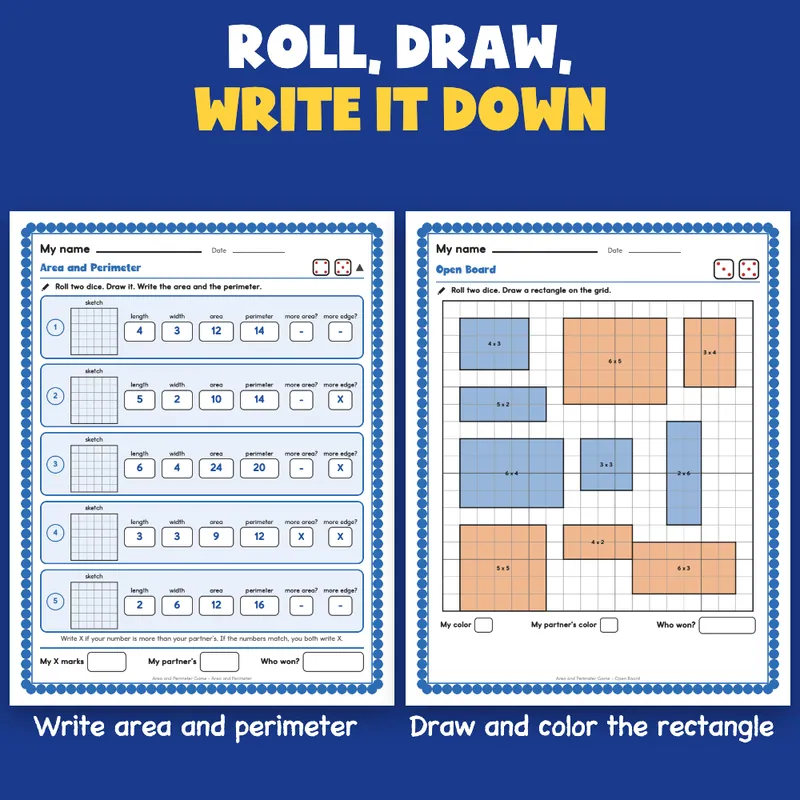
Two players, two dice and a grid. Roll, draw a rectangle on the board, color it in, then work out its area and perimeter. This is a print-and-play area and perimeter game for grades 3-4 with four recording sheets, so one board can practice area only, perimeter only, both together, and a same-area challenge. The recording sheets are type-in fillable PDF pages.
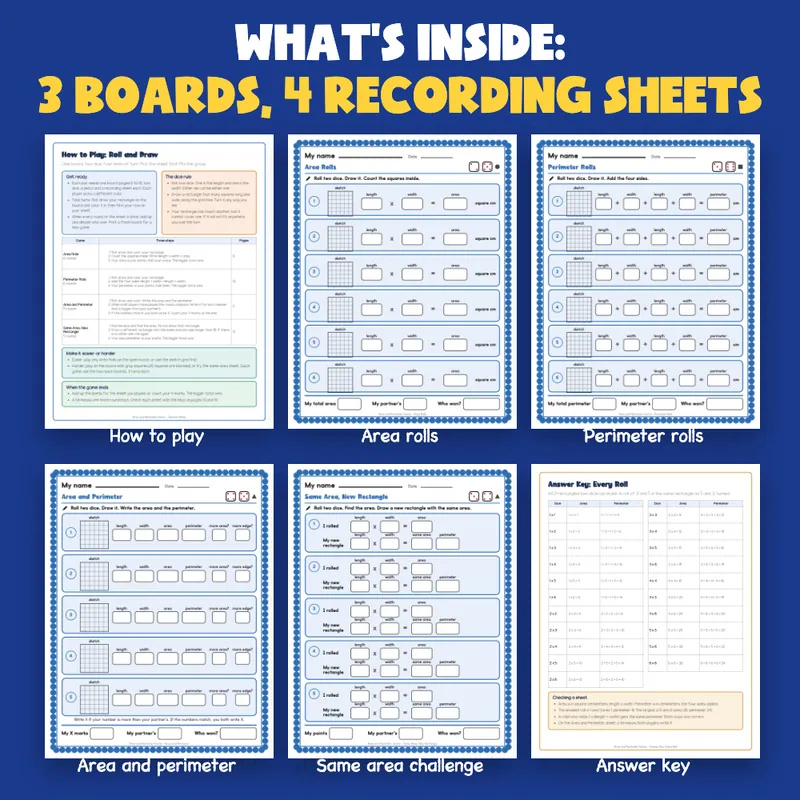
WHAT IS INCLUDED (20 pages)
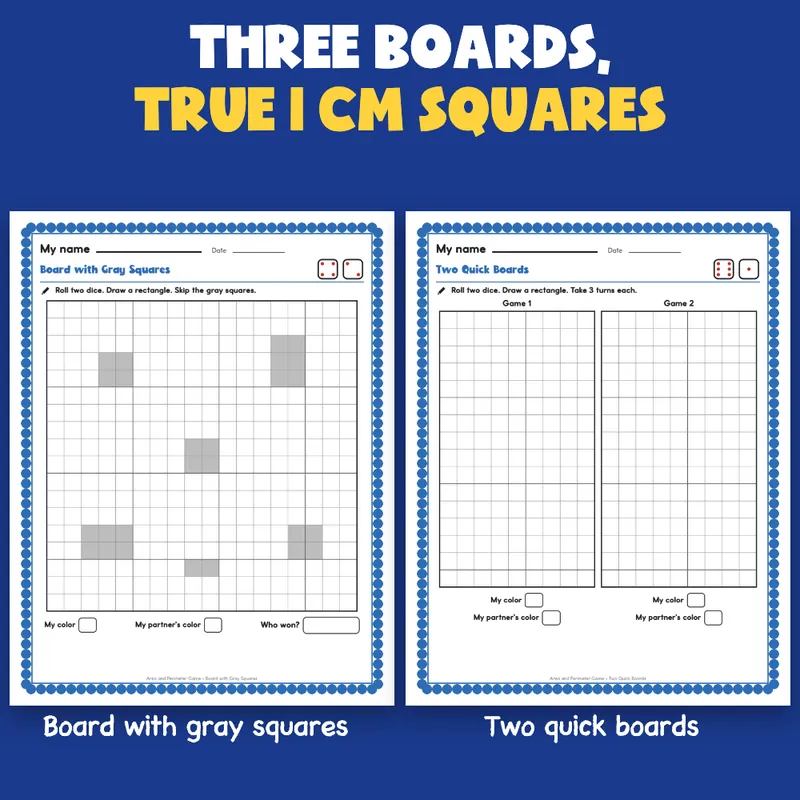
- Three game boards drawn in true 1-centimeter squares (print at 100 percent and a ruler agrees): an open 18 by 18 board, a board with gray blocked squares, and a page with two quick 9 by 16 boards.
- Four recording sheets, each marked with a small shape: Area Rolls (six rounds: length x width = area, with a sketch grid), Perimeter Rolls (six rounds: add the four sides), Area and Perimeter (five rounds: write both, then mark an X for each number bigger than your partner's) and Same Area, New Rectangle (five rounds: roll for an area, then draw a different rectangle with the same area and score its perimeter).
- A rules page with the dice rule, the three steps for each sheet, and easier and harder ways to play.
- A teach-the-words page: area and perimeter shown on one 5 by 3 rectangle, with every inside square counted 1 to 15 and every edge side counted 1 to 16, plus a modeled turn for each sheet.
- Two answer key pages: area and perimeter of all 21 rectangles two dice can make, and every same-area rectangle with its perimeter for all 18 areas two dice can make.
- Start Here with a which-page-when table, a tracker with a roll-up, a filled example (invented students Theo and Nia, ten rectangles on one board), a filled tracker, a family page, What's Next, terms of use and a thank-you page.
How To Play
1. Each pair of players needs one board, two dice, a pencil, a recording sheet each and two colored pencils or crayons.
2. Roll two dice. One is the length and one is the width, and either die can be either one. Draw that rectangle along the grid lines and color it in. It can touch another rectangle but cannot cover one. If it will not fit, you lose the turn.
3. Fill in your row on your sheet: the area, the perimeter, or both.
4. When the rounds are done, add up your points (or count your X marks). The bigger total wins.
Built For The Child Holding The Page
Every student page has a "My name" line, one short direction with a picture and big boxes with room to write. The boards are plain grid lines, so they copy cleanly in black and white. The pages use only grids, numbers and dice drawn as dots: nothing to distract a child from the rectangle.
Type In, Or Print
The name lines and the answer boxes on the recording sheets are type-in fields in any PDF reader. Print a board and color it with two pencils, or print any sheet and write by hand. Print at 100 percent with fit-to-page turned off. This is a fillable PDF for printing and typing; it is not a slide or word processor file.
Who This Is For
Teachers of grades 3-4, resource rooms and self-contained classrooms who want a math center or small-group game for area and perimeter without making anything themselves. The sheets step up from area only, to perimeter only, to both, to the same-area challenge, so a group can work at different points on the same board.
What This Is, And What It Is Not
Working paper and a board game for practicing area and perimeter of rectangles. It is not a full math curriculum, an assessment or a therapy program, and it makes no health claims. Your school decides what a child should be able to do and when.
More For Your Math Block
Pair it with Area and Perimeter Project, Array Game, Break Apart Multiplication Games and Multiplication Flash Cards, all live from Bright Path Sped.