Area and Perimeter Task Cards
- 29 pages
- 3rd, 4th
$2.00 $4.00 on Teachers Pay Teachers
Half the Teachers Pay Teachers price. The same PDF, sold direct.
DownloadOr get it with All-Access: pick any 20 resources a month for $7.
New here? Your first month of All-Access is half off with code TEACHERTOK
Already bought this, or a member?
Instant download. One teacher's license: colleagues need their own copy. Each file carries a license number.
Also on Teachers Pay Teachers: see the Bright Path Sped store
About this resource
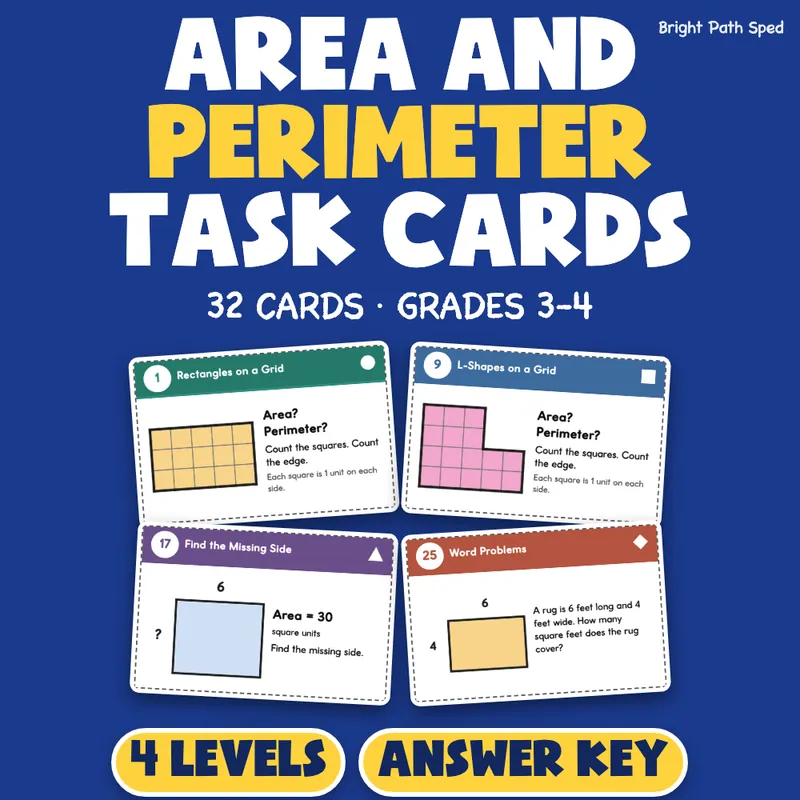
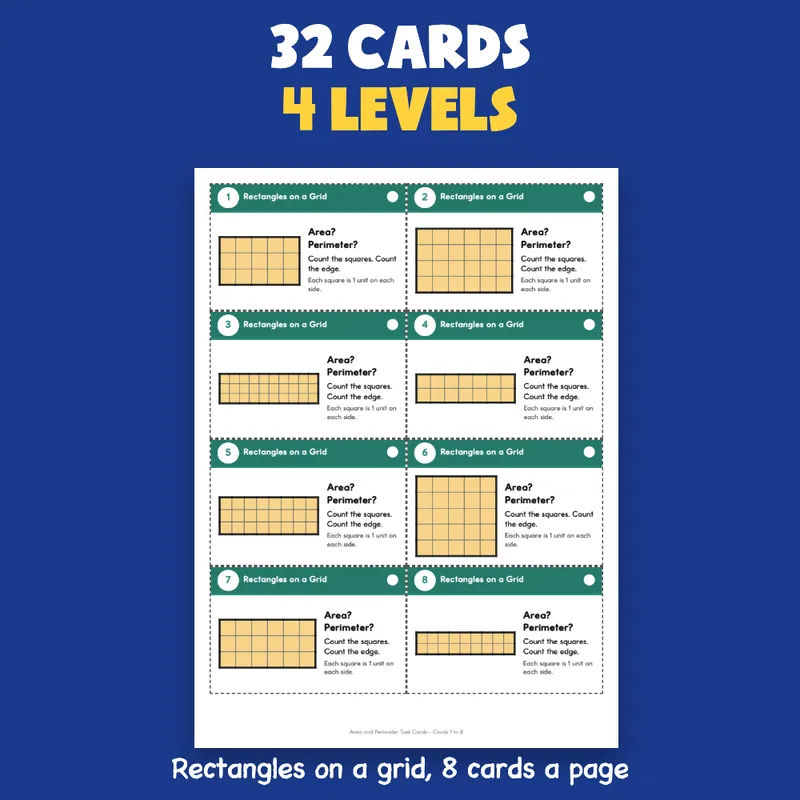
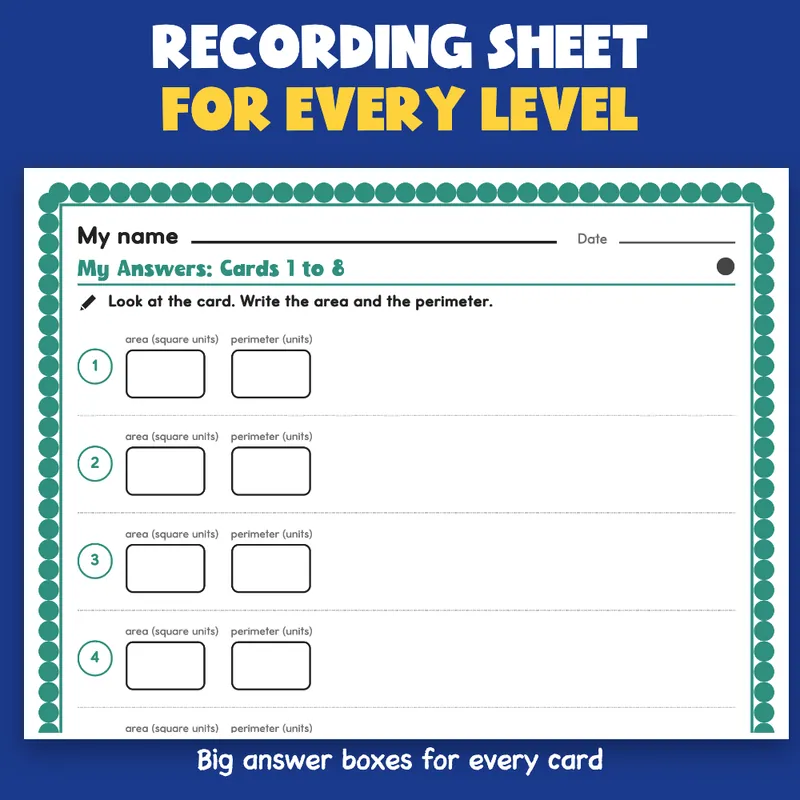
Looking for area and perimeter task cards where students can actually count the squares? This set has 32 numbered task cards in four levels of 8. The grid cards are drawn with real unit squares, so a student can count the area inside and walk the perimeter around the edge. Then the cards move to L-shapes, missing sides, and word problems. Cards print 8 to a sheet, edge to edge, so you cut a few straight lines and laminate. Students answer on a recording sheet with big answer boxes, and every answer is in the key with the work shown.
EVERYTHING INSIDE (29 pages)
- 32 task cards in 4 levels of 8, each card 3.7 by 2.4 inches, on four card sheets (one level a sheet).
- Level 1, Rectangles on a Grid (circle): a rectangle drawn with unit squares. Find the area and the perimeter.
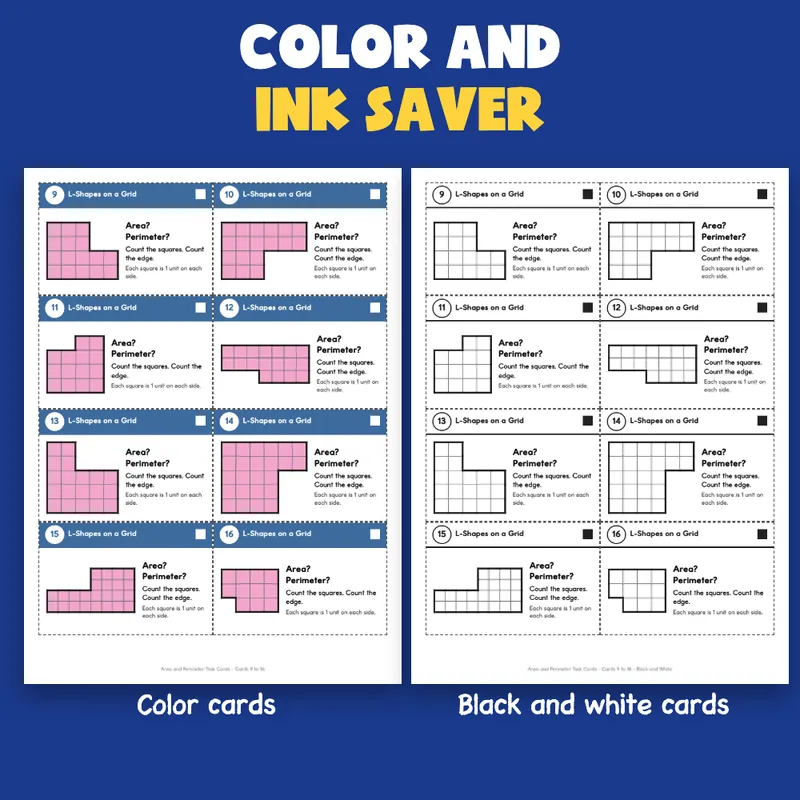
- Level 2, L-Shapes on a Grid (square): an L-shape drawn with unit squares, with the cut-out corner in each of the four corners. Find the area and the perimeter.
- Level 3, Find the Missing Side (triangle): the area or the perimeter and one side are printed. Find the missing side, then the other measure. 4 cards give the area and 4 give the perimeter.
- Level 4, Word Problems (diamond): 8 short story problems, each with a labeled picture: 2 area, 2 perimeter, 2 missing side, and 2 L-shaped regions (one area, one perimeter). Students show their work, write the answer and name the unit.
- A black-and-white copy of all 4 card sheets, outlines only and no color, in the same order, to save ink.
- 4 recording sheets, one for each level, 8 rows each, with a "My name" line, the card numbers and big answer boxes. The word-problem sheet has a work space on every row.
- 8 Check It cards, "Which one is right?": each shows a rectangle on a grid and two answers, one right and one wrong. A recording sheet has A and B check boxes and three reasons to choose from (area and perimeter were mixed up, only two sides were added, the sides were added and not multiplied).
- A cut-and-sort: 12 equal cards (6 about area and 6 about perimeter) and a two-box sort mat, with room for 6 cards in each box. Students cut 3 across and 4 down.
- 1 steps poster with a worked grid example: look, area, perimeter, check.
- 3 answer key pages: every card with the work shown, every Check It card with the reason, and every sort card.
- Start Here and a how-to-use page (prep and cutting, three ways to run the cards, what to say when an answer is wrong).
- 1 tracker, 1 class progress grid, 1 filled example (an invented student), 1 family page, and a thank-you page with what's next.
How A Student Uses It
1. Look at the steps poster once: look, area, perimeter, check.
2. Take a card. Count the squares inside, then trace the edge.
3. Write the answers on the recording sheet for that level.
4. Check with the key, or swap with a partner.
5. Try the Check It cards to catch a mixed-up answer, then sort what is about area and what is about perimeter.
The Answers
Every card's answer is computed from the same numbers that draw its picture, and each grid is checked by counting its squares and its outline back. The key shows the area and the perimeter for Levels 1 and 2, the missing side and the other measure for Level 3, and the answer with its unit for Level 4, each with the work. On the Check It cards the right answer is A on 4 cards and B on 4 cards, and the key names the reason the other answer is not right.
Built For The Student Holding The Page
A student page has a big "My name" line, one short instruction with a small picture cue, answer boxes at least half an inch tall, and a plain colored border. Nothing on a student page is written for an adult: keys, tracker and directions are on separate teacher pages. The four levels are marked with a small shape (circle, square, triangle, diamond) so you can hand a student the one that fits today.
Invented Examples
Every name and number in the file is made up for practice. The filled example, "Dev R.", is an invented student and says so on the page. The tracker is a working paper with a blank line for your own standard.
Type In, Or Print
The name line and every answer box and check box on the recording sheets are type-in fields in any PDF reader: click one, type, then save. The tracker, class grid and family page are type-in too. The task cards are meant to be printed and cut. This is a fillable PDF; it is not a Google Slides or PowerPoint file.
Standards
Supports finding area by counting unit squares and by multiplying (3.MD.C.7), perimeter of polygons and missing sides (3.MD.D.8), and applying the area and perimeter formulas to rectangles in word problems (4.MD.A.3). Standard numbers are named as a reference only; check your own state's wording.
Who This Is For
Third and fourth grade teachers, special education and resource rooms, math intervention groups, co-taught classes, tutors, and substitutes who need a set that is ready to hand out.
What This Is, And What It Is Not
A task card set with the recording and record-keeping around it. It is not a timed test, a screener, a clinical tool, or a claim about any student's age or rate of progress. There is no IEP goal language or eligibility wording anywhere in the file.
If You Want More
More area and perimeter for the same students: Area and Perimeter Anchor Chart | Posters, Formulas, Grid Examples Gr 3-4, Area of Irregular Shapes Worksheets | Decompose Rectilinear Figures Grade 3-4, and Area and Perimeter of Rectangles Progress Monitoring Probes | IEP Goal Data.