Auditory Memory Progress Monitoring Probes
- 24 pages
- Kindergarten, 1st, 2nd, 3rd, 4th, 5th
$1.75 $3.50 on Teachers Pay Teachers
Half the Teachers Pay Teachers price. The same PDF, sold direct.
DownloadOr get it with All-Access: pick any 20 resources a month for $7.
New here? Your first month of All-Access is half off with code TEACHERTOK
Already bought this, or a member?
Instant download. One teacher's license: colleagues need their own copy. Each file carries a license number.
Also on Teachers Pay Teachers: see the Bright Path Sped store
About this resource
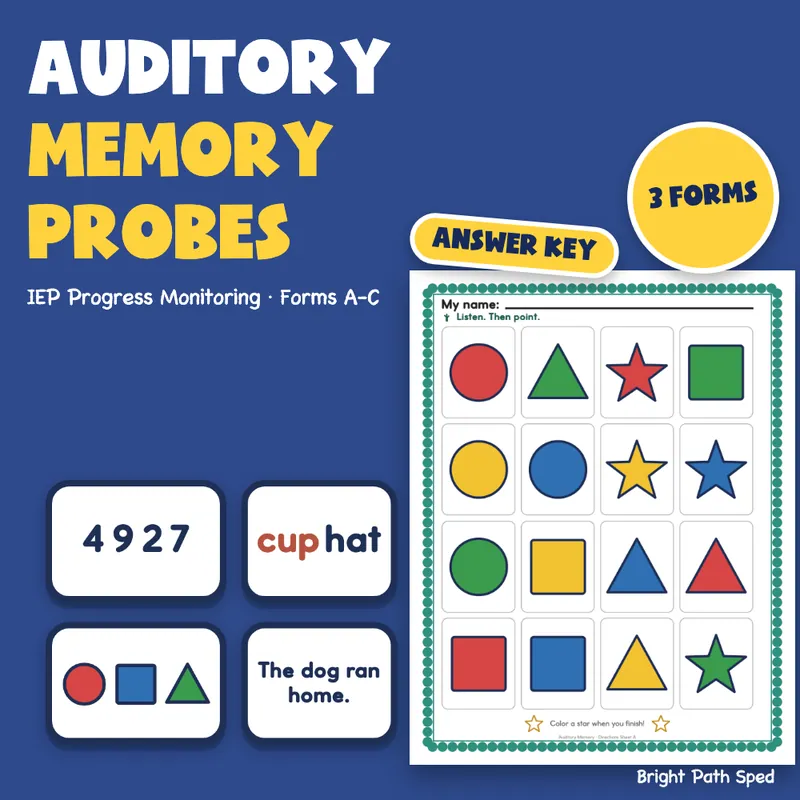
Auditory memory, one skill, start to finish. An IEP goal frame, three equivalent forms of digit strings, word lists, sentences and directions, a score-by-length table, an answer key, and a graph scaled to the probe. Baseline on Monday, goal written by Tuesday, first data point on Friday.
You read each item aloud once. The student says it back, writes it, or points on a sheet of shapes. That is all it measures: recall of what was just heard. Digit strings run from 2 to 6 digits, word lists from 2 to 6 unrelated one-syllable words, sentences from 4 to 10 words, and directions from 1 to 3 steps. Every form has the same plan, the same lengths and the same number of items at each length, so a score means the same thing from one week to the next.
WHAT IS INCLUDED - 24 sheets: three forms (A, B and C) with 37 items each, 111 items in all. Each form has 10 digit strings, 10 word lists, 8 sentences and 9 directions. In all: 30 digit strings, 30 word lists (120 different words, none used twice), 24 sentences and 27 directions (54 steps), plus a goal frame, a score-by-length table, an answer key, a graph and data log, a caseload summary, a filled-in example, a family update sheet and a binder cover with divider tabs.
Start Here (Sheet 3)
- The seven steps from baseline to decision, a five-minute weekly routine, and print and prep notes
A Binder Cover And Divider Tabs (Sheet 4)
- A binder cover with student, case manager and school year fields
- Six divider tabs, one per section of this file, print and cut
The Goal Sheet (Sheet 5)
- A sample goal with every bracket meant to be edited by the team
- The six-part goal frame as type-in fields
- A baseline table: three probes and the median
- Three benchmark rows with target date, target score, actual score and met
- Giving-and-scoring directions, and lines for this student's pace, answer type and scoring rules
Score By Length (Sheet 6)
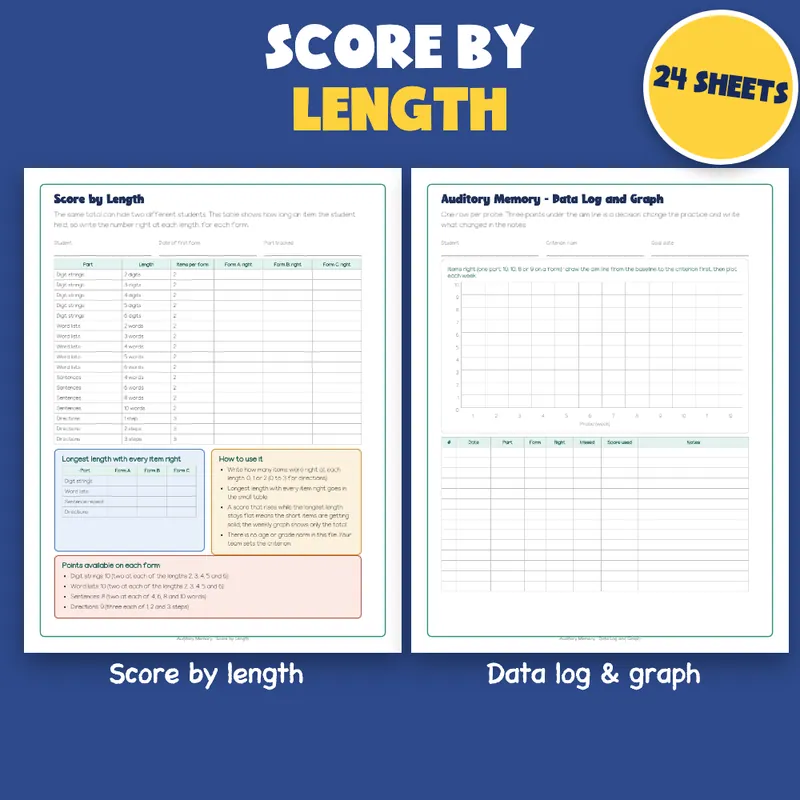
- 17 rows, one for each length: digit strings of 2, 3, 4, 5 and 6 digits, word lists of 2, 3, 4, 5 and 6 words, sentences of 4, 6, 8 and 10 words, directions of 1, 2 and 3 steps
- Type-in cells for how many were right at each length on Form A, B and C, plus a small table for the longest length with every item right
- The most points on each form: 10, 10, 8 and 9
Student Sheets (Sheets 7-11)
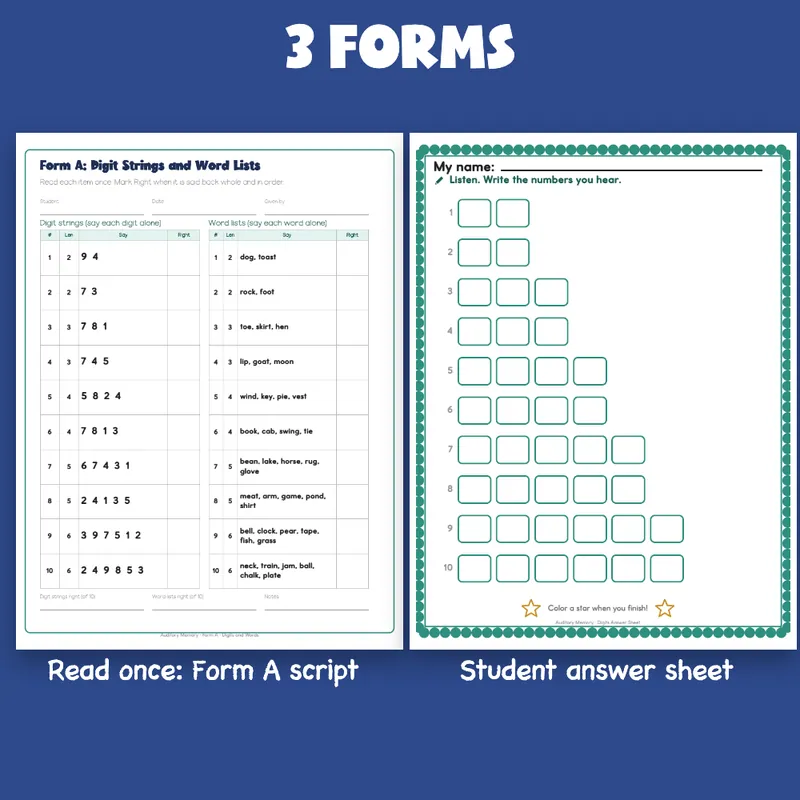
- A digits answer sheet and a words answer sheet: a big My name line, one short instruction, and a row of boxes for each item, as long as the item (sheets 7 and 8)
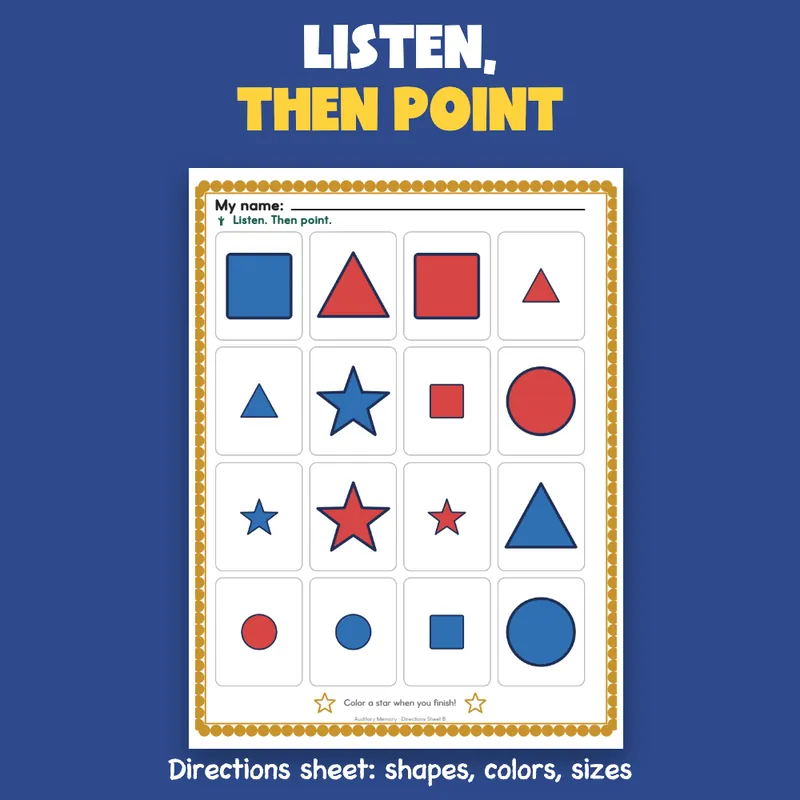
- Three directions sheets (A, B and C) of 16 plain shapes each: circle, square, triangle, star on two of them, heart, diamond, rectangle, oval on the third; colors on all three and big and small sizes on one (sheets 9 to 11)
Six Scripts To Read From (Sheets 12-17)
- For each form, one sheet with the 10 digit strings and 10 word lists and one with the 8 sentences and 9 directions
- Large type, a Right box beside every item, and score boxes at the foot
An Answer Key (Sheet 18)
- For every direction on all three forms, where the student should point, in order, by row and spot
- Points on each form and how to score each part, item by item
Teacher Notes And A Phrase Bank (Sheet 19)
- Where an item broke: stopped early, order changed, something added or left out, a step skipped
- Five observation phrases for the notes column, and who can give the probe
The Data Log And Graph (Sheet 20)
- A y-axis already scaled 0 to 10, twelve probe columns, and the instruction to draw the aim line from the baseline to the criterion first
- A 14-row log with date, part, form, number right, number missed, the score used on the graph and notes
The Caseload Summary (Sheet 21)
- Twelve student rows, baseline and criterion, eight probe columns and a decision column
A Worked Example (Sheet 22)
- Maya, third grade, invented. Twelve rows of digit-string probes: the baseline as a median, three points under the aim line prompting a change, the criterion met, and the progress-report sentence the log produces
A Family Update And Team Handoff Sheet (Sheet 23)
- A family update with blanks for this week's score, a team handoff checklist for a paraprofessional or substitute, and a meeting summary sentence with blanks for two numbers off the log
What This Is, And What It Is Not
It is a fillable PDF. The goal sheet, score-by-length table, scripts, data log, caseload sheet and family update sheet are type-in fields: open the file in a PDF reader, click a line or a cell, type, and Save As once per student. The student sheets print clean: the student writes or points on paper.
Who This Is For
Special education teachers and case managers in kindergarten through fifth grade writing a goal on listening and recall, intervention teachers, speech-language and resource staff who keep their own data, and the paraprofessionals who give the weekly probe.