Auditory Processing and Discrimination Data Sheets Editable
- 24 pages
- Not Grade Specific
- PDF, fillable
$3.50
DownloadOr get it with All-Access: pick any 20 resources a month for $7.
New here? Your first month of All-Access is half off with code TEACHERTOK
Already bought this, or a member?
Instant download. One teacher's license: colleagues need their own copy. Each file carries a license number.
Also on Teachers Pay Teachers: see the Bright Path Sped store
About this resource
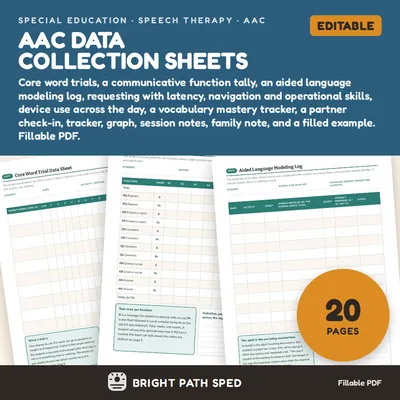
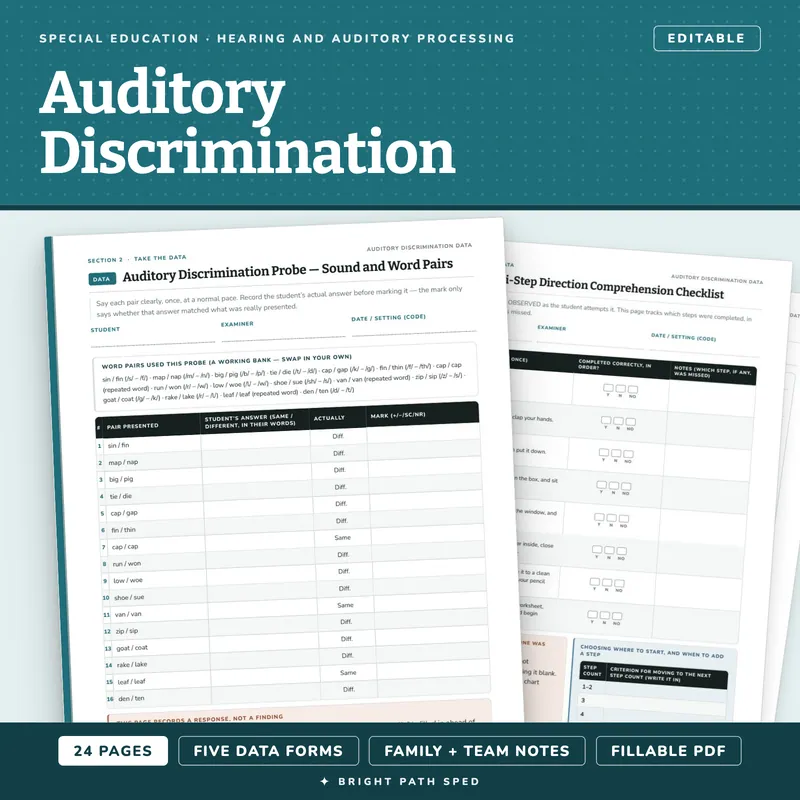
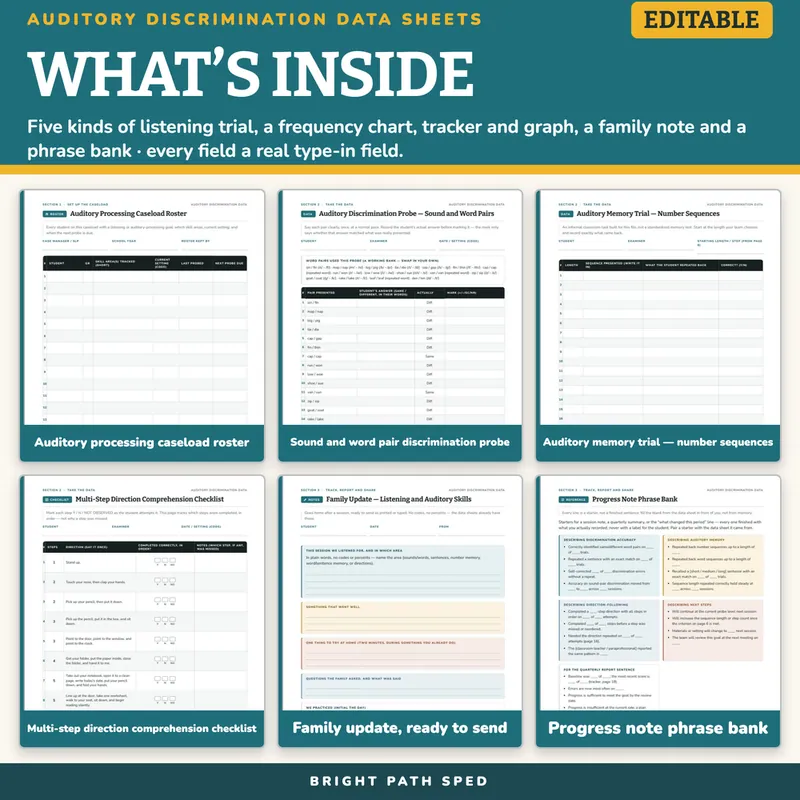
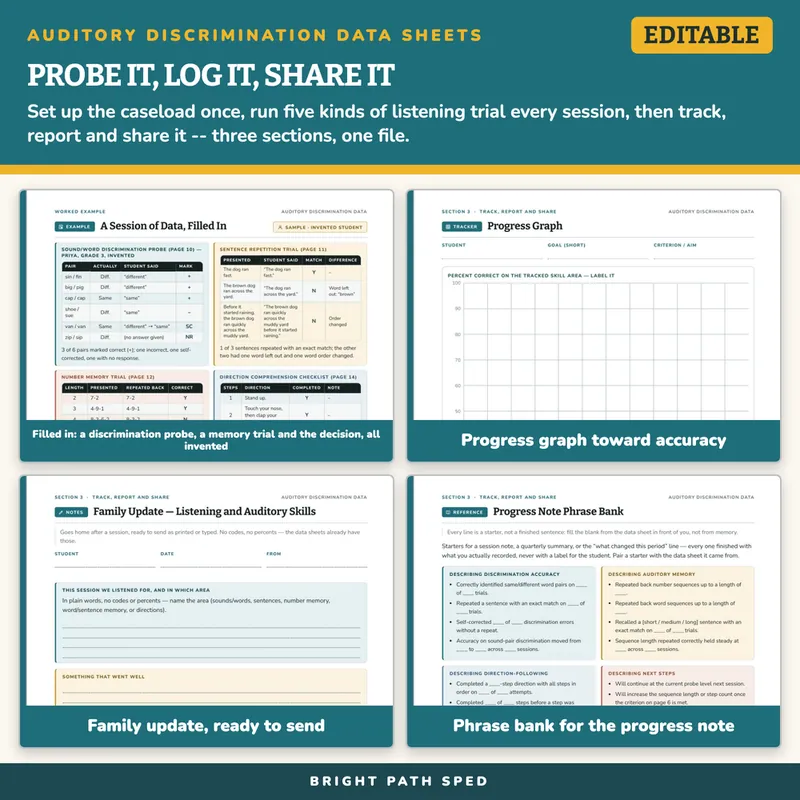
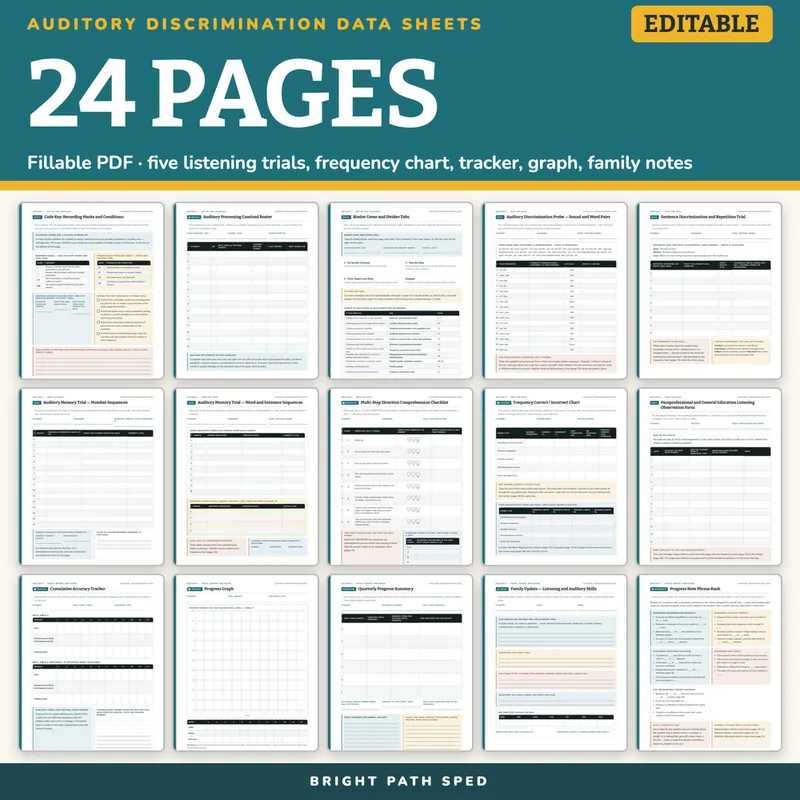
Everything inside: 24 pages, 651 type-in fields · five kinds of listening trial (sound/word discrimination, sentence repetition, number memory, word/sentence memory, multi-step directions) · a within-session frequency chart with a 4-session quick-trend table · a whole-caseload roster · a binder cover and 4 cut-out tabs · a 2-skill-area, 12-session tracker and graph · a quarterly summary · a family update · a 20-starter phrase bank · a simplified paraprofessional form · a worked, invented example.
Speech-language pathologists, audiologists and special educators are asked to show whether a listening or auditory-processing goal is changing, not just whether a screening happened. This file is the trial-data companion: run a sound-pair discrimination probe, a sentence repetition trial, a number or word/sentence memory trial, or a multi-step direction checklist, mark what the student actually said or did, add the session up on one chart, and roll it into a report and a family update that write themselves. Every mark on every page says only whether a recorded answer matched what was actually presented or actually true — never a score against a published norm, a name for a condition, or a rule for when a referral is warranted.
WHAT IS INCLUDED — 24 pages
Set Up The Caseload
- Code Key: Recording Marks and Conditions — 4 response marks (+/−/SC/NR), 4 presentation-condition codes (quiet/noisy, presented once/twice), a starting-length/step-size box for the memory trials, and a 4-item "before the first session" setup checklist, every descriptor a blank line the team defines
- Auditory Processing Caseload Roster — 14 rows: student, skill area(s) tracked, current setting, last probed, next probe due
- Binder Cover and Divider Tabs — a spine/cover card, 4 cut-out tabs matching the file's sections, and an 11-row "where to find things" index
Take The Data
- Auditory Discrimination Probe: Sound and Word Pairs — a 16-pair working word bank (13 different-sound pairs, 3 identical-word pairs, so the task cannot be passed by always answering "different") with the actual same/different fact printed ahead of time, and a row for the student's own answer and the mark
- Sentence Discrimination and Repetition Trial — 9 rows, a 3-sentence illustrative bank at short/medium/long length, a verbatim-transcript column, a match column, and a "types of difference" reference card
- Auditory Memory Trial — Number Sequences — 16 rows across increasing sequence lengths, a "longest correct length" summary box and a session-context write-on card, stated on the page as an informal, invented task, not a standardized memory test
- Auditory Memory Trial — Word and Sentence Sequences — a 10-row word-sequence table, a 4-row sentence-length recall table, and a "longest length, each kind" summary box
- Multi-Step Direction Comprehension Checklist — 8 directions across 1 to 5 steps, each with a Y/N/NOT OBSERVED mark and a notes column for which step (if any) was missed, plus a "choosing where to start" step-count reference table
- Frequency Correct/Incorrect Chart — one row per probe type (5 rows) tallying presented/correct/incorrect/self-corrected/no-response for the session, plus an optional 4-session quick-trend table (5 rows x 4 sessions) for a fast read before a meeting
- Paraprofessional and General Education Listening Observation Form — 12 rows, plain words instead of codes, for the adult in the room who is not the case manager
Plus a Start Here quick-start, a 3-section contents page with real page thumbnails, 3 section dividers, and a "what's next" back page.
What This Is, And What It Is Not
It is a fillable PDF. Open it in a PDF reader, click a field, type, Save As once per student. It works offline with no account or subscription. It is NOT a Google Sheets file, a Google Doc, or an Excel workbook, and it does not score a trial against a published norm or compute a percent for you.
Who This Is For
Speech-language pathologists, educational audiologists, and special education case managers with a listening or auditory-processing goal on the caseload, plus the paraprofessionals and general education teachers who help collect the data.
If You Want More
Hearing Screening and Auditory Processing Data Sheets Editable is the 16-page screening companion. Vision Screening and Functional Vision Assessment Data Sheets Editable is the other senses-cluster screening file, built the same way.