Behavior Generalization Data Sheets Editable
- 21 pages
- Not Grade Specific
- PDF, fillable
$3.50
DownloadOr get it with All-Access: pick any 20 resources a month for $7.
New here? Your first month of All-Access is half off with code TEACHERTOK
Already bought this, or a member?
Instant download. One teacher's license: colleagues need their own copy. Each file carries a license number.
Also on Teachers Pay Teachers: see the Bright Path Sped store
About this resource
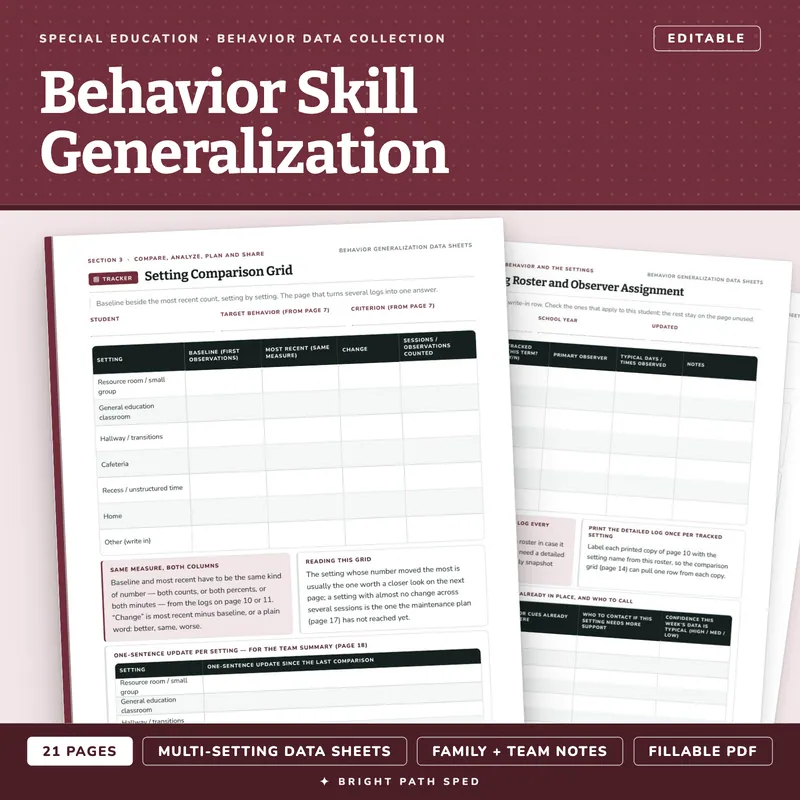
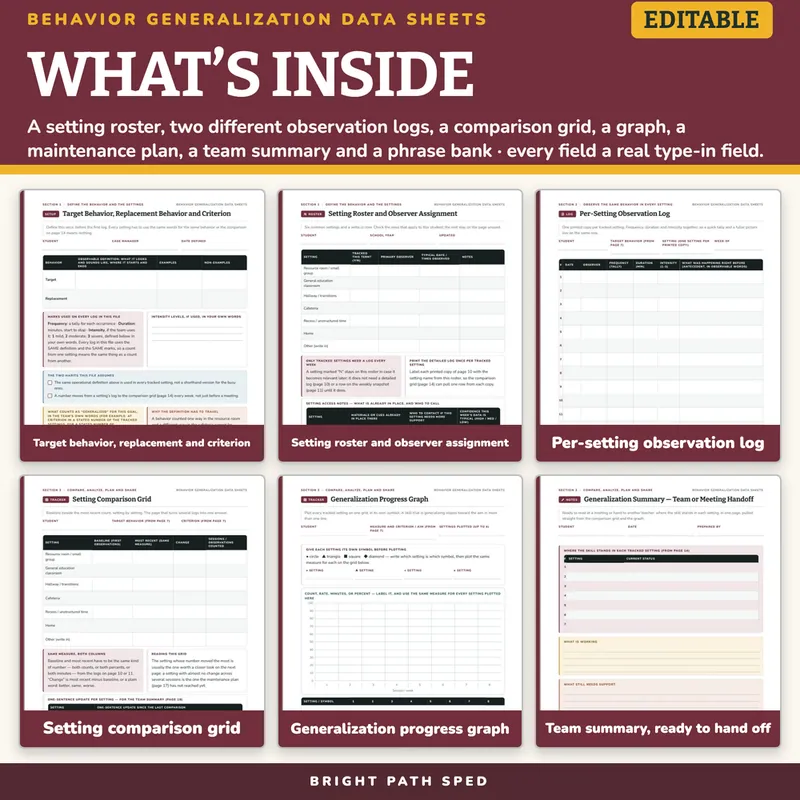
Everyone assumes a behavior skill taught in the resource room shows up in the general education classroom, the hallway, the cafeteria, recess, or home. This file measures that instead of assuming it: a setting roster, two different ways to observe (a detailed per-setting log and a weekly cross-setting snapshot), a quick card for the teacher, paraprofessional or family member who is not the case manager, a setting comparison grid, a strongest/most-difficult-setting analysis, a multi-setting graph, a maintenance plan, a team summary, a phrase bank, and a filled-in example.
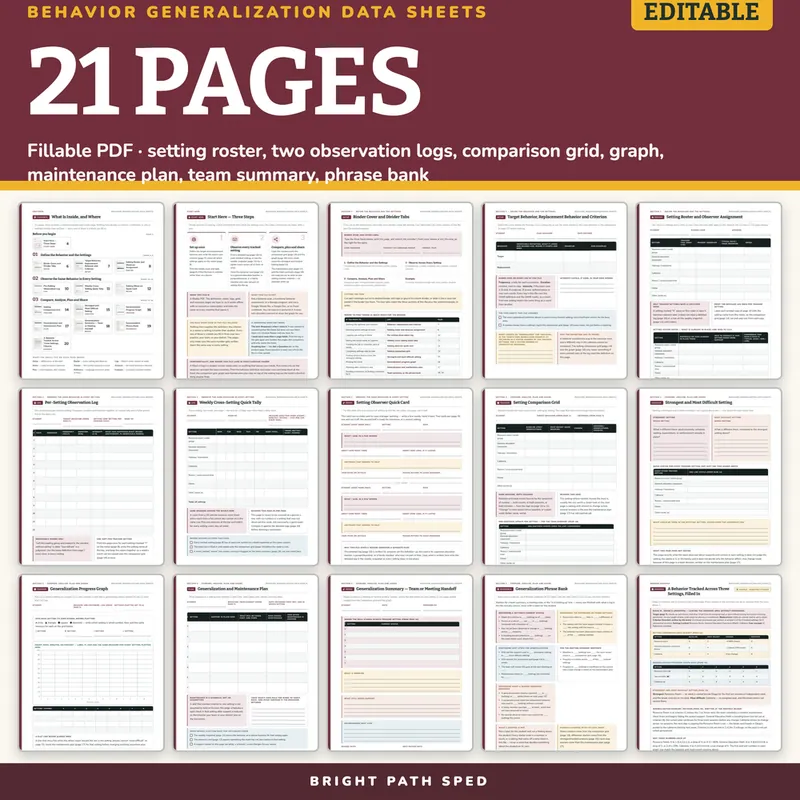
WHAT IS INCLUDED - 21 pages, 404 type-in fields
Setup
- Binder Cover and Divider Tabs - a spine label, four cut-out dashed tabs matching the file's three sections plus the example, and a 10-row routing index ("if you need to… use… page")
- Target Behavior, Replacement Behavior and Criterion - an observable-definition table for the target and the replacement behavior, the frequency/duration/intensity marks used on every log in the file, an intensity-levels write-in, a two-item checklist of habits the file assumes, and a blank for the team's own criterion for calling the goal "generalized"
- Setting Roster and Observer Assignment - two 7-row tables: which of six named settings (resource room, general education classroom, hallway/transitions, cafeteria, recess, home) plus a write-in row are tracked, who observes each, and a second table of what materials or cues are already in place and who to contact for more support
Observe Across Every Setting
- Per-Setting Observation Log - 12 rows: date, observer, frequency tally, duration, intensity, and the antecedent in observable words, printed once per tracked setting
- Weekly Cross-Setting Quick Tally - all 7 settings plus a total-across-settings row, Monday through Friday, week total and trend, on one page
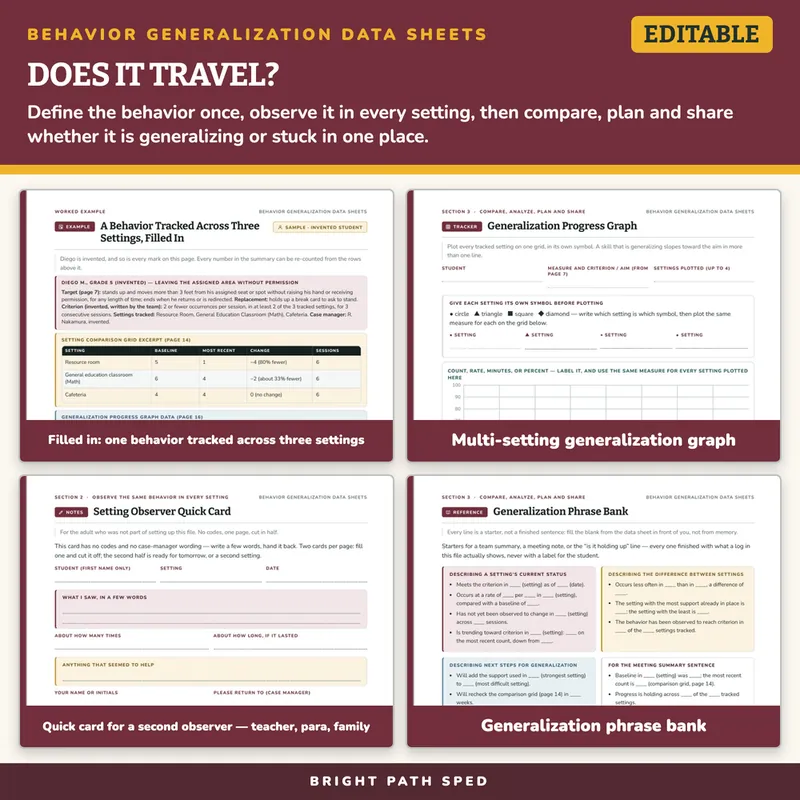
- Setting Observer Quick Card - two cut-apart cards with no codes, for a general education teacher, paraprofessional or family member: what was seen, about how often or how long, and what seemed to help
Compare, Analyze, Plan And Share
- Setting Comparison Grid - a 7-row table of baseline against most recent count with the change, plus a second 7-row table for a one-sentence update per setting
- Strongest and Most Difficult Setting - two cards naming the strongest and hardest setting and what is different in each, a 7-row quick-status table for every other tracked setting, and a card for what to try in the hard setting borrowed from the strong one
- Generalization Progress Graph - a hand-drawn grid for up to four settings, each in its own symbol, across eight sessions, plus a data table to log the numbers
- Generalization and Maintenance Plan - a 7-row table of the support in place, what fades first, who checks, and how often, plus a 3-item checklist of what triggers an early check
- Generalization Summary - a ready-to-send team or meeting handoff: current status in all 7 tracked settings, what is working, what needs support, and the recommended next step
- Generalization Phrase Bank - 18 observable-language starters across 5 groups (setting status, difference between settings, next steps, the meeting-summary sentence, and what a second observer reported)
- A filled-in example for an invented fifth grader tracked across three settings, with the comparison grid, the graph data, the strongest/hardest call and the team's decision all checked against the same six numbers
What This Is, And What It Is Not
It is a fillable PDF. Open it in a PDF reader, click a line, a box or a cell, type, press Tab to move on, and print it when you need a paper copy. It works offline with no account or subscription. It is NOT a Google Sheets file, a Google Doc or an Excel workbook, and it does not calculate a percent or draw the graph for you.
It is not a behavior plan, a functional behavior assessment, or a therapy program. Nothing on any page supplies the operational definition, the criterion for "generalized," or a reason one setting is harder than another — every one of those is a blank the team fills in from its own practice or the district's own procedure.
Who This Is For
Special education case managers, behavior specialists and school psychologists who need to know whether a behavior goal is transferring out of the setting it was taught in, the general education teachers, paraprofessionals and family members asked to observe a second setting, and IEP teams preparing a meeting update on generalization.