Behavior & Social Skills IEP Progress Report Editable
- 24 pages
- Not Grade Specific
- PDF, fillable
$3.50
DownloadOr get it with All-Access: pick any 20 resources a month for $7.
New here? Your first month of All-Access is half off with code TEACHERTOK
Already bought this, or a member?
Instant download. One teacher's license: colleagues need their own copy. Each file carries a license number.
Also on Teachers Pay Teachers: see the Bright Path Sped store
About this resource
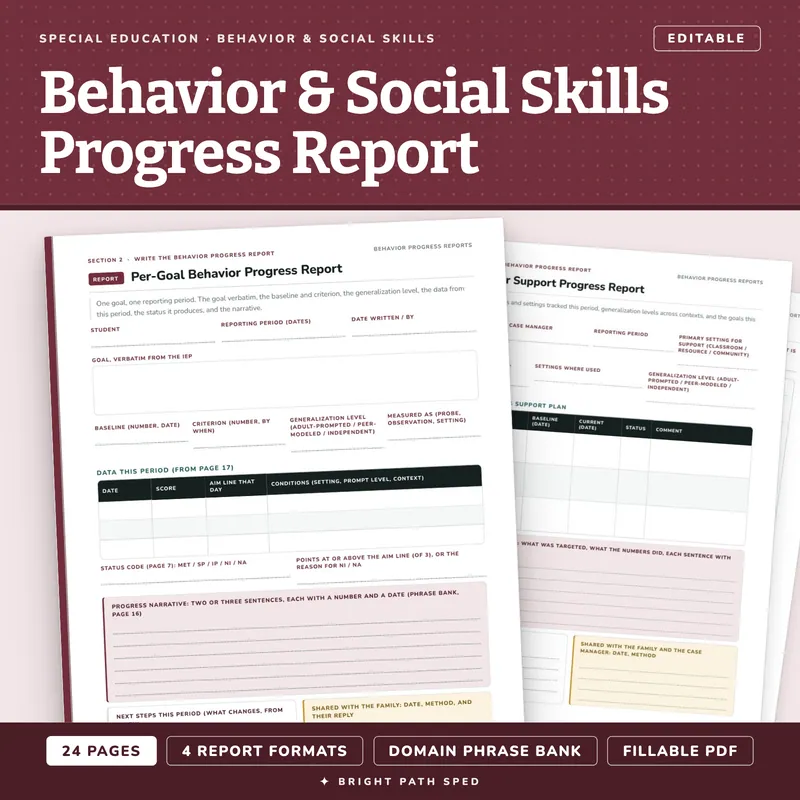
Four behavior progress-report formats a quarterly report needs, in one fillable PDF: a per-goal report (with a second copy for a student with two goals), an all-goals summary, a behavior support report with strategies used across settings and generalization levels, and an end-of-year summary — plus a phrase bank organized by domain (self-regulation, peer interaction, classroom expectations, emotional awareness), the data table and graph every report is written from, a parent behavior home note, a classroom teacher input request, a cover sheet and delivery log, and a filled-in example whose status is computed from its own data, not chosen. Type the status codes and schedule once, Save As per student per reporting period, and copy the numbers in from the data table.
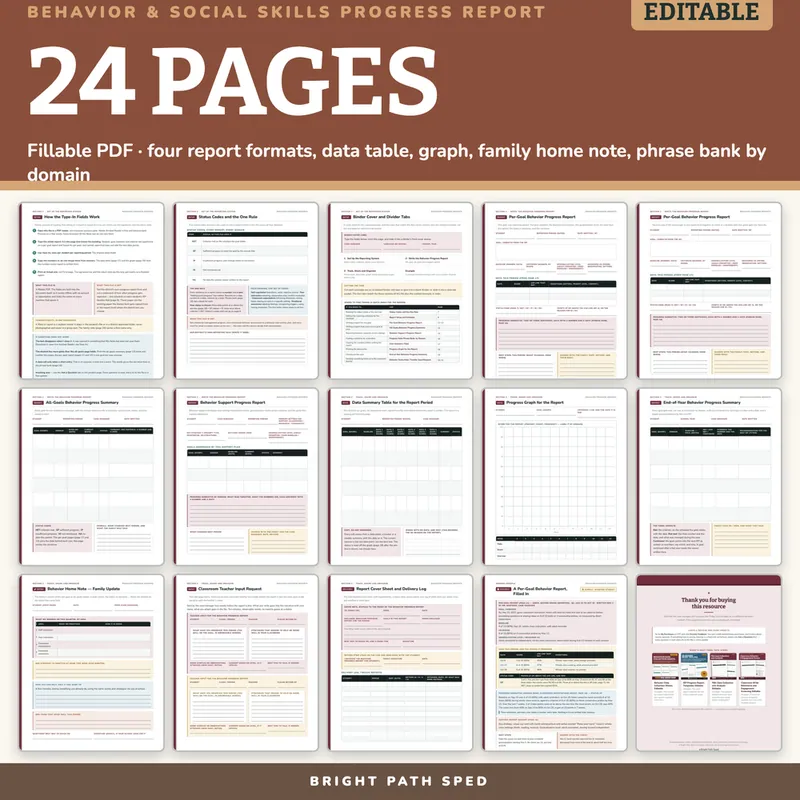
WHAT IS INCLUDED - 24 pages, 615 type-in fields
Set Up The Reporting System
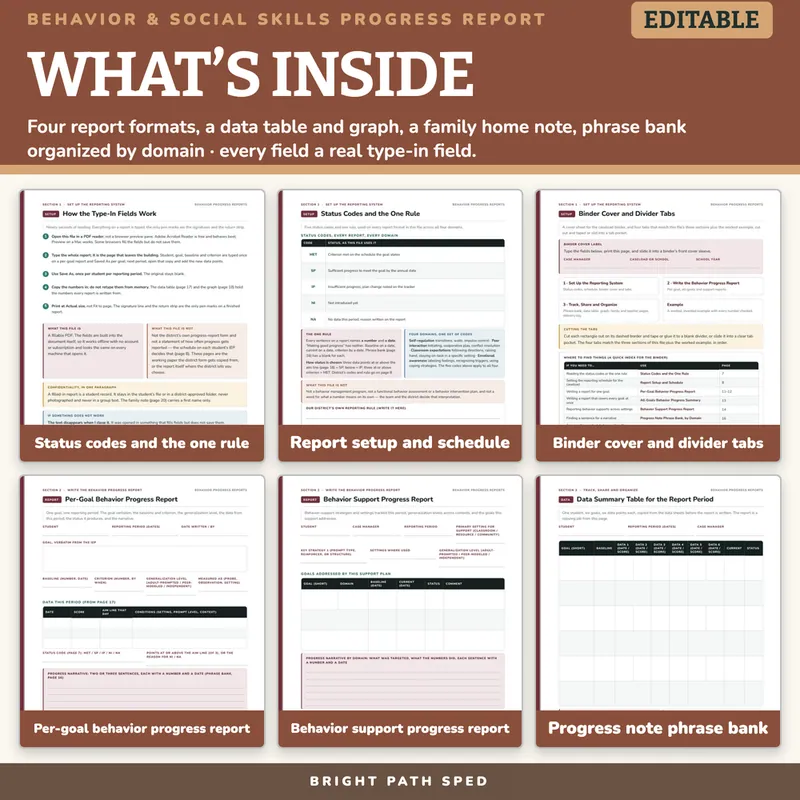
- How the Type-In Fields Work - one page, so nobody emails you
- Status Codes and the One Rule - five status codes used on every report and every domain, the rule that every sentence names a number and a date, and how the status is read off the aim line
- Report Setup and Schedule - 12 students by 4 reporting periods: due, sent, how, plus a line for the district's own reporting rule
- Binder Cover and Divider Tabs - a cover sheet for the caseload binder, four cut-out section tabs, and a quick "if you need to... use... page" index
Write The Behavior Progress Report
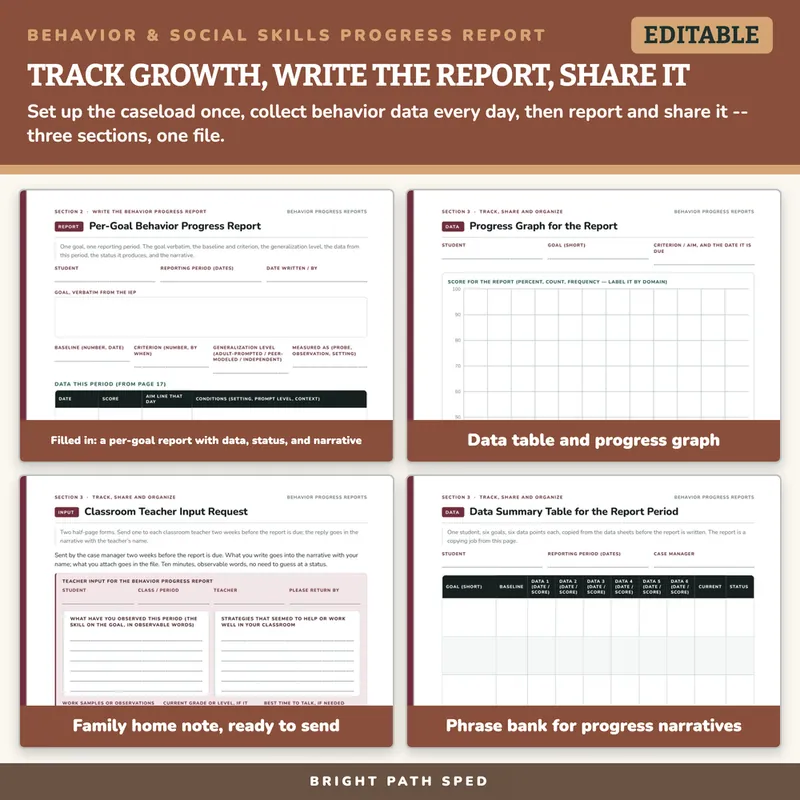
- Per-Goal Behavior Progress Report (two copies) - the goal verbatim, baseline, criterion, a generalization level (adult-prompted / peer-modeled / independent), 3 data points with the aim line, the status it produces, and the narrative
- All-Goals Behavior Progress Summary - 6 goals by domain on one page, status and one sentence each
- Behavior Support Progress Report - strategies delivered across settings, generalization levels, and 3 domain rows for the goals this support addresses
Track, Share And Organize
- Progress Note Phrase Bank, by Domain - 19 starters: 4 each across self-regulation, peer interaction, classroom expectations and emotional awareness, plus 3 for the quarterly-report-sentence group; every starter ends in a number, a count or a date, never a severity word
- Data Summary Table for the Report Period - 6 goals by 6 data points each, copied from the data sheets before the report is written
- Progress Graph for the Report - 12 sessions, aim line drawn from baseline to criterion
- End-of-Year Behavior Progress Summary - 6 goals by domain: met, not met or continued, with evidence and a typed recommendation for the next IEP
- Behavior Home Note (family update) - what we worked on this quarter by domain, a strategy to practice at home, how the family can help
- Classroom Teacher Input Request - two half-page forms, sent two weeks before the report is due
- Report Cover Sheet and Delivery Log - a cover note, a tear-off return strip, and a 12-row log of what went out and whether it came back
- A filled-in example for an invented second-grader: a per-goal report on raising hand in class, moving from baseline toward criterion, the status read off its own aim line, and notes on behavior-support strategies that are working
What This Is, And What It Is Not
It is a fillable PDF. Open it in a PDF reader, click a line, a box or a cell, type, press Tab to move on, and Save As once per student per reporting period. It works offline with no account or subscription. It is NOT a Google Sheets file, a Google Doc or an Excel workbook, and it does not calculate percents or draw the graph.
It is not a behavior management program, not a functional behavior assessment, and not your district's own progress-report form or a statement of how often progress gets reported — the schedule on each student's IEP decides that, and there is a line to write your district's rule on. Every sentence names a number and a date. A self-regulation frame counts observed instances; it never assigns a severity word. A classroom expectation frame names the specific setting and what was observed.
Who This Is For
Case managers and school psychologists with a quarterly or trimester progress report due for IEP goals in behavior and social skills (self-regulation, peer interaction, classroom expectations, emotional awareness); educators who write the same report in several formats for different readers (the IEP file, the family, the classroom teacher); and teams who want their behavior-support strategies and settings tracked on the same page as the goal data.