Bilingual Speech Therapy Data Sheets Editable
- 20 pages
- Not Grade Specific
- PDF, fillable
$4.00
DownloadOr get it with All-Access: pick any 20 resources a month for $7.
New here? Your first month of All-Access is half off with code TEACHERTOK
Already bought this, or a member?
Instant download. One teacher's license: colleagues need their own copy. Each file carries a license number.
Also on Teachers Pay Teachers: see the Bright Path Sped store
About this resource
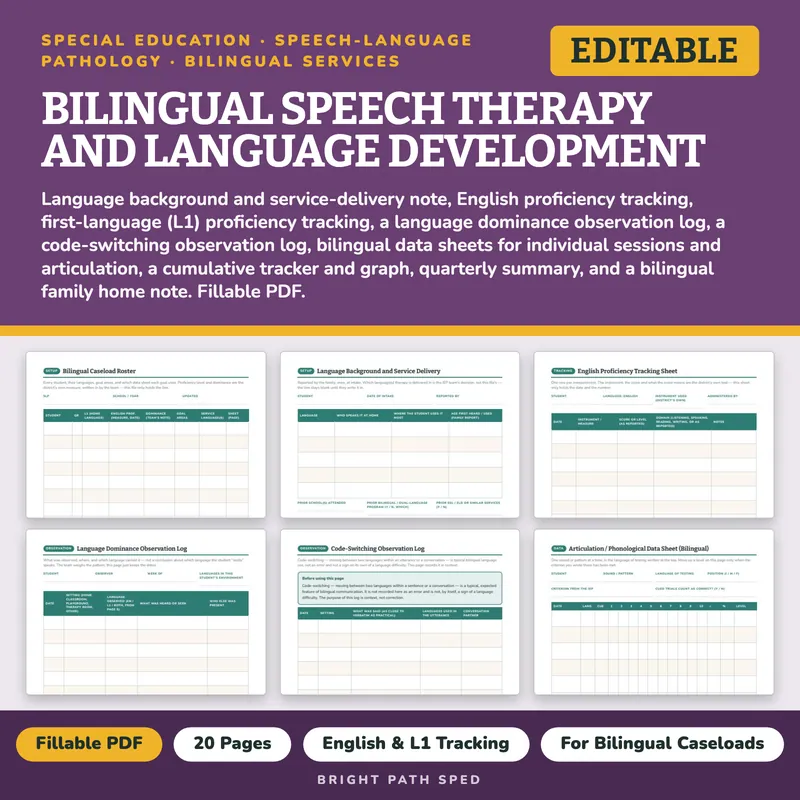
The store's only SLP file built for a bilingual caseload: not a second copy of the general speech data sheets, but the paperwork a caseload split across two languages actually needs. Track language background and a bilingual service-delivery note, English proficiency over time, first-language (L1) proficiency over time, which language shows up in which setting, and code-switching in context — recorded as the ordinary bilingual language use it is, never as an error. Bilingual data sheets for individual sessions and articulation carry a language column on every trial. A cumulative tracker and graph, quarterly summary, and a bilingual family home note close the loop. Every entry is dated; the file never scores proficiency, decides language dominance, or says which language(s) therapy is delivered in — those stay blank lines for the district's own instrument and the IEP team's decision.
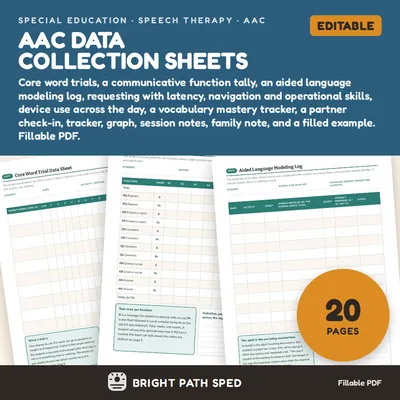
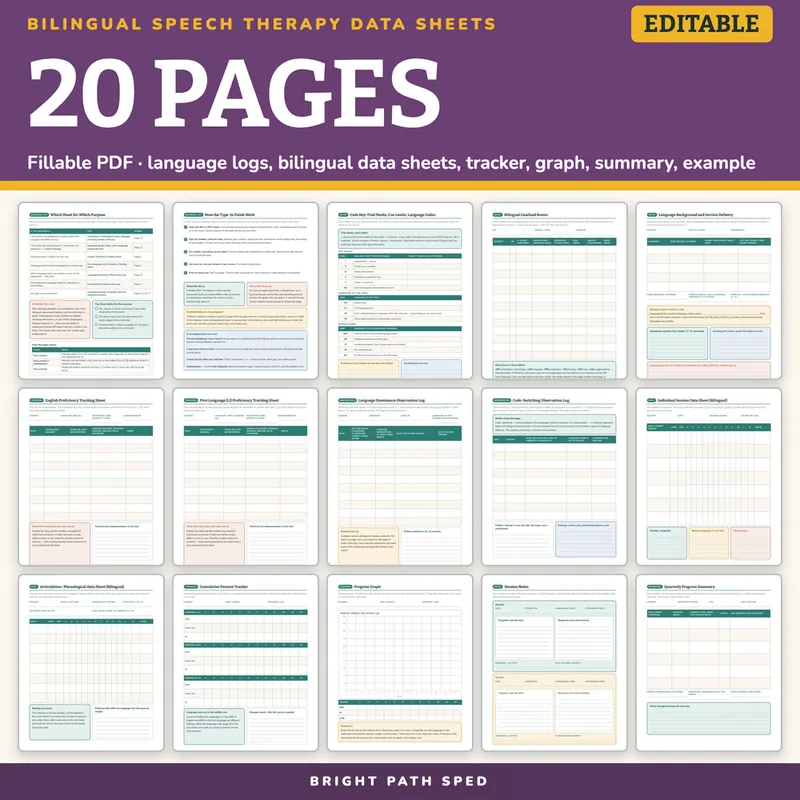
WHAT IS INCLUDED — 20 pages, 978 type-in fields
Setup
- Which Sheet for Which Purpose — a chooser table matching seven common questions to the sheet that answers them, plus a "How the Paper Moves" table for the session/month/quarter workflow
- How the Type-In Fields Work — one page, so nobody emails you
- Code Key — trial marks (+, -, cue codes, 0, X), six cue levels (I, V, M, P, T, Mx), four language-of-trial codes (EN, L1, CS, TR), and five progress-status codes
- Bilingual Caseload Roster — 14 students: home language, English proficiency (measure and date), dominance note, goal areas, service language(s), sheet page
Language Background And Tracking
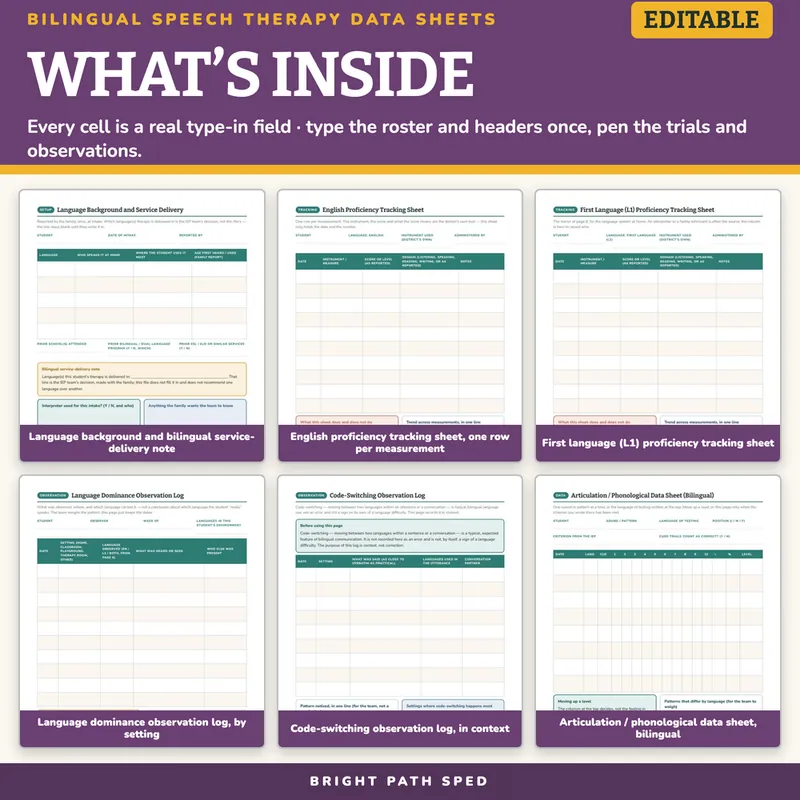
- Language Background and Service Delivery — 5-row language table (who speaks it, where it's used most, age first heard), prior-school and prior-service fields, and the bilingual service-delivery note with a blank line for which language(s) therapy is delivered in
- English Proficiency Tracking Sheet — 10 rows: date, instrument, score/level as reported, domain, notes
- First Language (L1) Proficiency Tracking Sheet — the same 10-row structure, mirrored for the home language
- Language Dominance Observation Log — 10 rows: date, setting, language observed, what was heard, who was present
- Code-Switching Observation Log — 9 rows, opened with a note that code-switching is typical bilingual language use, not an error
Bilingual Data Sheets
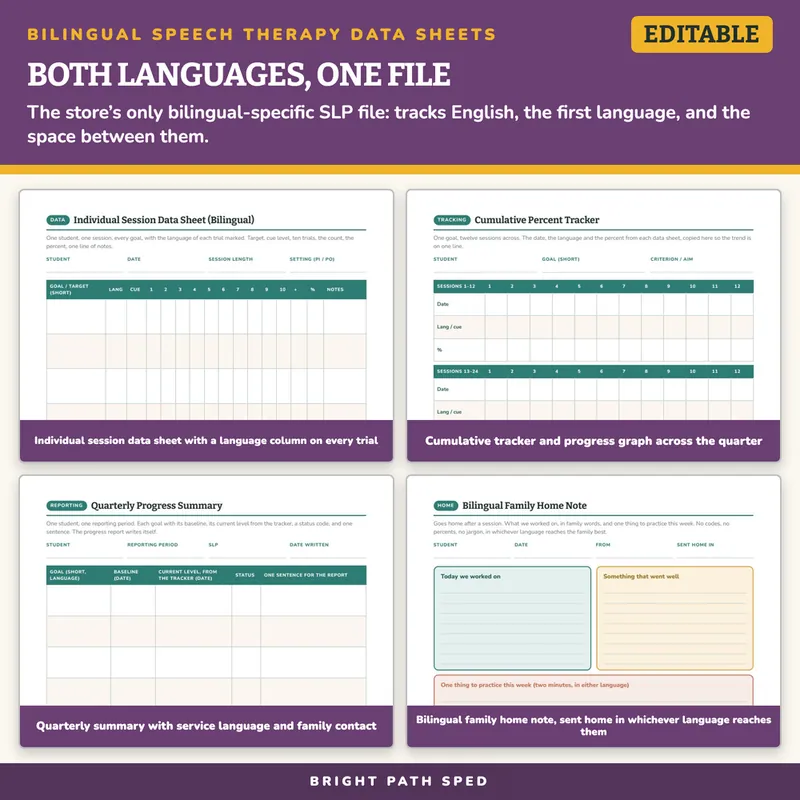
- Individual Session Data Sheet (Bilingual) — 7 goal rows, each with a language column and 10 trial cells
- Articulation / Phonological Data Sheet (Bilingual) — 8 date rows, each with a language column and 10 trial cells, level column, criterion and cued-trial fields at the top
Tracking, Reporting And Home
- Cumulative Percent Tracker — one goal, 36 sessions across three 12-session blocks, with a language/cue row under every date
- Progress Graph — plot the tracker with an aim line at the criterion
- Session Notes — two sessions per page, language(s) used field on each
- Quarterly Progress Summary — 6 goal rows: baseline, current level from the tracker, status code, one sentence, plus service-language and proficiency-measure fields for the period
- Bilingual Family Home Note — what we worked on, what went well, one practice idea, a 7-day practice tracker, and a "sent home in" language field
- Filled-in example for an invented second-grader (Valentina) showing an articulation sheet tested in both languages, one language-dominance log entry, and the quarterly summary row it feeds
What This Is, And What It Is Not
It is a fillable PDF. Open it in a PDF reader, click a field, type, press Tab to move on, Save As once per student. It works offline with no account or subscription. It is NOT a Google Sheets file, a Google Doc or a PowerPoint presentation.
It is not a proficiency test, a bilingual assessment battery, or a therapy program, and it carries no word lists or goals. It does not score proficiency, define what counts as language dominance, or decide which language(s) therapy is delivered in — every one of those is a blank line for your district's own instrument and your IEP team's decision. Code-switching is documented here as typical bilingual language use, never as an error or as a sign on its own of a language difficulty. No age, eligibility, diagnosis or IDEA-timeline claim anywhere; no health data is pre-filled, and the example student (Valentina) is invented and named as such on page 19.
Who This Is For
School-based bilingual or dual-certified SLPs, SLPs working with an interpreter or a bilingual paraprofessional, and any speech-language team documenting progress in more than one language who need the language of every trial and every observation on the record, not assumed.
If You Want More
Speech Therapy Data Collection Sheets Editable is the 22-page single-language version of this file: caseload, schedule, six data sheets, tracker, graph. Speech Therapy Data Sheets FREE is the free sample of the single-language data sheets, to try the routine first.