Biology EOC Review Packet
- 39 pages
- 9th, 10th
$2.12 $4.25 on Teachers Pay Teachers
Half the Teachers Pay Teachers price. The same PDF, sold direct.
DownloadOr get it with All-Access: pick any 20 resources a month for $7.
New here? Your first month of All-Access is half off with code TEACHERTOK
Already bought this, or a member?
Instant download. One teacher's license: colleagues need their own copy. Each file carries a license number.
Also on Teachers Pay Teachers: see the Bright Path Sped store
About this resource
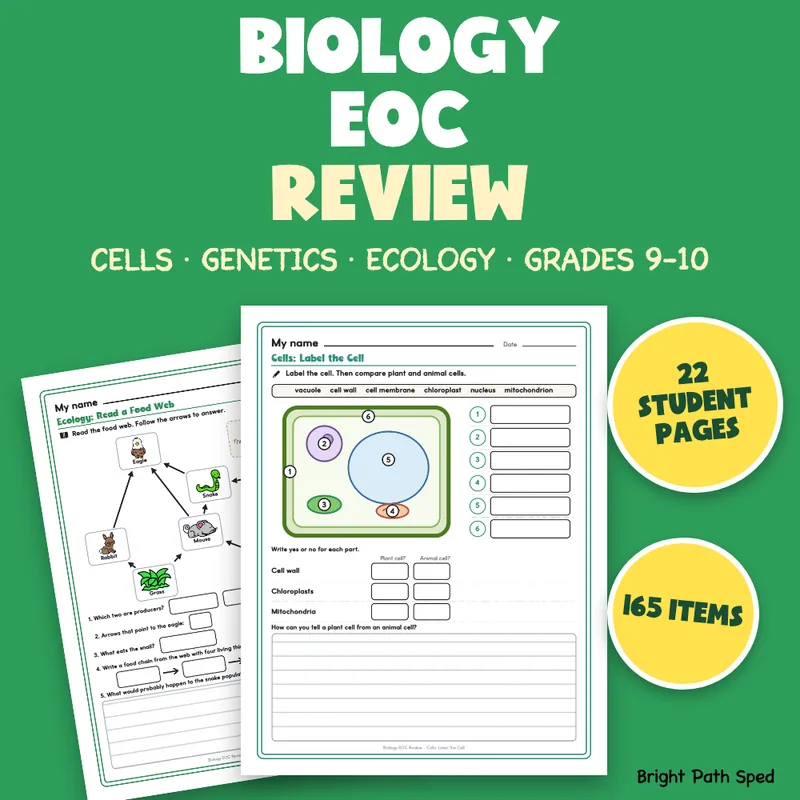
Reviewing for the end of a biology course and want practice a student can actually write on? This is end-of-course review practice for grades 9-10 in five units: cells, DNA and genetics, evolution and natural selection, ecology, and body systems with homeostasis basics. Every unit has a page of key ideas and words, a diagram or table page, and a page of multiple-choice and short-answer questions. Two mixed sets review all five units. Every page has a "My name" line, one short instruction and real room to write. Answer keys cover every item.
EVERYTHING INSIDE (39 pages)
- 22 student pages in 13 kinds of page, each with a name line and one short instruction
- 165 scored items on 21 scored sheets, every key built from the same lists that draw the page
- 5 units: Cells, DNA and Genetics, Evolution, Ecology, Body Systems
- 5 words-and-key-ideas pages: 5 key ideas and 6 words to match on each (30 words in all)
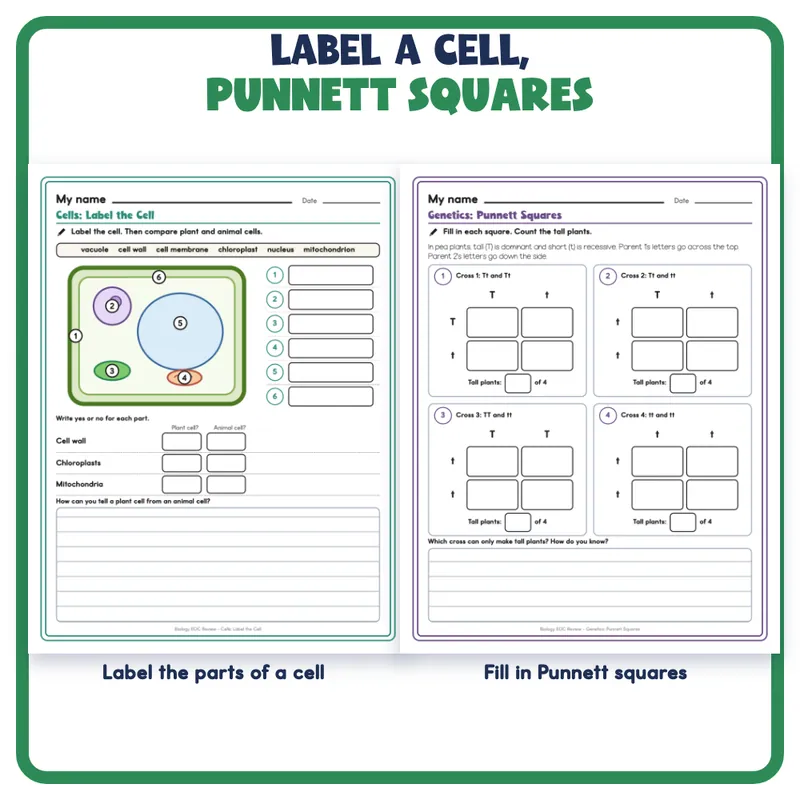
- Cells: label a drawn plant cell (6 parts) and compare plant and animal cells (6 yes-or-no items)
- DNA and genetics: match the bases on an 8-base strand, fill in a DNA to mRNA to protein flow, and 4 Punnett squares (16 squares and 4 counts)
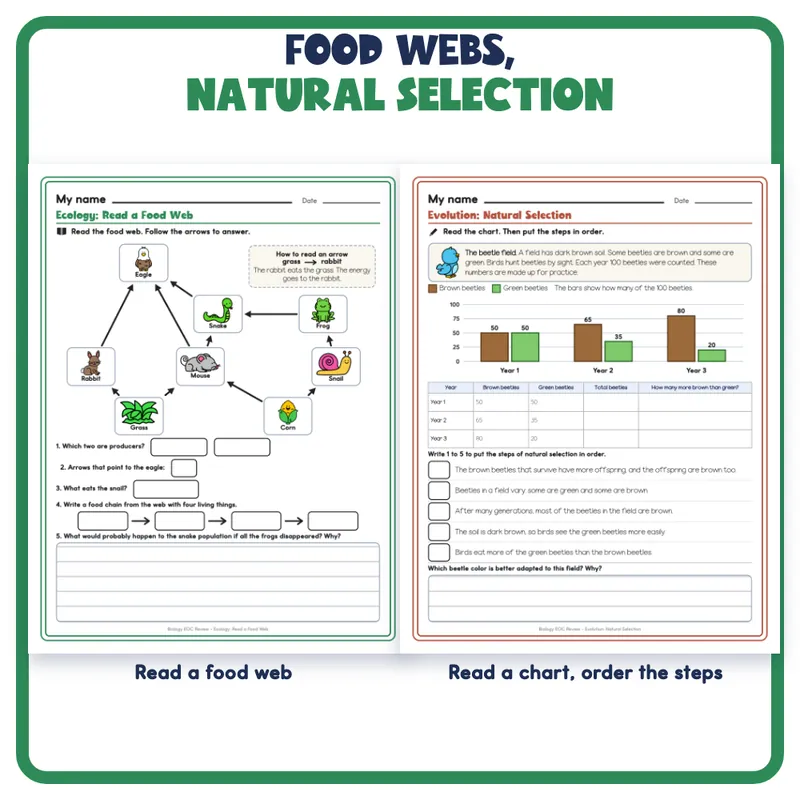
- Evolution: read a bar chart and table of beetle counts (invented numbers) and put 5 steps of natural selection in order
- Ecology: a food web with 8 living things and 10 arrows, an energy pyramid with the 10 percent rule, and a biotic or abiotic sort of 6 factors
- Body systems: match 6 systems to their jobs and organs, and fill in a homeostasis loop
- 5 question pages: 6 multiple-choice items and 2 short answers for each unit (30 multiple choice, 10 short answers)
- 2 mixed review sets: 8 multiple-choice items each, 16 in all, from all five units
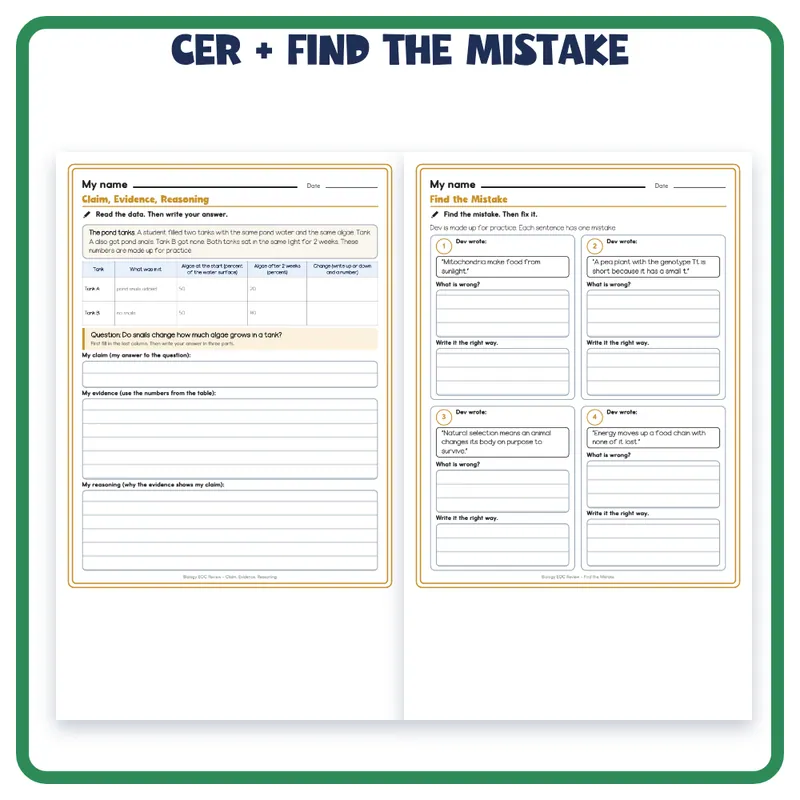
- 1 claim-evidence-reasoning page with an invented pond-tank data table; 1 Find the Mistake page (4 sentences from an invented student); 1 self check (10 statements)
- 4 answer key pages; 1 tracker, 1 class grid, 1 team note, 1 family page
- 1 filled example (an invented student), 1 phrase bank (16 starters in 6 groups)
- Start Here, a how-to-read-a-page page, a binder cover and a page of divider tabs
Built For The Student Holding The Page
A "My name" line, one short instruction with a small picture cue, and a plain double-rule border. The diagrams are drawn on the page to fill in, so a student can see what each question is about. Nothing on a student page is written for an adult: the keys and records are on separate teacher pages. Writing boxes hold two or more ruled lines. The file prints clean in black and white.
Invented Examples
The student in the filled example, the student on the mistake page, the beetle counts and the pond-tank numbers are made up and say so.
Type In, Or Print
The name line, every answer box, every check box and every ruled work box are type-in fields in any PDF reader: click one, type, then save. You can also print any page. This is a fillable PDF; it is not a Google Slides or PowerPoint file.
What This Is, And What It Is Not
End-of-course review practice with the record-keeping around it. It is not a copy of any state test, and it has no released test items, no test names and no standard codes. It is not a timed test, a screener or a clinical tool, and it makes no claim about any student's age or rate of progress. There is a line on the tracker for your own course standard.
If You Want More
Plant and Animal Cells Worksheets | Diagram, Sort, Compare, Write 6th-8th Grade; Levels of Biological Organization Worksheets | Cell to Organism Grades 6-8.