Blurting
- 31 pages
- Kindergarten, 1st, 2nd, 3rd
$2.00 $4.00 on Teachers Pay Teachers
Half the Teachers Pay Teachers price. The same PDF, sold direct.
DownloadOr get it with All-Access: pick any 20 resources a month for $7.
New here? Your first month of All-Access is half off with code TEACHERTOK
Already bought this, or a member?
Instant download. One teacher's license: colleagues need their own copy. Each file carries a license number.
Also on Teachers Pay Teachers: see the Bright Path Sped store
About this resource
EVERYTHING INSIDE — 31 pages
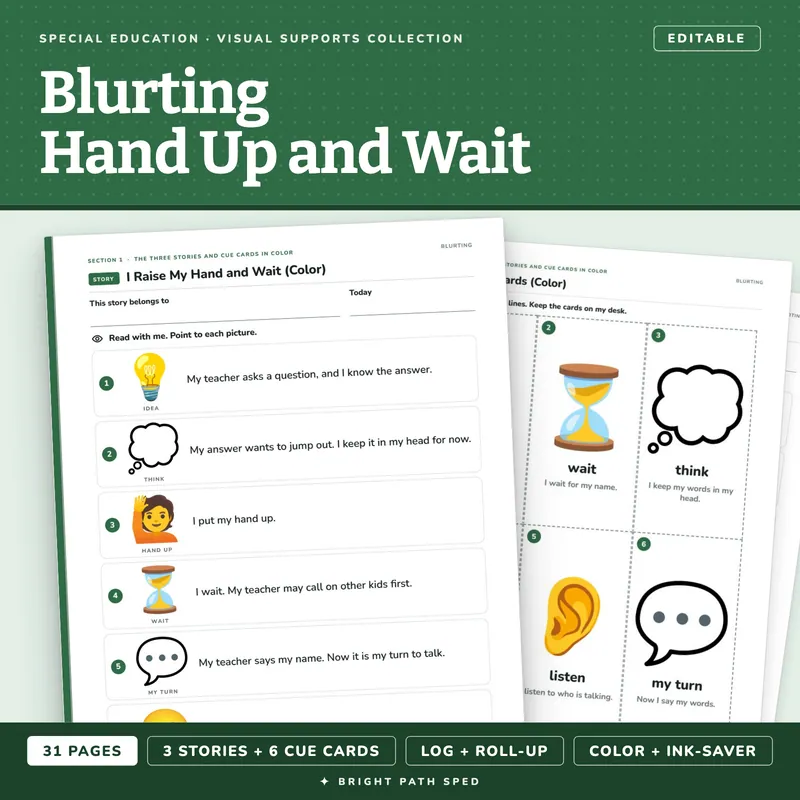
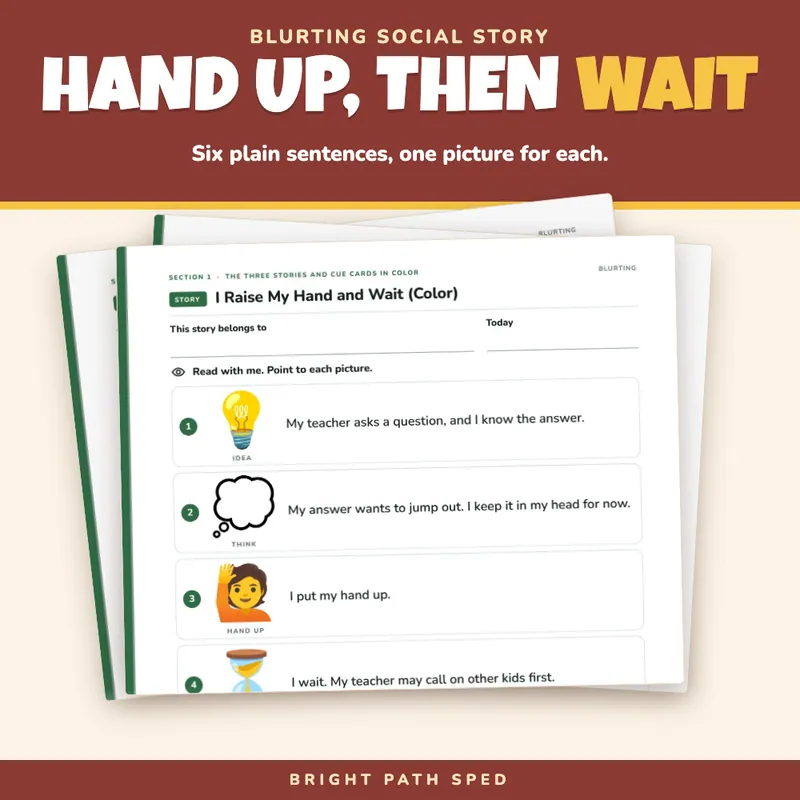
- 3 short social stories about what to do when an answer or a thought wants to jump out before the teacher calls on you: I Raise My Hand and Wait; I Write My Thought Down; I Wait While a Friend Talks — 6 plain, present-tense sentences each (18 in all), with a picture beside every sentence and a type-in name line
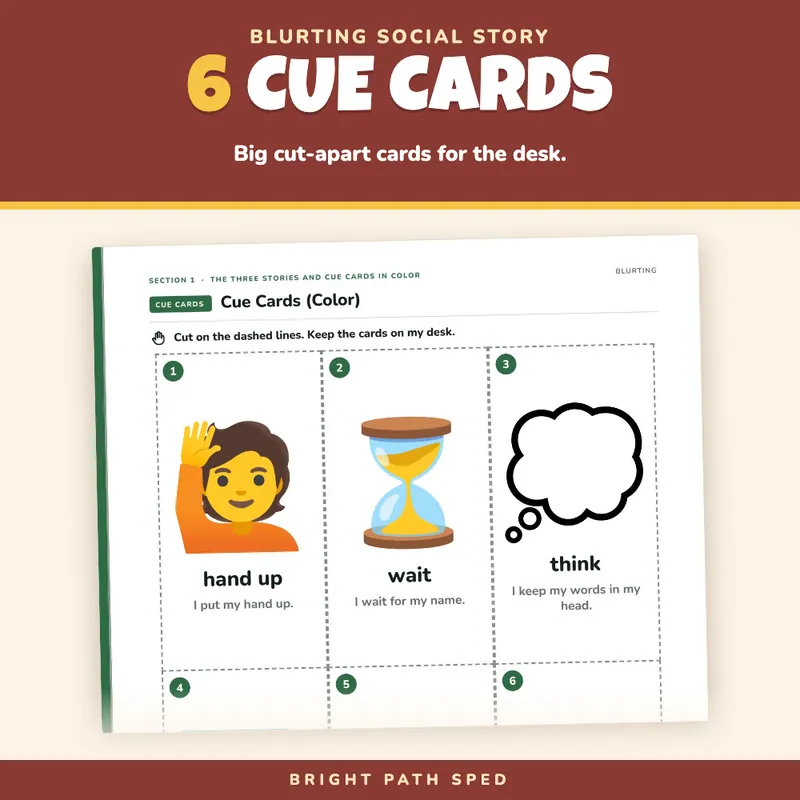
- 6 big cue cards to cut apart and keep on a desk: hand up, wait, think, write it down, listen, my turn — each with one short line the child says
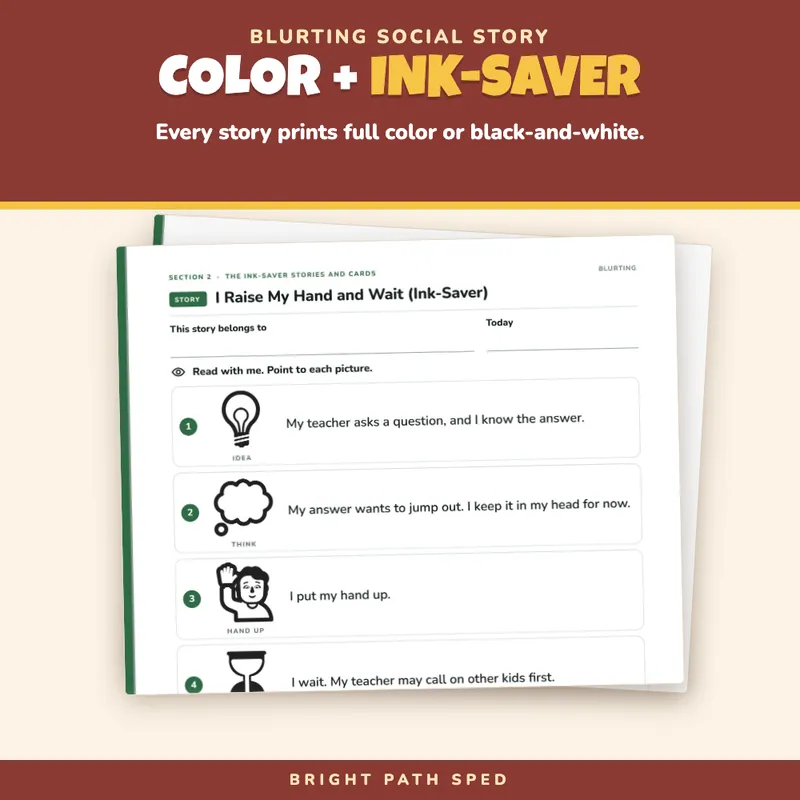
- Every story and the cue cards twice: a full-color set and a black-and-white ink-saver set for the photocopier
- Pocket story strips: each story's 6 pictures as numbered cut-apart cards (18 cards per set, in color and in ink-saver)
- A write-your-own story page: 6 numbered panels, each with a draw-or-glue picture box and two type-in sentence lines
- 3 practice pages, one per story: three "what can I do?" moments from that story with a type-in answer and a Y/N box, a Monday-to-Friday "I read the story / I did what the story says" strip, six put-the-story-in-order slots, three things to try with an adult, and lines for the student's own words
- A how-to page: before the first read, reading a story the same way every time, which story first, the practice pages, what counts on the log, the strips, cue cards and blank page, what the stories are and are not, sending home and handing off
- A Story and Moments Log (16 rows: date, story read, read by, moments seen, used it, initials)
- A weekly roll-up (8 weeks: story, days read, moments seen, used it, percent, notes) with a percent-of-moments graph
- A filled example — an invented student, one week on the log and three weeks on the roll-up, every percent re-counted from its own row
- A family page naming the story of the week, with a picture from that story, an at-home table and lines for what happened at home
- A hand-off page so a paraprofessional, a coach or another classroom reads the same story the same way, with a blank line for a team's own cue if it has one
- A phrase bank for writing a new story: 24 starters in 6 groups plus a 4-point check before a new story is printed
- A storage and binder label sheet (one label per story, plus 8 plain section labels) and a spine strip
- Start Here, a contents page with page thumbnails, and a "what's next" back page
Blurting out is a common classroom moment: the answer is right there and it comes out before the teacher says your name. These three stories show a young child, in pictures and six plain sentences, three things to do instead: put a hand up and wait to be called on, write the thought down so it is not lost, or keep it in your head while a friend finishes. The six cue cards put the same pictures on the desk where the child can see them.
The Stories
- I Raise My Hand and Wait — idea, think, hand up, wait, my turn, happy
- I Write My Thought Down — class, ear, write it down, hand up, my turn, happy
- I Wait While a Friend Talks — friend, ear, think, wait, my turn, happy
Six sentences each, one thing per sentence, in the first person and the present tense. Every picture is a concrete thing a young child can name in one word: a light bulb, a thought balloon, a raised hand, an hourglass, a memo, a speech balloon, an ear. No sentence calls calling out rude, wrong or bad; every line is written as a practical habit ("I put my hand up").
What This Is, And What It Is Not
It is a fillable PDF: type into the story name lines, the practice pages, the blank story, the log, the roll-up, the family page and the hand-off page, or print and use a pen. The story, strip and cue-card pages print on cardstock or plain paper; cards cut along dashed lines. It works offline with no account or subscription. It is NOT an editable online slideshow or word-processor document.
It tells a student, in pictures, what to do when words want to jump out, and counts what happened. It is not a behavior plan or any other legal or clinical procedure, and it promises no outcome. It carries no prompt hierarchy, fading schedule or mastery rule; which story a student reads first, for how many days, and when the next one starts are your team's decisions. The goal line and the criterion field are blanks for your district's own wording and your team's own number.
Who This Is For
Kindergarten through 3rd grade special education teachers, paraprofessionals and general education teachers who read a short story with a student about raising a hand and waiting instead of blurting out, case managers who need that reading to show up as data, and the families who get the home page sent home.
More In The Collection
Part of the Visual Supports Collection, alongside Waiting My Turn to Talk Picture Cards and Social Story (not talking over a person who is already speaking), Waiting and Self-Control Cue Cards with Log and Stop-Think-Act Impulse Control Picture Cards and Log. New to the collection? Visual Supports Starter Set FREE.
Pictures (color pages): Noto Emoji by Google, Apache License 2.0. Pictures (ink-saver pages): Fluent Emoji, Copyright (c) Microsoft Corporation, MIT License.