Box Method Division Worksheets
- 39 pages
- 4th, 5th
$1.70 $3.40 on Teachers Pay Teachers
Half the Teachers Pay Teachers price. The same PDF, sold direct.
DownloadOr get it with All-Access: pick any 20 resources a month for $7.
New here? Your first month of All-Access is half off with code TEACHERTOK
Already bought this, or a member?
Instant download. One teacher's license: colleagues need their own copy. Each file carries a license number.
Also on Teachers Pay Teachers: see the Bright Path Sped store
About this resource
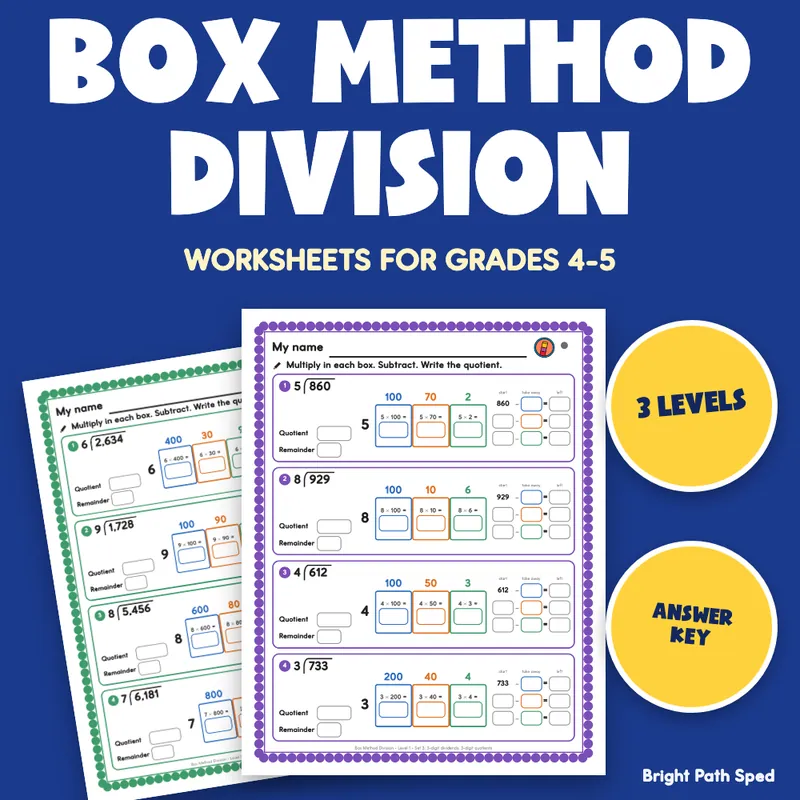
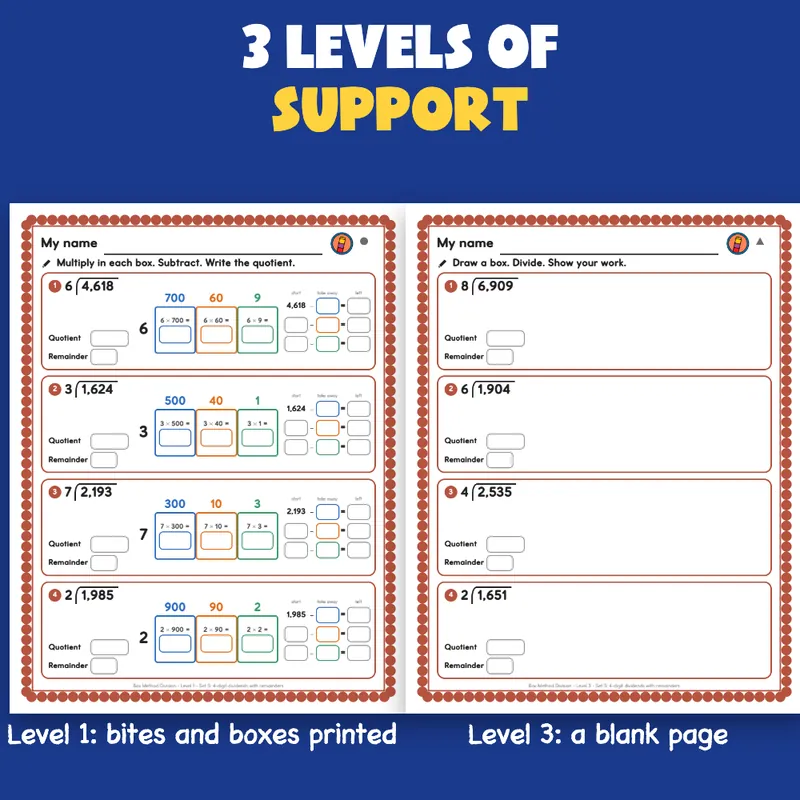
Give every child a box to hold the division. In the box method, the divisor sits at the left and each cell of the box is one place value of the answer: hundreds, tens, ones. Children pick a bite for each cell, multiply the divisor by it, subtract from what is left, and add the top numbers to find the quotient. This set has the same six problem sets at three levels: Level 1 prints the bite on top of every cell, Level 2 prints an empty box and subtraction chain, and Level 3 is a blank page. Start each child where they are, then move them along on the same kind of problem. Print what you need, or type into the pages first.
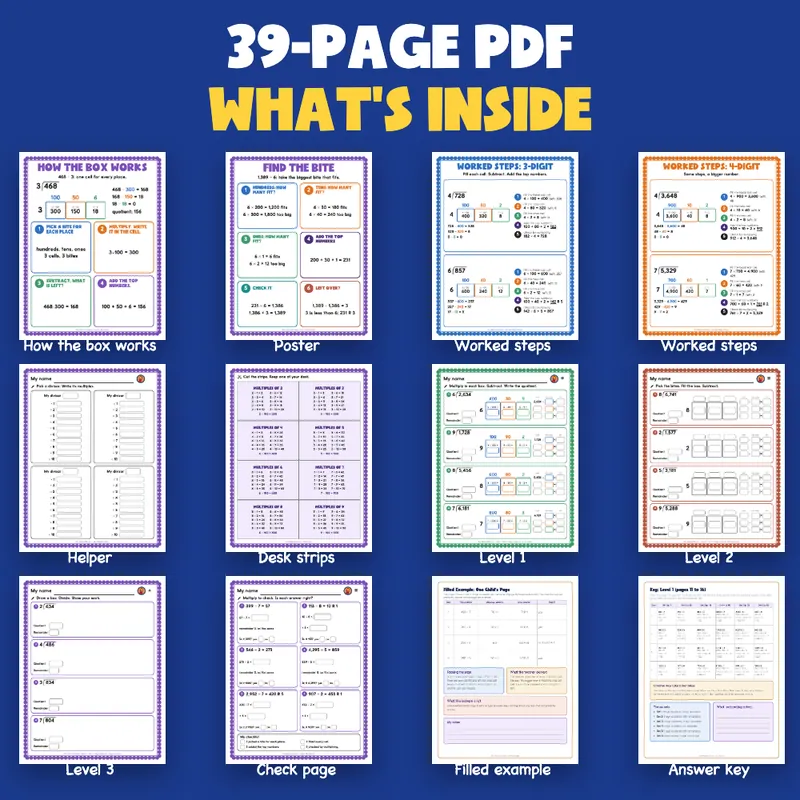
WHAT IS INCLUDED (39 pages)
- 3 levels on 18 worksheet pages: 6 problem sets, each at every level, 4 problems a page, 72 problems in all (42 with a 3-digit dividend, 30 with a 4-digit dividend, every divisor from 2 to 9; 36 have a remainder).
- The 6 problem sets: 3-digit dividends with 2-digit quotients; 3-digit dividends with remainders; 3-digit dividends with 3-digit quotients; 4-digit dividends; 4-digit dividends with remainders; and a mixed review of 3-digit and 4-digit problems.
- Level 1 (circle): the bite is printed on top of every cell, each cell reads divisor times the bite, and the cells and the subtraction chain are color-coded by place value (hundreds, tens, ones). Level 2 (square): the same box and chain, empty, so the child picks the bites. Level 3 (triangle): the problem, open room to draw a box, and boxes for the quotient and remainder. Levels are marked with small shapes, not numbers.
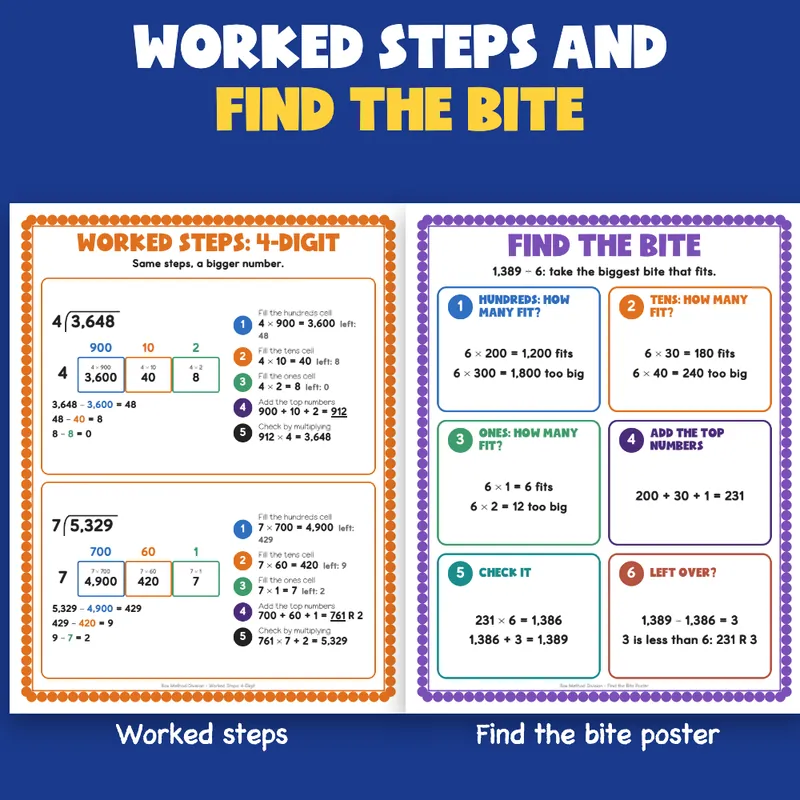
- A how-the-box-works page: one worked box (468 divided by 3) with four numbered steps.
- A find-the-bite poster: 1,389 divided by 6 with how many hundreds, tens and ones fit, the add-up, a check by multiplying, and what a leftover looks like.
- 2 worked-step pages with 4 worked examples (two with a 3-digit dividend, two with a 4-digit dividend; one of each with a remainder). Every step is numbered and ends with a check by multiplying.
- A multiples helper: 4 blank tables where a child picks a divisor and writes its multiples from times 1 to times 10 (type-in fields).
- 8 desk strips to cut on 1 sheet, edge to edge, each with the multiples of one divisor (2 through 9) from times 1 to times 10, plus times 100.
- A self-check page: 6 answers to check by multiplying back, plus a checklist of the four steps. Four of the six answers are right.
- Teacher pages: Start Here with a which-page-when table, five short routines, a filled example (an invented child, every answer invented), answer keys for every worksheet page and the check page, a class tracker, a note home, a phrase bank of 20 starters in 5 groups, and a binder cover with spine and 4 tabs.
- Terms of use and a thank-you page.
How To Use It
Show the how-the-box-works page and the poster, then walk through one worked example together. Hand out Level 1, 2 or 3 of the same set. The key shows the place-value bites (hundreds, then tens, then ones) with each partial product. A child who takes a different bite and still reaches the same quotient and remainder is right, so check the quotient and the remainder. Children can check their own work by multiplying back on the check page.
Built For The Child Holding The Page
Every worksheet page has a big "My name" line, one short direction with a picture, big numbers, and a box or a blank space for every step. There are four problems on a page, each with room to work, and every page reads in black and white too.
Type In, Or Print
The name lines, the boxes and answer boxes on the worksheets, the multiples helper, the check page, the tracker, the note home and every notes area are type-in fields in any PDF reader. You can also print any page and write by hand. Print at 100 percent with fit-to-page turned off. This is a fillable PDF; it is not a Google Slides or PowerPoint file.
Who This Is For
4th and 5th grade classrooms, resource rooms, math centers and intervention groups, and anyone who wants box method division practice at more than one level of support. Every practice problem divides a 3-digit or 4-digit whole number by a 1-digit divisor.
What This Is, And What It Is Not
Classroom worksheets, posters and working paper for one division strategy. It is not a full math curriculum, an assessment or a therapy program, and it makes no health claims. Your school decides what a child should be able to do and when; the pages give you a blank to write your own notes.