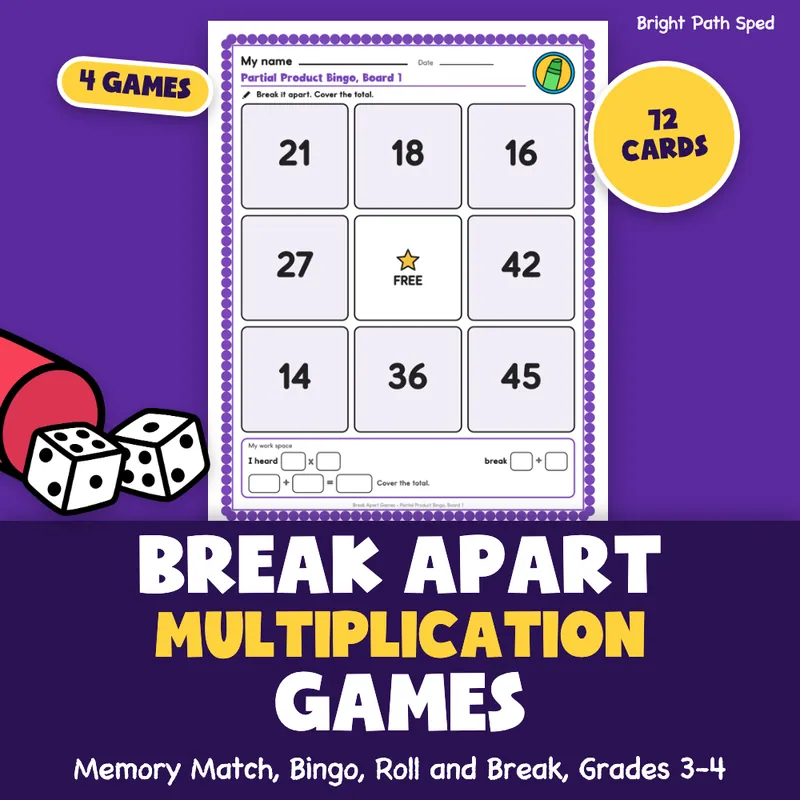
Break Apart Multiplication Games
- 38 pages
- 3rd, 4th
$2.00 $4.00 on Teachers Pay Teachers
Half the Teachers Pay Teachers price. The same PDF, sold direct.
DownloadOr get it with All-Access: pick any 20 resources a month for $7.
New here? Your first month of All-Access is half off with code TEACHERTOK
Already bought this, or a member?
Instant download. One teacher's license: colleagues need their own copy. Each file carries a license number.
Also on Teachers Pay Teachers: see the Bright Path Sped store
About this resource
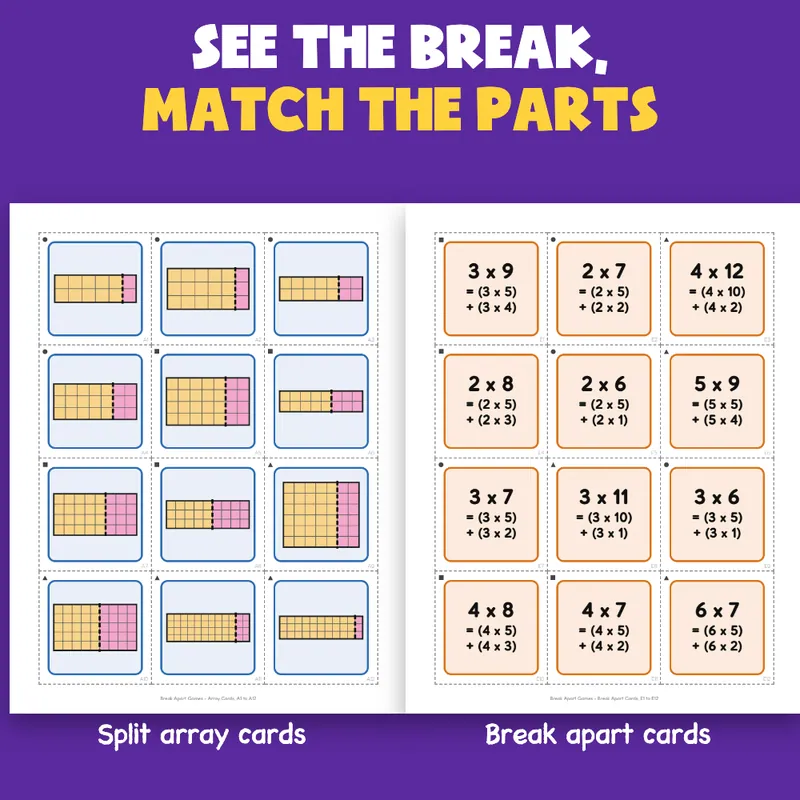
Break Apart Multiplication Games: four no-prep partner games that practice one strategy. Split a multiplication fact into two friendly parts, multiply each part, and add the partial products, like 6 x 7 = (6 x 5) + (6 x 2) = 30 + 12 = 42. Every card shows the array with its dashed break line, so children see why the strategy works. This is a print-and-play set for grades 3 to 4 with 72 cut cards plus a low-ink copy of 60 of them. Cut and laminate once, then play all year. The student pages are type-in fillable PDF pages.
What Is Included
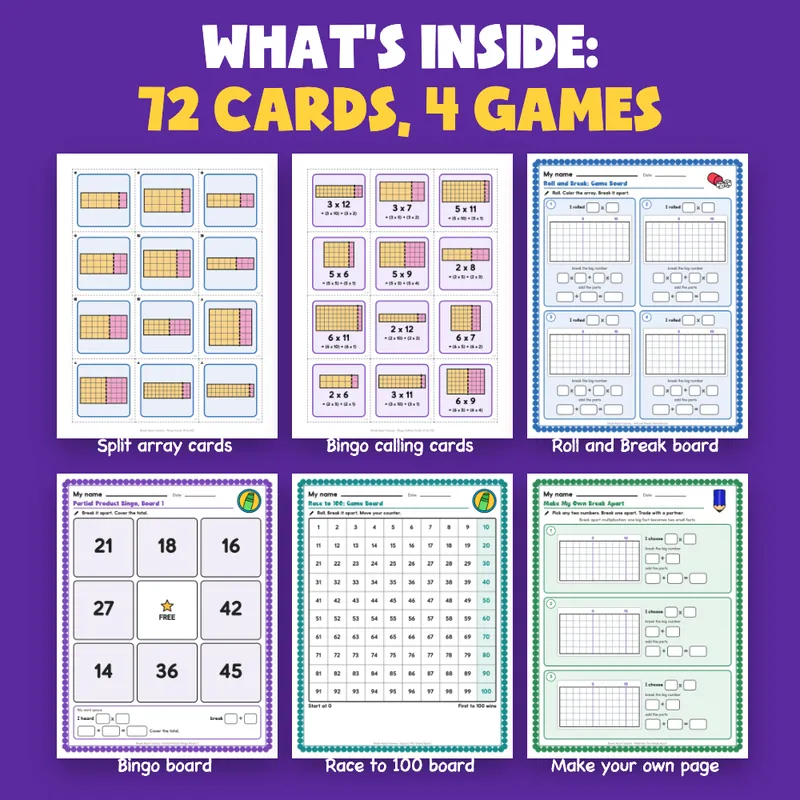
- 72 cut cards, 2.5 inches square, 12 to a sheet, edge to edge so you make a few straight cuts: 12 split array cards, 12 break apart cards, 12 total cards, 24 bingo calling cards and 12 number cards (rows 1 to 6, where 1 means roll again, and six big numbers).
- A low-ink copy: 60 cards (the array, break apart, total and calling cards) in a gray part and a white part with dark outlines, on five sheets, for a black and white printer.
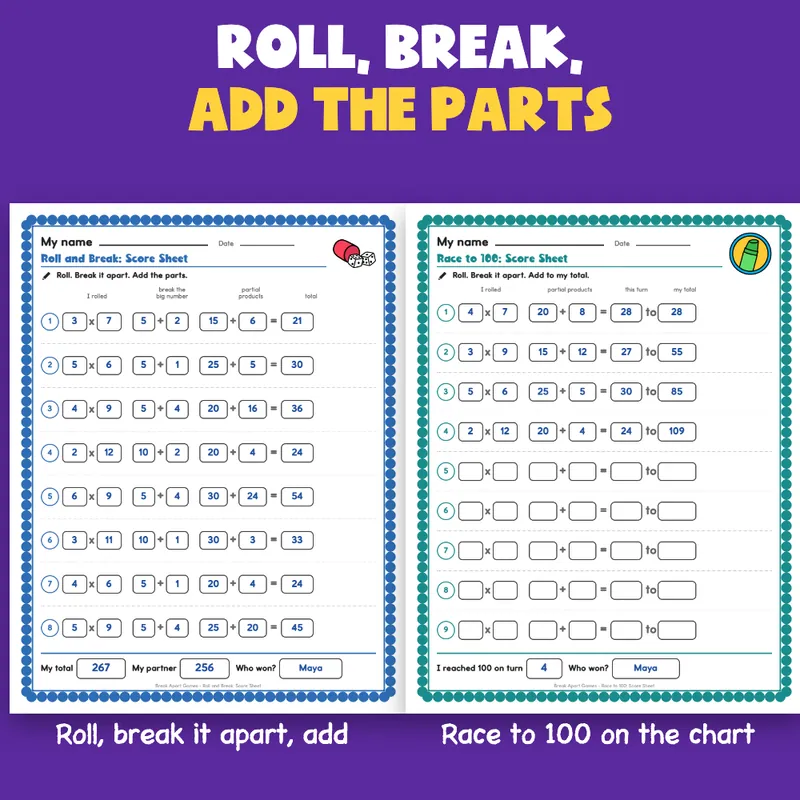
- 4 games: Roll and Break (a board of 4 rounds and a score sheet of 8), Split It! Memory Match (3 ways to play: array with break apart card, array with total card, or all three together), Partial Product Bingo (6 boards and 24 calling cards) and Race to 100 (a 100 chart and a score sheet).
- 12 student pages: a Roll and Break game board and score sheet, a Memory Match record page, 6 Bingo boards with a work space, a Race to 100 board and score sheet, and a make-your-own page.
- Three shapes on the memory cards (circle, square, triangle, 4 problems each) so you can deal the easiest cards first.
- Teacher pages: Start Here with a which-page-when table, a page that shows what a break apart looks like (the array and the area model), how to play each game in three steps, 4 answer keys (all 30 facts a roll can make, the memory triples, the bingo calling cards and the bingo boards), a tracker with a roll-up, a filled example (invented students), a family page, a What's Next page, terms of use and a thank-you page.
How The Break Works
We break the big number into 5 plus something (6 to 9) or 10 plus something (11 and 12): 7 = 5 + 2, 12 = 10 + 2. Rows are 2 to 6 and the big numbers are 6, 7, 8, 9, 11 and 12, so every roll and every draw is one of 30 facts, and the key lists all of them.
How To Play
1. Print, cut and laminate the cards once. Every card is edge to edge, so each cut is one straight line.
2. Pick a game. Roll and Break: roll the cube for the rows, turn over a big number card for the columns, color the array, break it apart and add. Memory Match: turn over cards and keep the ones that describe the same problem. Bingo: show a calling card, everyone breaks it apart and covers the total. Race to 100: add each turn's total to your running score; the first to reach 100 wins.
3. Record on the student page, check with the key, and color a box on the tracker.
Built For The Child Holding The Page
Every array is a clear grid of square cells in two colors with a thick dashed break line. Every student page has a "My name" line, one short direction with a picture, and room to work, with a 6 by 12 grid that shows where 5 and 10 are. The memory problems each have a different total, so a break apart card or a total card matches one array only. In Race to 100 every turn adds at least 12, so a game never goes past 9 turns for each player.
Type In, Or Print
The name lines and the number boxes on the student pages are type-in fields in any PDF reader. The grids are colored by hand on a printed page, and you can print any page and write by hand. Print at 100 percent with fit-to-page turned off. This is a fillable PDF for printing and typing; it is not a slide or word processor file.
Who This Is For
Teachers of grades 3 to 4, resource rooms and self-contained classrooms who want a math center or small-group game for the break apart (distributive) strategy without making anything themselves.
What This Is, And What It Is Not
Working paper and cards for playing and writing about one multiplication strategy. It is not a full math curriculum, an assessment or a therapy program, and it makes no health claims. Your school decides what a child should be able to do and when.
More For Your Math Block
Pair it with Break Apart Multiplication (worksheets), the Array Game, Array City and the Rows and Columns Poster, all live from Bright Path Sped.