Category Naming Fluency, Timed
- 19 pages
- Not Grade Specific
$1.50 $3.00 on Teachers Pay Teachers
Half the Teachers Pay Teachers price. The same PDF, sold direct.
DownloadOr get it with All-Access: pick any 20 resources a month for $7.
New here? Your first month of All-Access is half off with code TEACHERTOK
Already bought this, or a member?
Instant download. One teacher's license: colleagues need their own copy. Each file carries a license number.
Also on Teachers Pay Teachers: see the Bright Path Sped store
About this resource
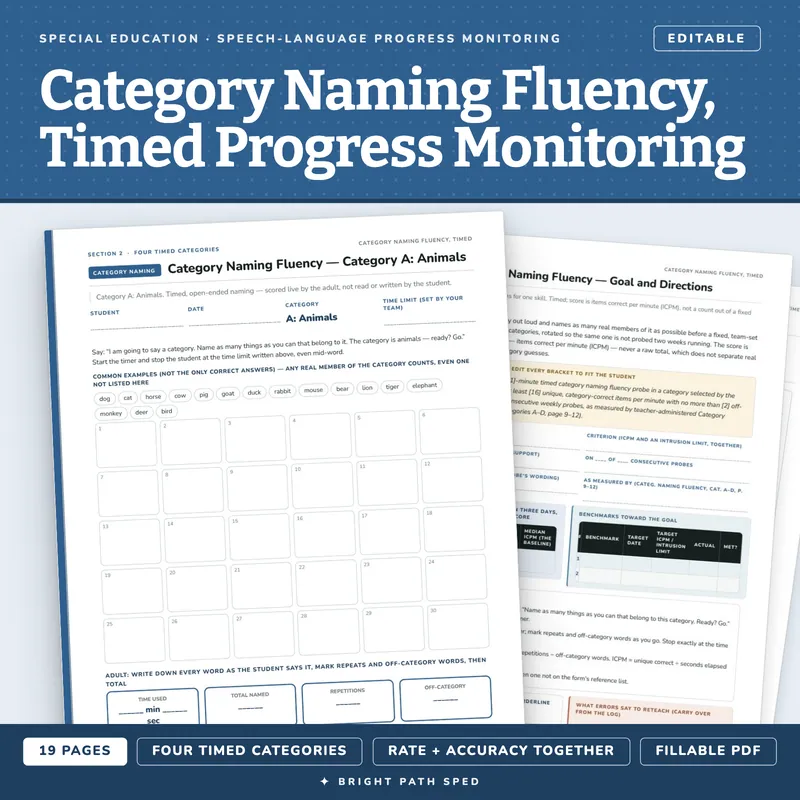
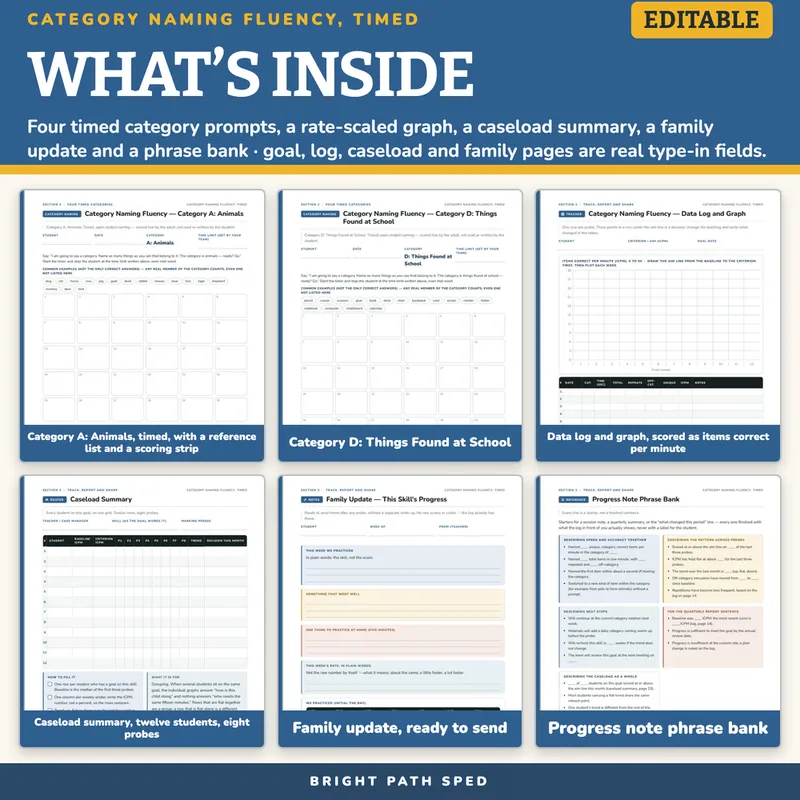
Everything inside: 19 pages · four ready-to-use timed category prompts (Animals, Foods, Clothing, School Supplies) · a data log and graph scored as items correct per minute · a caseload summary · a family update · a 19-starter phrase bank · a worked, invented example.
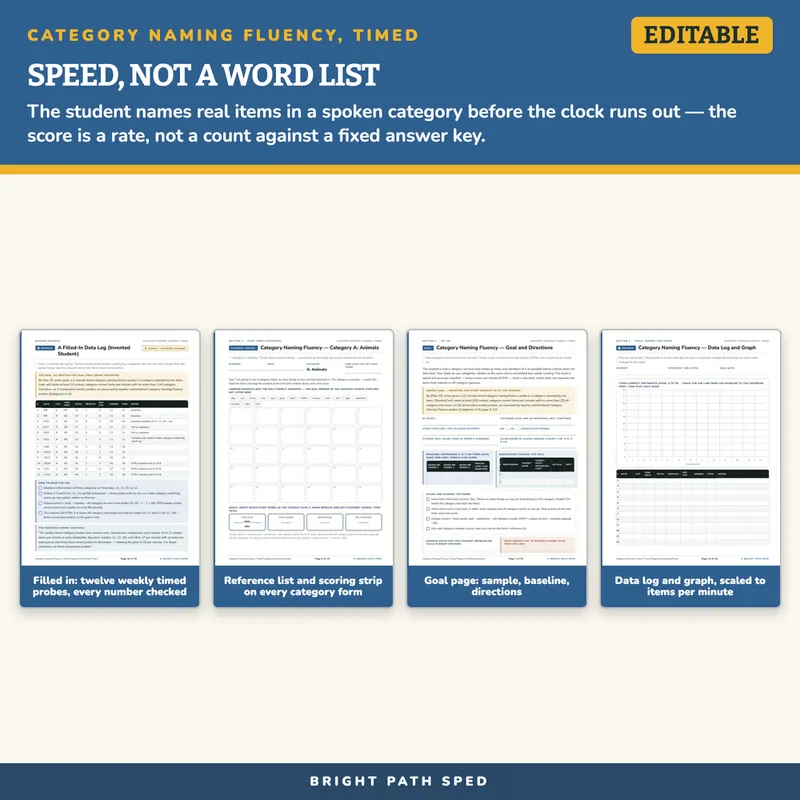
The store's existing Category Naming Progress Monitoring Probes is a reading task: a student reads four printed words that already share a category and writes the category's name, untimed, scored right or wrong out of ten. This is a different skill entirely — a spoken, generative one. The student hears a category out loud and names as many real members of it as possible before a team-set clock runs out, and the adult writes down every word as it is said. The score is a rate, not a count against a fixed set: items correct per minute (ICPM), with repeated words and off-category guesses tracked separately so the rate reflects real, new, on-topic answers.
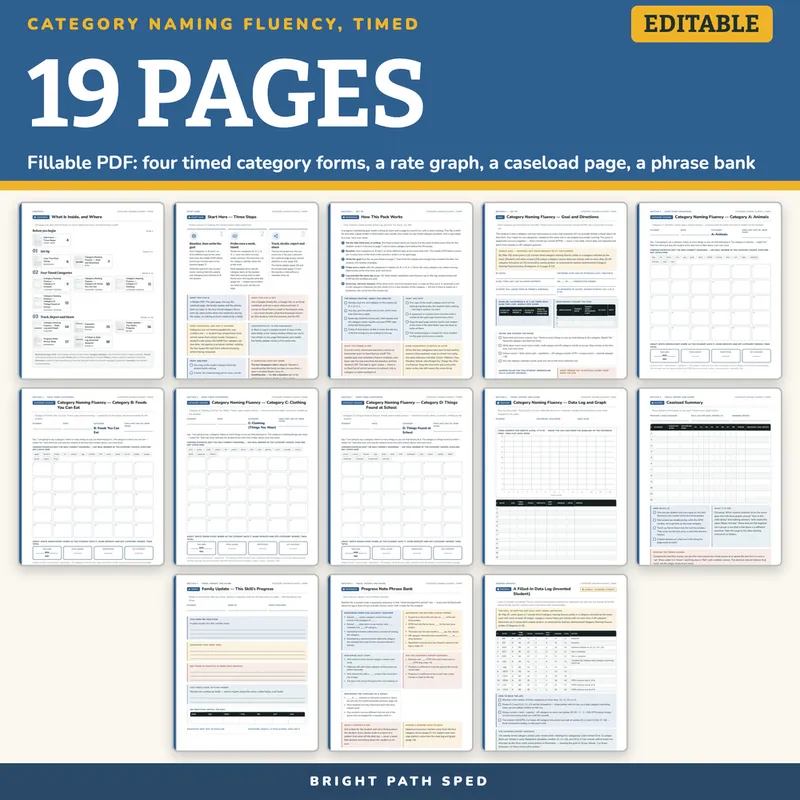
WHAT IS INCLUDED — 19 pages, 327 type-in fields
Set Up
- How This Pack Works — six numbered steps from baseline to weekly routine to reteach decision, plus a list of six more categories to rotate in later
- Category Naming Fluency — Goal and Directions — a sample goal with a six-part fill-in frame, a 3-probe baseline table, a 2-row benchmark table, and scoring directions including the ICPM (items correct per minute) formula
Four Timed Categories
- Categories A-D (Animals, Foods You Can Eat, Clothing, Things Found at School) — each with a 16-word non-exhaustive reference list to speed up a borderline scoring call, a 30-cell blank grid to write down every word the student says in order, and a total/repetitions/off-category/unique-correct scoring strip
Track, Report And Share
- Category Naming Fluency — Data Log and Graph — a 12-row log (date, category, time, total, repeats, off-category, unique, ICPM, notes) and a graph scaled 0-30 ICPM
- Caseload Summary — 12 students by 8 probes, one decision column
- Family Update — a ready-to-send communication page: what was practiced, one win, a home-practice idea, this week's rate in plain words, and a 7-day practiced table
- Progress Note Phrase Bank — 19 observable-language starters across 5 groups (speed/accuracy, pattern across probes, next steps, quarterly report sentence, caseload-wide)
- A Filled-In Data Log — a worked, invented example (Leah, first grade) with 12 weekly timed probes rotating all four categories, every total/repeat/off-category/unique/ICPM number checked against its own row
Plus a Start Here quick-start, a 3-section contents page with real page thumbnails, 3 section dividers, and a "what's next" back page.
What This Is, And What It Is Not
It is a fillable PDF. Open it in a PDF reader, click a field, type, Save As once per student. It works offline with no account or subscription. It is NOT a Google Sheets file, a Google Doc, or an Excel workbook, and it is not a norm-referenced test or a screener — it carries no benchmark score or fixed fluency cutoff anywhere in the file. The four timed category forms print; the goal page, log, caseload page, family update and phrase bank are type-in.
It is not the store's existing Category Naming Progress Monitoring Probes, which is untimed, closed-set and reading-based: four printed words already share a category and the student reads them and writes the category name. This file prints no words at all for the student — the task is spoken, open-ended and timed, and the score is a rate (items per minute), not a right/wrong count out of ten. It is also not the store's picture-based Category Naming and Classification Picture Cards, a pre-reading, un-timed naming tool. Any real member of the named category counts as correct, even one not on a form's reference list; the list exists to speed up the adult's own in-the-moment judgment call, never to limit the answer — the same judgment call any oral probe asks a teacher to make.
It is not a curriculum, a clinical tool, or a rule about how many items per minute counts as "fluent." What fluent enough means for a given student is the team's own judgment, written in from the baseline and the IEP; this file never sets that number on its own. No age, eligibility or IDEA-timeline claim anywhere; no health data is pre-filled, and the example student (Leah) is invented and named as such on page 18.
Who This Is For
Speech-language pathologists, special education teachers and case managers who need a timed, repeatable way to track word-retrieval and category naming speed — not just whether a student can name a category member, but how many real, new, on-topic members they can produce against a clock.
If You Want More
Category Naming Progress Monitoring Probes is the untimed, reading-and-writing companion — four printed words share a category and the student writes its name. Rapid Automatic Naming (RAN) Mixed-Stimulus Probes is another timed naming-speed probe (letters, numbers, shapes and colors instead of categories). Math Counting Fluency and Number Identification Speed Probes uses the same goal-log-graph shape for a math skill.