Clothing and Shopping Picture Cards
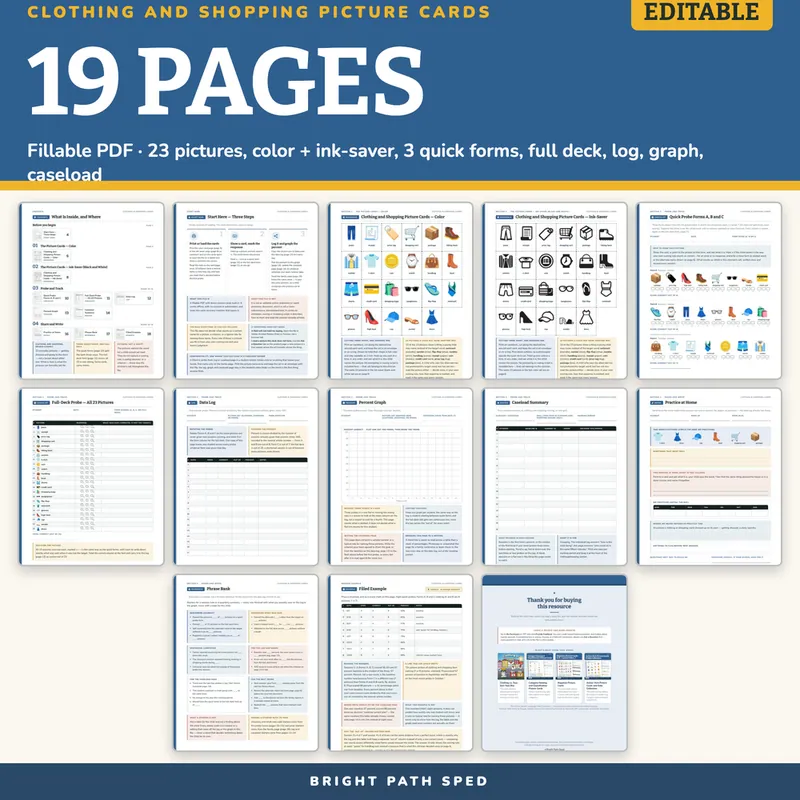
- 19 pages
- Not Grade Specific
$3.50
DownloadOr get it with All-Access: pick any 20 resources a month for $7.
New here? Your first month of All-Access is half off with code TEACHERTOK
Already bought this, or a member?
Instant download. One teacher's license: colleagues need their own copy. Each file carries a license number.
Also on Teachers Pay Teachers: see the Bright Path Sped store
About this resource
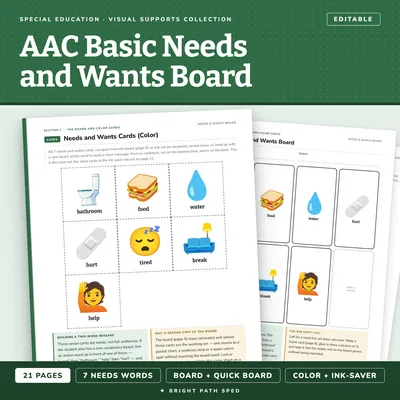
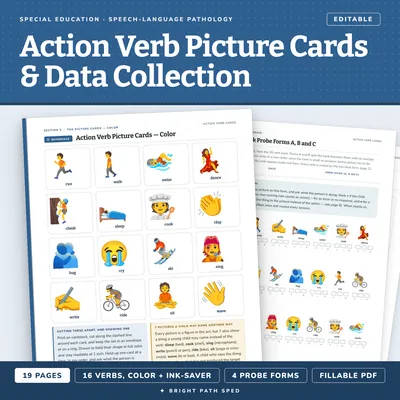
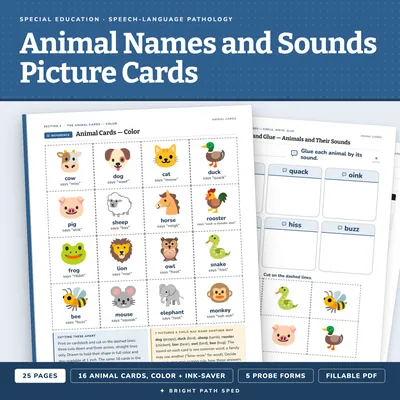
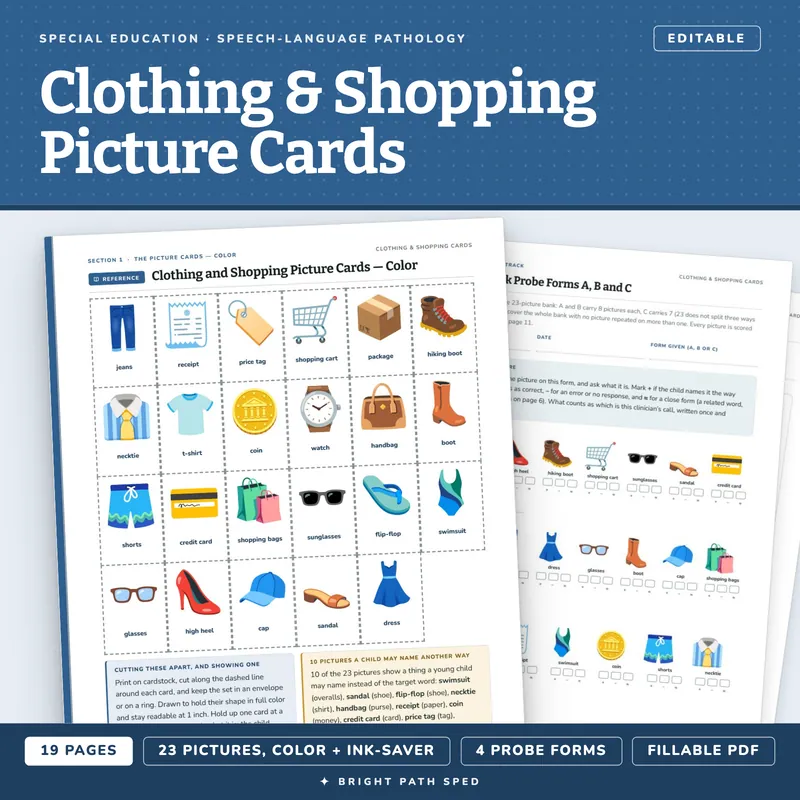
A picture card for every word -- getting dressed and going to the store, twenty-three everyday pictures in all. Hold up a card and ask what it is; the child names the picture. This is a naming and data-collection task, not a lesson about clothing or shopping, and the file never decides what counts as a correct answer; that stays your own scoring rule.
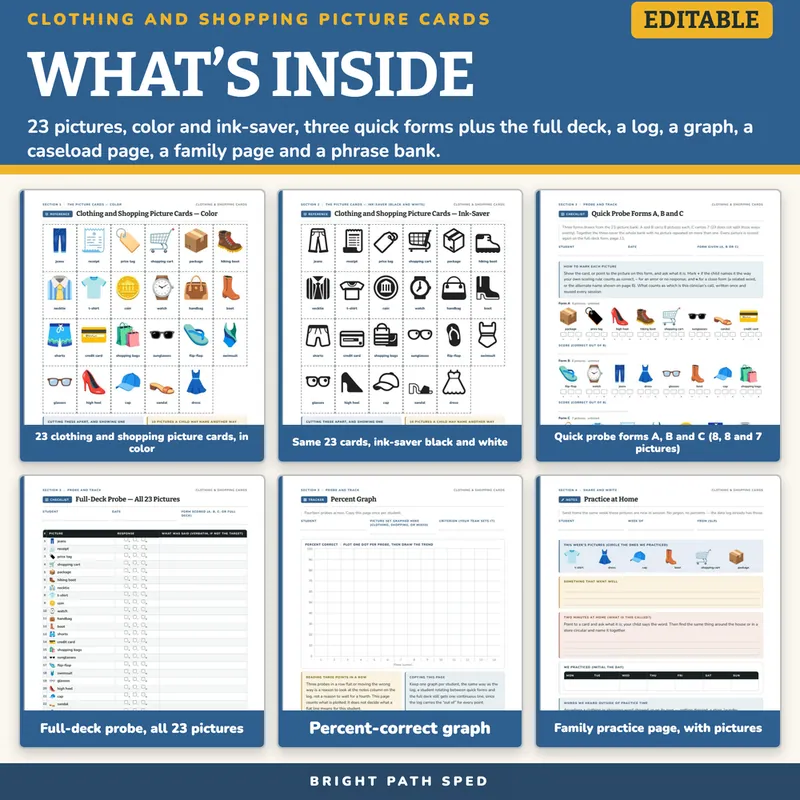
WHAT IS INCLUDED -- 19 pages, 383 type-in fields
Picture Cards
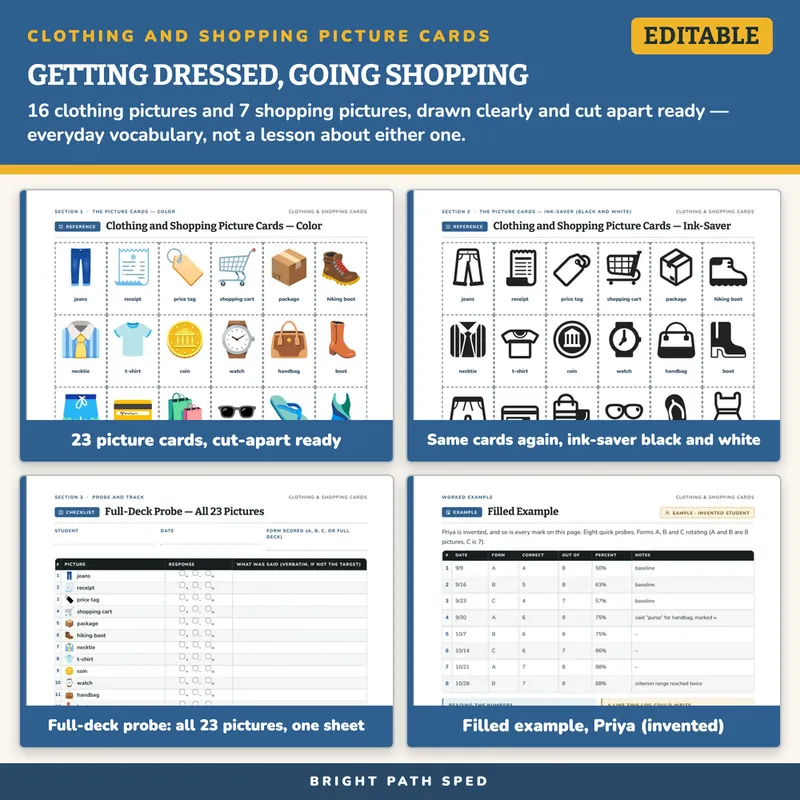
- 23 picture cards in full color, each a big cut-apart piece laid edge to edge in a 6-across grid (four rows, the last row five wide) so cutting is a few straight lines -- 16 clothing pictures (t-shirt, jeans, dress, shorts, swimsuit, high heel, sandal, flip-flop, cap, glasses, sunglasses, necktie, watch, handbag, boot, hiking boot) and 7 shopping pictures (shopping cart, shopping bags, receipt, coin, credit card, price tag, package)
- The same 23 cut pieces again as an ink-saver set in pure black outlines, for the photocopier
Probe And Track
- 3 quick picture probe forms (A and B, 8 pictures each; C, 7 pictures -- 23 does not split three ways evenly) that together cover the whole bank with no picture repeated on more than one
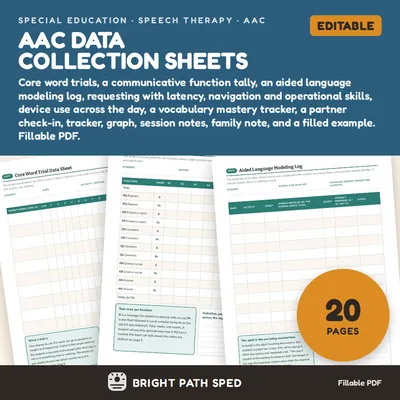
- Full-Deck Probe -- all 23 pictures on one sheet, with a verbatim column for what was actually said
- Data Log -- 17 rows: date, form, correct, out of, percent, notes
- Percent Graph -- 14 probes across, 0-100 percent grid, a field for the team's own criterion
- Caseload Summary -- 16 rows: student, baseline, current, trend, decision
Share And Write
- Practice at Home -- a family update built from six of the same pictures used in session, a weekly practice table, and lines for the words a family noticed outside of practice time
- Phrase Bank -- 21 observable-language starters across 6 groups (accuracy, what was said, carryover, the log and graph, the caseload page, the next probe)
- Filled Example -- an invented student, eight probes across three differently sized forms, every percent re-counted from its own row
What This Is, And What It Is Not
It is a fillable PDF: type into the log, graph, caseload page, family page, and probe-form headers, or print and use a pen. It works offline with no account or subscription. It is NOT an editable online slideshow or word-processor document, and it is not a norm-referenced or standardized test.
It carries no elicitation, cueing or modeling script. It does not decide what counts as a correct name for a picture, a criterion, or a typical rate for naming these items -- every one of those is this clinician's own call, written once and reused every session. Pictures replace the printed word list a child cannot yet read; they do not replace the clinician's scoring rule.
Who This Is For
Speech-language pathologists and special education teams with young or pre-reading students on a vocabulary or expressive-language naming goal, and the families who get the practice page sent home.
Pictures: Noto Emoji by Google, Apache License 2.0 (color); Fluent Emoji by Microsoft, MIT License (ink-saver black and white).