Colonial Life Worksheets
- 41 pages
- 5th, 6th, 7th, 8th
$2.50 $5.00 on Teachers Pay Teachers
Half the Teachers Pay Teachers price. The same PDF, sold direct.
DownloadOr get it with All-Access: pick any 20 resources a month for $7.
New here? Your first month of All-Access is half off with code TEACHERTOK
Already bought this, or a member?
Instant download. One teacher's license: colleagues need their own copy. Each file carries a license number.
Also on Teachers Pay Teachers: see the Bright Path Sped store
About this resource
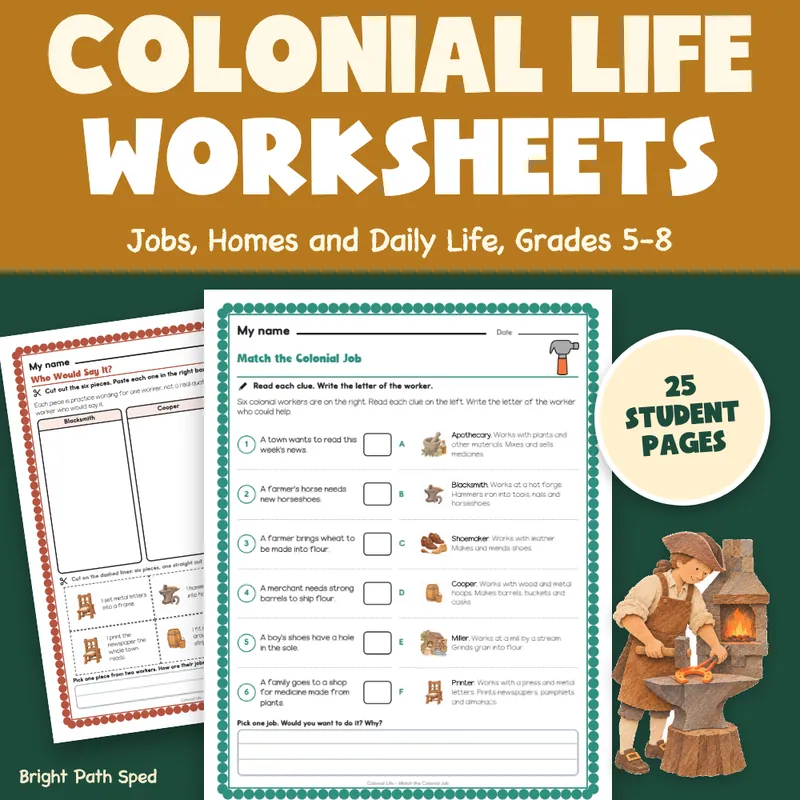
Teaching colonial life and want more than a one-page reading? This is a complete set for grades 5-8 on how ordinary people lived in the thirteen colonies: five short readings, original to this file, on homes, food, jobs, school, and play and clothes. Every reading names New England, the Middle Colonies and the Southern Colonies, so students see how the land and the weather shaped daily life. Each reading has a cause box and an effect box with room to write, and two checks to answer with a letter. Students match six colonial workers (blacksmith, cooper, printer, apothecary, miller and shoemaker) to the clue that fits, sort facts by region, fill in a three-region chart, compare colonial times with today, complete a cause and effect chain, write a letter as a colonial child, write what three children in three regions might have said, check true or false and fix the false ones, answer short questions with room for four lines each, plan and write a claim-evidence-reasoning paragraph, sort by hand, and take a twelve-item quiz. Answer keys give the letters, the sort answers and a sample for every open answer.
EVERYTHING INSIDE (41 pages)
- 25 student pages in sixteen kinds of page, each with a name line and one short instruction
- 66 scored items spread over fourteen pages, every answer taken from the same lists that print on the page
- 5 readings of about 159 to 178 words each, each with a cause box, an effect box (3 ruled lines each) and 2 checks (10 checks in all)
- 1 Before You Read page (three regions, home and food, work and school) with two write-in boxes
- 1 True or False? Fix It page: 6 statements, with a fix-it line for each false one
- 1 Words to Know page: match 8 words (hearth, hornbook, apprentice, trade, cooper, apothecary, almanac, colony) to their meanings
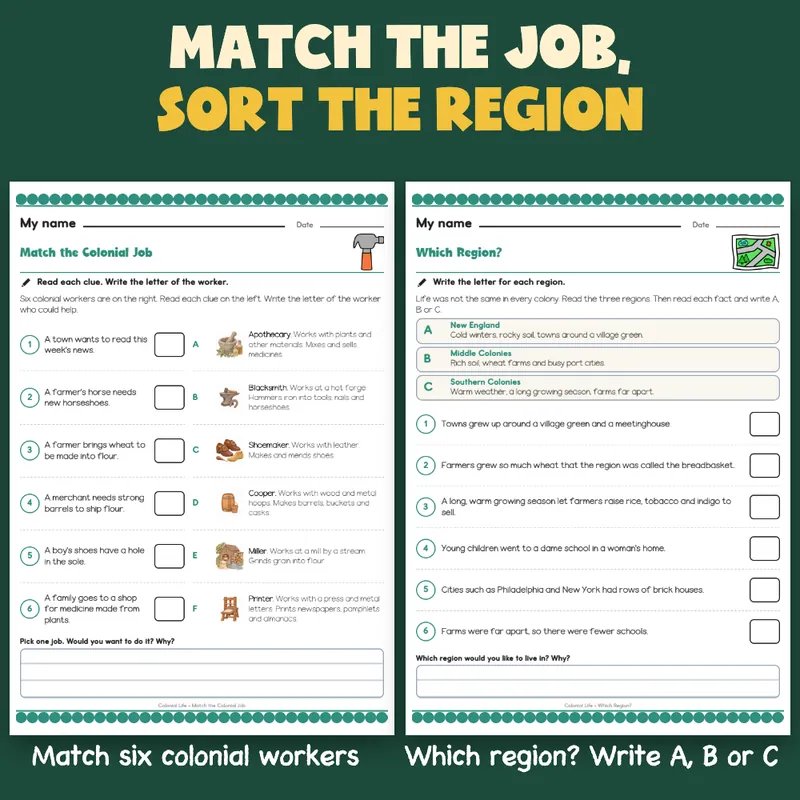
- 1 Match the Colonial Job page: 6 workers and 6 clues
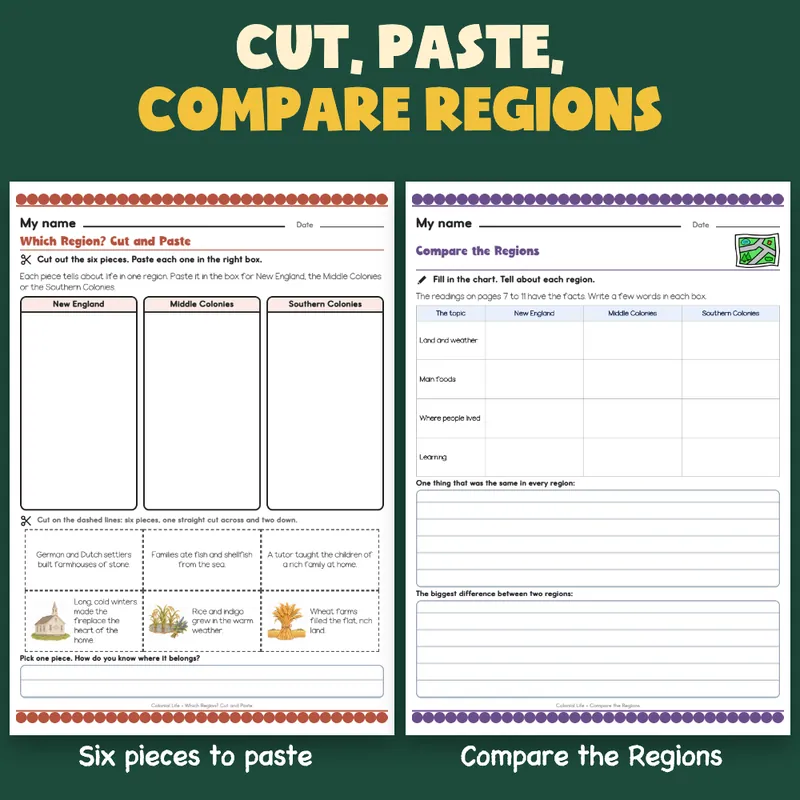
- 1 Which Region? page: 3 regions and 6 facts to sort with a letter; 1 Compare the Regions chart (4 topics by 3 regions); 1 Then and Now chart (5 rows)
- 1 Cause and Effect Chain page (4 effects to write, 2 causes to write)
- 1 A Letter to a Cousin page (a colonial child writes home, with a plan and a ruled letter) and 1 Three Children, Three Regions page (3 roles)
- 6 short-answer questions across two pages, 4 ruled lines each
- 2 claim-evidence-reasoning pages: an organizer and an 18-line paragraph page
- 12-item quiz across two pages; 1 self check (8 statements)
- 18 cut-and-paste pieces on 3 sort mats (which region; who would say it: blacksmith, cooper or printer; homes, food, or school and play), 6 pieces each in a 3 by 2 grid
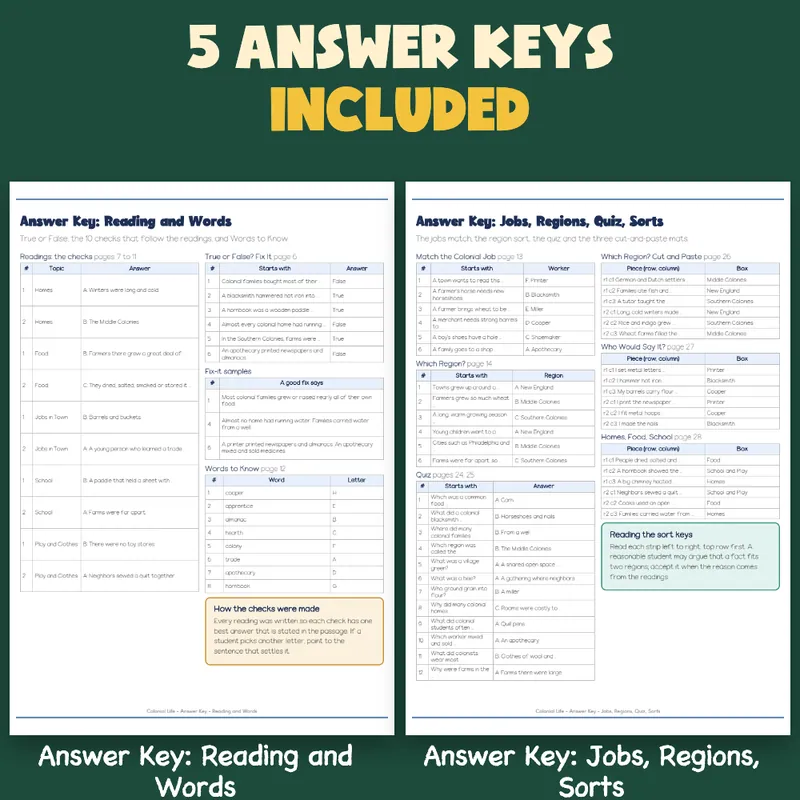
- 5 answer keys with a sample for every open answer; 1 tracker, 1 class grid, 1 team note, 1 family page
- 1 filled example (an invented student), 1 phrase bank (17 starters in 6 groups)
- Start Here and a how-to-read-a-page page
How To Use It
1. Start with Before You Read and True or False to find out what students already know.
2. Hand out one reading at a time. Students read, write the cause and the effect, and answer two checks.
3. Use the jobs match, the region sort and the two charts to compare, then the letter and the three children to write.
4. Finish with the quiz and a cut-and-paste sort. Score with the answer keys and the tracker.
A Short Account, Not A Full Textbook
The readings stick to facts found in standard grade 5-8 history sources: houses, hearths and chimneys, corn and wheat, the work of a blacksmith or a printer, hornbooks and dame schools, husking and quilting bees. They are short summaries written for this file, and they say plainly that on large Southern farms the work was done by enslaved Africans who were forced to work without pay. The set does not try to teach that history in full, so add your own textbook or source for more depth. The practice wording on the who-would-say-it sort and the three-children page is written for this file; nothing is a quotation and no source is invented. No real person is pictured.
Built For The Student Holding The Page
A "My name" line, one short instruction with a small picture cue, a plain scalloped border and big ruled boxes. Nothing on a student page is written for an adult: the keys and records are on separate teacher pages. The cut pages have six pieces in a strip-and-grid layout, edge to edge, so there are only a few straight cuts. The file prints clean in black and white.
Type In, Or Print
The name line, every answer box, every check box and every ruled work box are type-in fields in any PDF reader: click one, type, then save. This is a fillable PDF; it is not a Google Slides or PowerPoint file.
What This Is, And What It Is Not
A set of history readings and practice pages with the record-keeping around it. It is not a timed test, a screener, a clinical tool, or a claim about any student's age or rate of progress. There is no IEP goal language or eligibility wording anywhere in the file, and no claim of alignment to any standard. The only student in the file is an invented example, and it says so.
Who This Is For
Teachers of social studies in grades 5-8, special education and resource teachers who co-teach it, and families who want a clear, low-prep set on daily life in the American colonies.
If You Want More
Colonial Regions Worksheets | Compare New England, Middle, Southern Grades 6-8; 13 Colonies Worksheets | Regions, Sort, Match, Read and Write 5th-8th Grade; Stamp Act Worksheets | Reading, Cause and Effect, Colonial Response Grades 5-8.