Community Signs Skill Pack
- 77 pages
- Not Grade Specific
$2.50 $5.00 on Teachers Pay Teachers
Half the Teachers Pay Teachers price. The same PDF, sold direct.
DownloadOr get it with All-Access: pick any 20 resources a month for $7.
New here? Your first month of All-Access is half off with code TEACHERTOK
Already bought this, or a member?
Instant download. One teacher's license: colleagues need their own copy. Each file carries a license number.
Also on Teachers Pay Teachers: see the Bright Path Sped store
About this resource
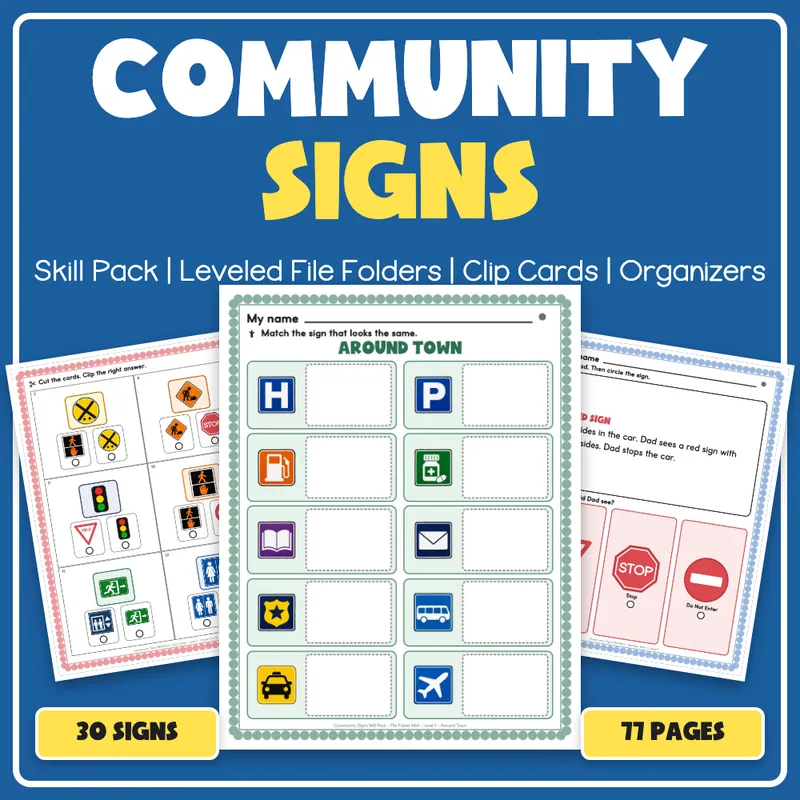
Children read signs all day: on the road, inside a building, around town. This is 77 pages that teach what 30 common signs look like, say and tell us, in three kinds of hands-on practice and at three levels. Print what you need, or type into the pages first.
EVERYTHING INSIDE (77 pages)
- 30 signs in three groups of ten. On the Road: Stop, Yield, Do Not Enter, Speed Limit, One Way, No Parking, Railroad Crossing, Road Work, Traffic Light, Walk Signal. In a Building: Exit, Restroom, Accessible, Elevator, Wet Floor, Wash Hands, No Smoking, Poison, Recycle, First Aid. Around Town: Hospital, Parking, Gas, Pharmacy, Library, Post Office, Police, Bus Stop, Taxi, Airport. Most signs are real pictures (a bus, a wheelchair symbol, a skull and crossbones, a gas pump), not just words.
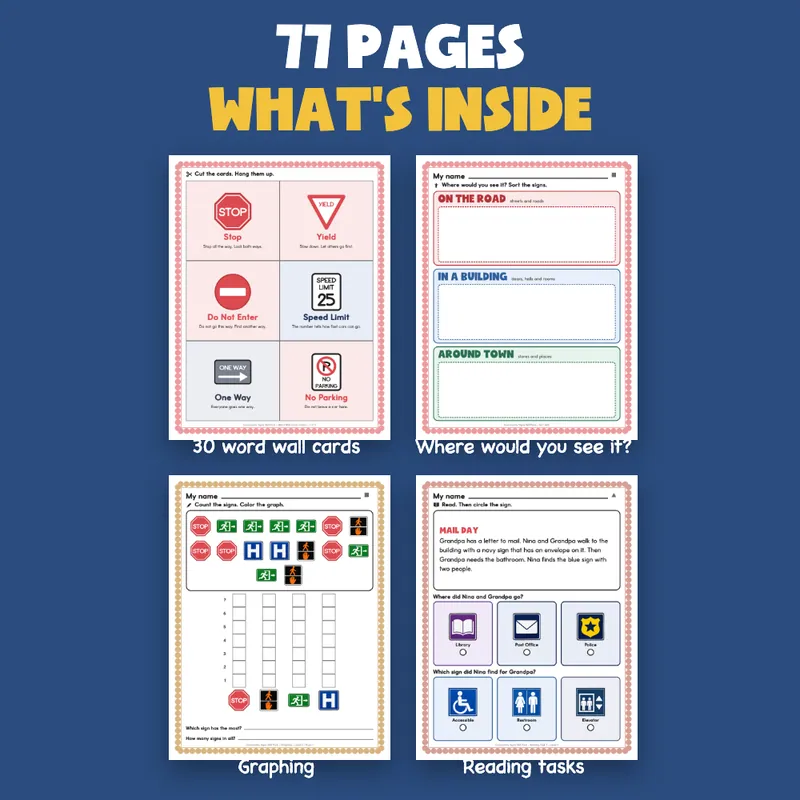
- 30 word wall cards (a big sign, the word, and one line in kid words that says what it tells us), 6 to a page, in color and again in ink-saver.
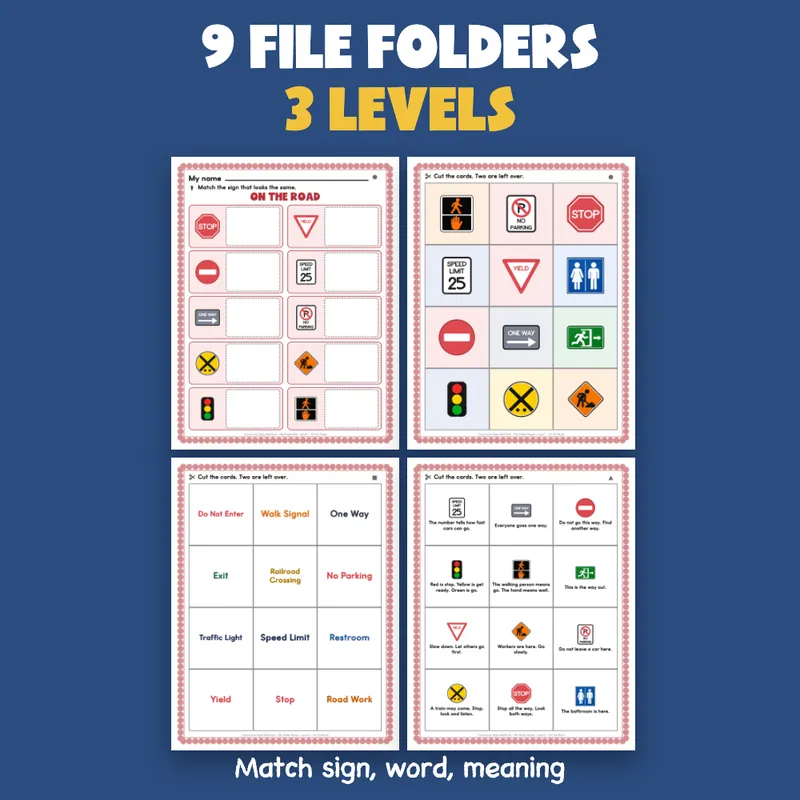
- 9 leveled file folders: a mat and a piece page for each. Level 1 matches the same sign, Level 2 matches a sign to its word, Level 3 matches a word to what the sign tells us. Each piece page has 12 pieces for the 10 boxes on its mat, so two are left over on purpose.
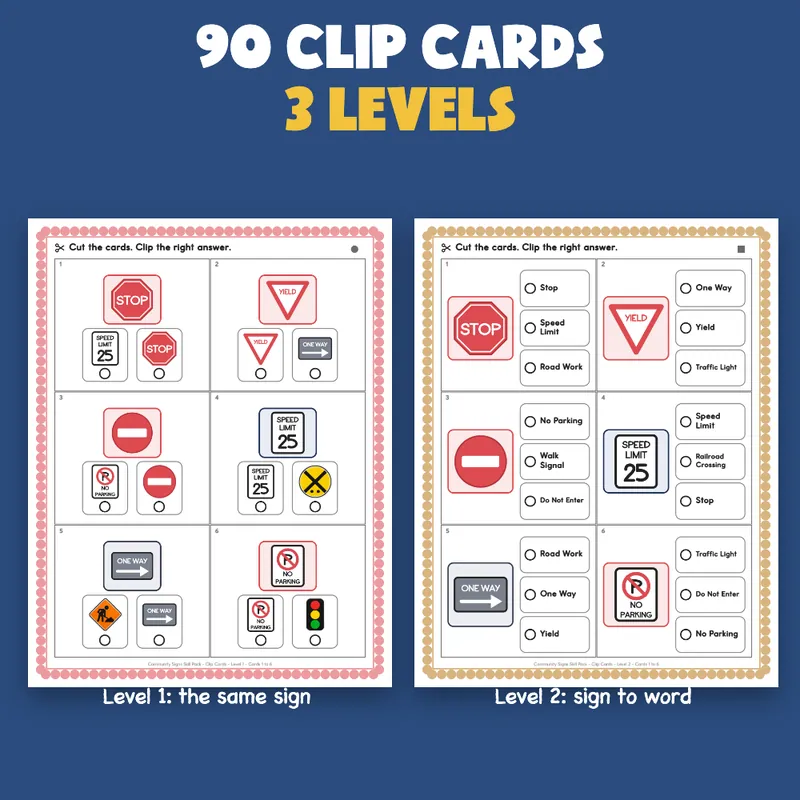
- 90 clip cards, 30 at each of 3 levels, 6 to a page. Clip a clothespin on the right answer.
- 9 vocabulary organizer pages, 3 levels: trace the word and write it, write the word and where you see it, write the word and what it tells us.
- A where-would-you-see-it sort: 1 mat (On the Road, In a Building, Around Town) and 2 piece pages of 15 signs each.
- 4 graphing pages at 2 levels: count the signs, color the graph, answer questions. The second level has 6 signs and asks how many more.
- 6 short reading tasks with picture choices (8 questions in all), from two sentences to a short story.
- Teacher pages: Start Here with a which-page-when chart, how to build and use it, 2 answer keys, a data sheet, a filled example (an invented student, 8 sessions), a note to families, and a phrase bank of 20 starters in 5 groups.
- Contents, terms of use and a thank-you page with what's next.
How To Use It
Pick a format and a level. Print the mat and piece pages for a folder, glue the mat inside a file folder, cut the pieces and keep them in a bag or an envelope. Cut the clip cards apart and clip the answer. Use the organizers for writing, the sort for talking about where signs live, and the graphs and reading tasks for math and reading time. Record each session on the data sheet.
Built For The Child Holding The Page
Every student page has a big "My name" line where a child writes, one short direction with a picture, big signs and room to write. A small shape in the corner marks the level: a circle for starting, a square for building, a triangle for ready for more. Cut pages are laid out edge to edge in a short grid so each cut is one straight line. Signs are pictures in true sign colors, with a small picture on the Level 3 sentence cards too.
Type In, Or Print
The name lines, organizers, graphing questions, reading answers, data sheet and family note are type-in fields in any PDF reader. You can also print any page and write by hand. Print at 100 percent with fit-to-page turned off. This is a fillable PDF; it is not a Google Slides or PowerPoint file.
Who This Is For
Special education and resource room teachers, life skills and community-based instruction units, early elementary classrooms, paraprofessionals, substitutes, and families who want to practice the same signs at home.
What This Is, And What It Is Not
Classroom working paper for learning what common signs look like and say. The signs are simplified teaching pictures made for this product and can look a little different from the ones where you live, so the file suggests comparing with your own streets. It is not a driving, safety or pedestrian training program, and it sets no rules: your school and your family decide those, and the family note has blanks for your words. The filled example is an invented student and says so.