Complete Sentences and Fragments Worksheets
- 34 pages
- 1st, 2nd
$4.00
DownloadOr get it with All-Access: pick any 20 resources a month for $7.
New here? Your first month of All-Access is half off with code TEACHERTOK
Already bought this, or a member?
Instant download. One teacher's license: colleagues need their own copy. Each file carries a license number.
Also on Teachers Pay Teachers: see the Bright Path Sped store
About this resource
"The little dog" is not a sentence yet, and "ran to the gate" is not one either. Put them together and it is. This is a complete sentences and fragments kit for first and second grade built on one idea a child can see: a sentence has a WHO and a DOES WHAT, drawn as two puzzle pieces that fit together. Children sort, fix and write, with primary handwriting lines and room to work on every page they write on.
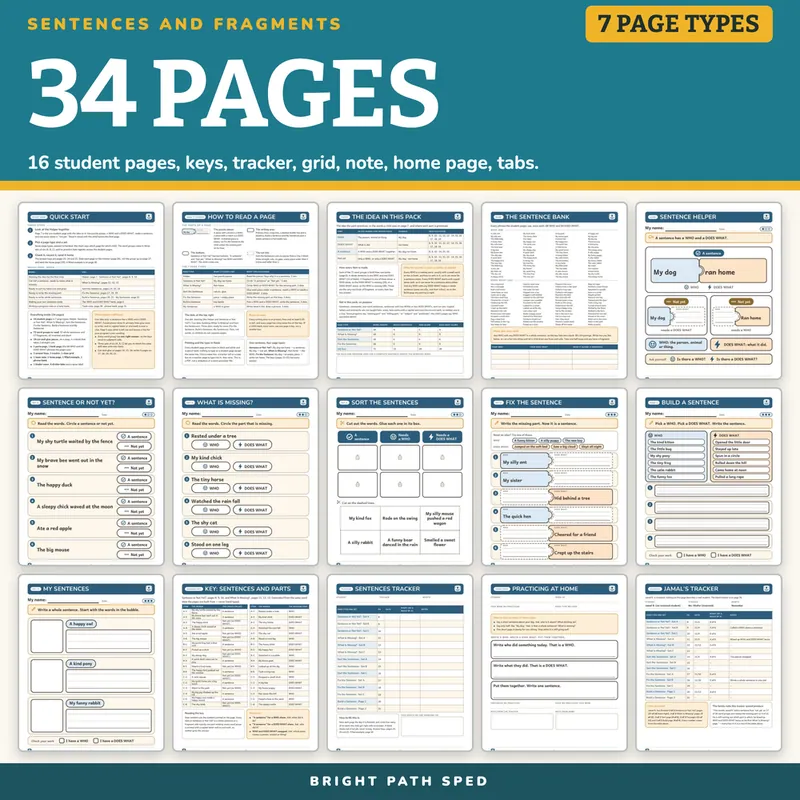
EVERYTHING INSIDE (34 pages)
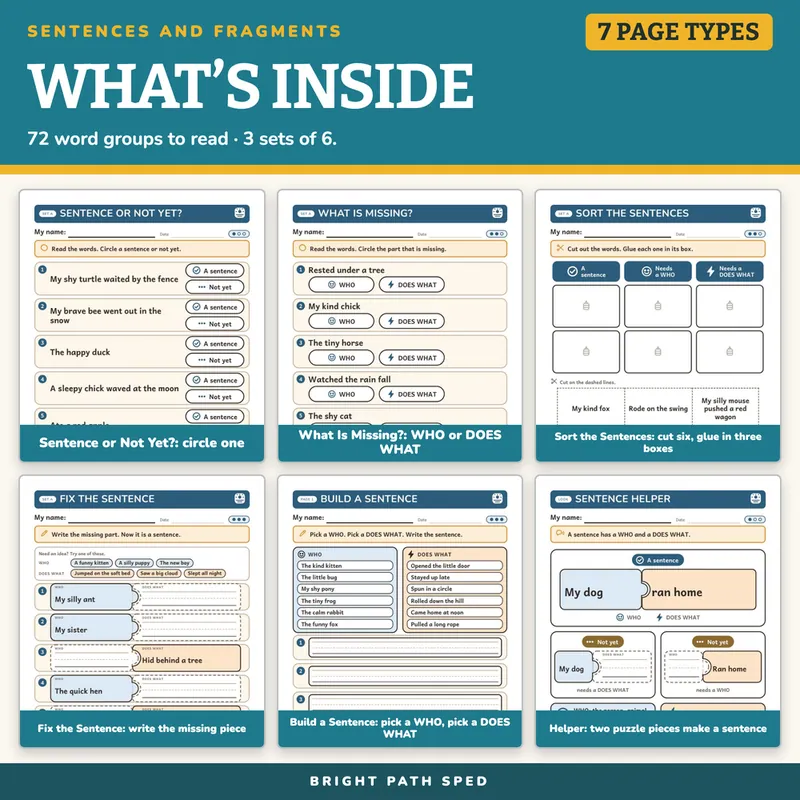
- 16 student pages in 7 page types (below), each with a big "My name" line and one short instruction
- 72 word groups to read on the practice pages: 15 whole sentences and 57 fragments (29 with the DOES WHAT missing, 28 with the WHO missing), all invented and short; no practice item repeats across the student pages
- 18 cut-and-glue pieces, six a page, in a block that takes 3 straight cuts
- 8 Build a Sentence lines on primary lines, from two banks of six WHO and six DOES WHAT a page
- 1 parts page for the teacher (with a blank line for your program's own wording) and 1 bank page listing the 68 WHO and 64 DOES WHAT phrases the pages use, with a table to make your own
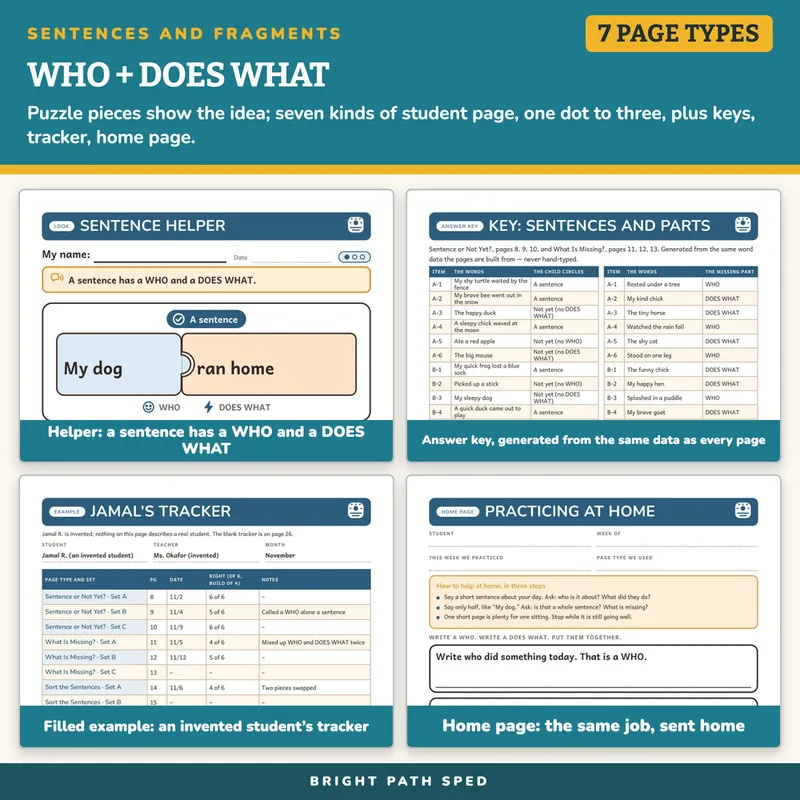
- 3 answer keys generated from the same data as the pages
- 1 tracker (14 rows), 1 class progress grid, 1 team note, 1 home page, 1 filled example (an invented student), 1 phrase bank (17 starters)
- 1 binder cover and 6 divider tabs with a spine label to cut out
- Start Here, a how-to-read-a-page page, and a back page
THE SEVEN PAGE TYPES (dots show the level, never color)
1. Sentence Helper (1 dot) — two puzzle pieces, a WHO and a DOES WHAT, make a sentence; one piece alone is "not yet."
2. Sentence or Not Yet? (1 dot, 3 pages) — six word groups a page; the child circles "A sentence" or "Not yet."
3. What Is Missing? (2 dots, 3 pages) — a fragment; the child circles WHO or DOES WHAT for the part that is missing.
4. Sort the Sentences (2 dots, 3 pages) — cut six pieces from a 3 by 2 block (three straight cuts) and glue each one under "A sentence," "Needs a WHO" or "Needs a DOES WHAT."
5. Fix the Sentence (3 dots, 3 pages) — a puzzle piece with an empty dashed piece beside it; the child writes the missing part on primary lines. An idea strip on each page is there for children who need it.
6. Build a Sentence (3 dots, 2 pages) — a WHO bank and a DOES WHAT bank; the child picks one of each and writes four sentences a page on primary lines.
7. My Sentences (3 dots, 1 page) — a WHO is given; the child writes what it did and draws a picture.
The word groups come in three sets of six (A, B, C), so a child never meets the same one twice.
Built For The Child Holding The Page
A big "My name" line, one short instruction with a picture, large rounded letters, and every writing area on primary lines at least 0.65 inch tall on the pages children write on. Nothing on a student page is written for an adult. Cutting is limited to Sort the Sentences: six pieces a page, touching edge to edge, each wider than 2 inches and taller than 1.
One Idea, No Clues
Every item is built from two banks. A whole sentence is one WHO and one DOES WHAT; a fragment is one of them alone. Every WHO has no verb in it and every DOES WHAT starts with a past-tense verb, so each fragment is missing exactly one part. Every item starts with a capital letter and none has an end mark, so neither one gives the answer.
Type In, Or Print
The name and date lines, the tracker, the class grid, the team note, the home page and the parts-page note box are type-in fields in any PDF reader. The words a student writes in the boxes are pencil work. This is a fillable PDF; it is not a Google Slides or PowerPoint file.
Who This Is For
First and second grade classrooms, self-contained and resource rooms, and any teacher working with an older student who still needs to hear what makes a whole sentence. The home page sends the same job to a family; the team note hands off what changed since the last meeting.
What This Is, And What It Is Not
Complete sentence and fragment practice with the record-keeping around it. It is not a probe, a goal bank or a score sheet, not a writing assessment, and not a claim about any student's age or rate of progress. Questions, commands, one-word sentences, run-ons, capital letters and end marks are not practiced here. Some programs say "naming part" and "telling part," or "subject" and "predicate"; the children's pages say WHO and DOES WHAT, and the teacher pages say so.