Converting Improper Fractions to Mixed Numbers Probes
- 27 pages
- 4th, 5th
$2.00 $4.00 on Teachers Pay Teachers
Half the Teachers Pay Teachers price. The same PDF, sold direct.
DownloadOr get it with All-Access: pick any 20 resources a month for $7.
New here? Your first month of All-Access is half off with code TEACHERTOK
Already bought this, or a member?
Instant download. One teacher's license: colleagues need their own copy. Each file carries a license number.
Also on Teachers Pay Teachers: see the Bright Path Sped store
About this resource
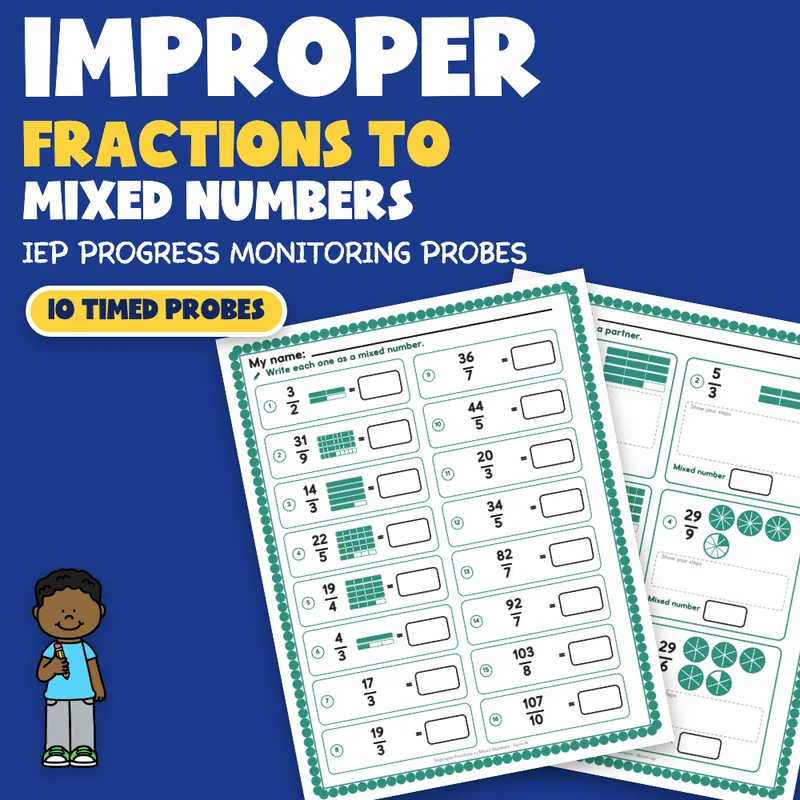
Converting improper fractions to mixed numbers, measured every week. An IEP goal frame, ten equivalent timed probe forms, answer keys with a score box and a graph scaled to the probe. Baseline in the first week, goal written by the end of it, first data point on Friday.
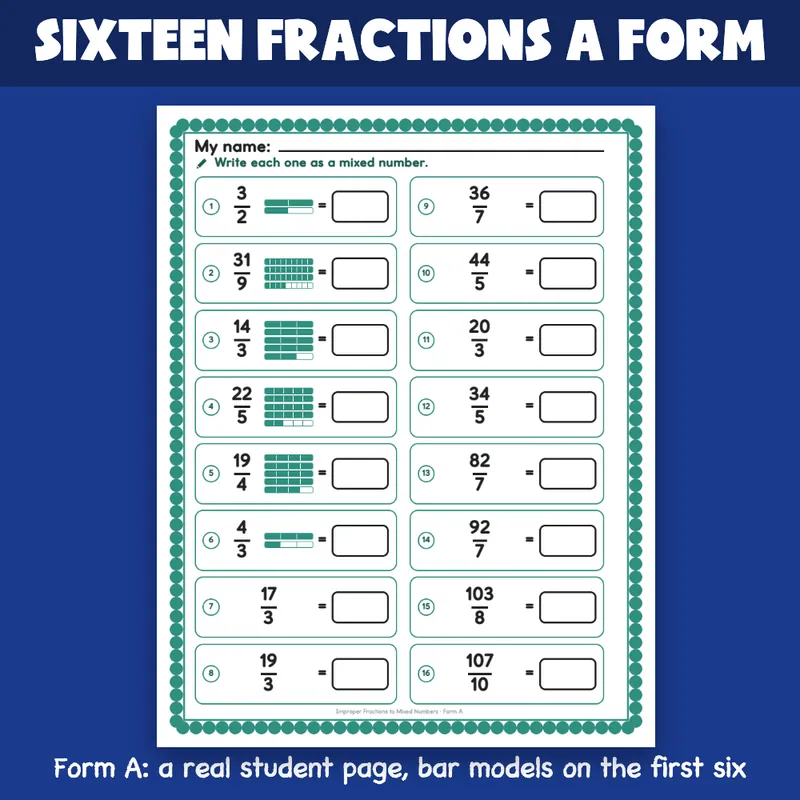
Every form is one page of sixteen improper fractions, numbered 1 to 16, each with its own answer box. Every denominator is from 2 to 10. No fraction divides evenly, so every answer is a whole number with a leftover fraction, and every answer is in lowest terms. Items 1 to 6 have a bar model beside the fraction, items 7 to 12 are the fraction alone, and items 13 to 16 are larger. The kind of item at each number is the same on every form, so a score means the same thing on Form A and on Form J.
WHAT IS INCLUDED - 27 pages, ten timed probe forms of sixteen fractions each (160 fractions, none repeated, no two on a form worth the same), two pages of answer keys with a correct / attempted / errors box for every form, a steps page with a bar model and a circle model, a six-item warm-up page, a score bars page for the student, a directions page, a teacher notes page, a binder cover and divider tabs, a family update page
Start Here And The Goal
- A one-page quick start: six steps and which page is for which job
- A goal page with a sample goal (every bracket meant to be edited), the goal frame as type-in fields, a baseline table and three benchmark rows
- A blank for your state's standard or your district's goal code
- Lines for the time limit and scoring rules, and the supports the IEP allows
Ten Timed Forms, A Through J
- A big My name line, one short instruction with a pencil picture, and a big answer box for every fraction
- Bar models drawn beside the first six fractions on every form (sixty in all)
- No answers, goal text or scoring strip on a student sheet
Student Pages For Teaching The Steps
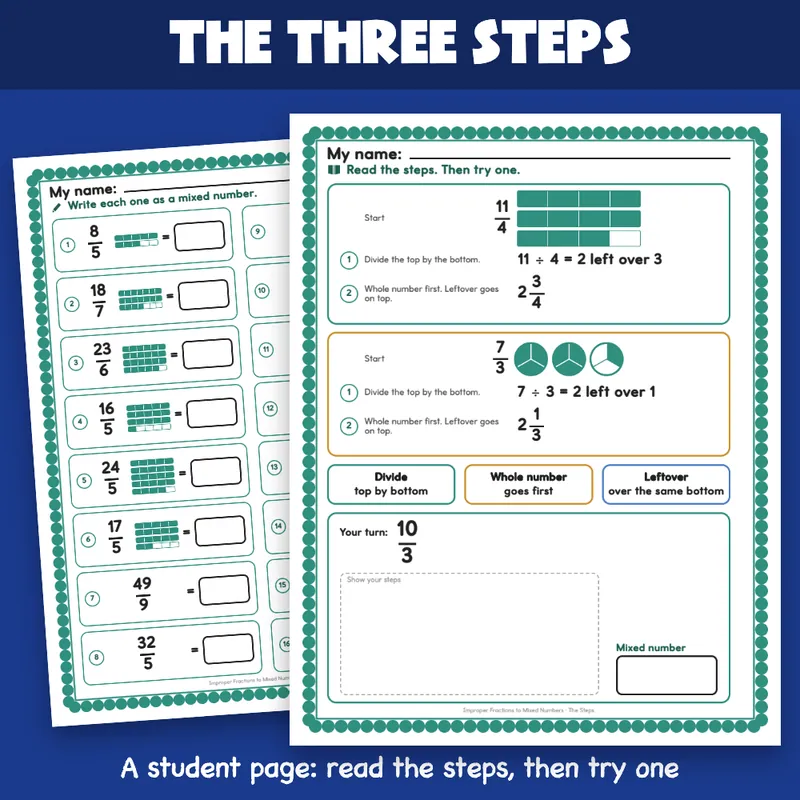
- The Steps: two worked examples (one with bars, one with circles): divide the top by the bottom, whole number first, leftover over the same bottom, and one to try
- A warm-up page of six fractions with models and work space, for a partner or a small group before the probe
- My Score Bars: twelve weeks, color a box for each one right
Directions, Answer Keys And Teacher Notes
- A directions page: what to say, what correct, attempted and errors mean, what is on every form
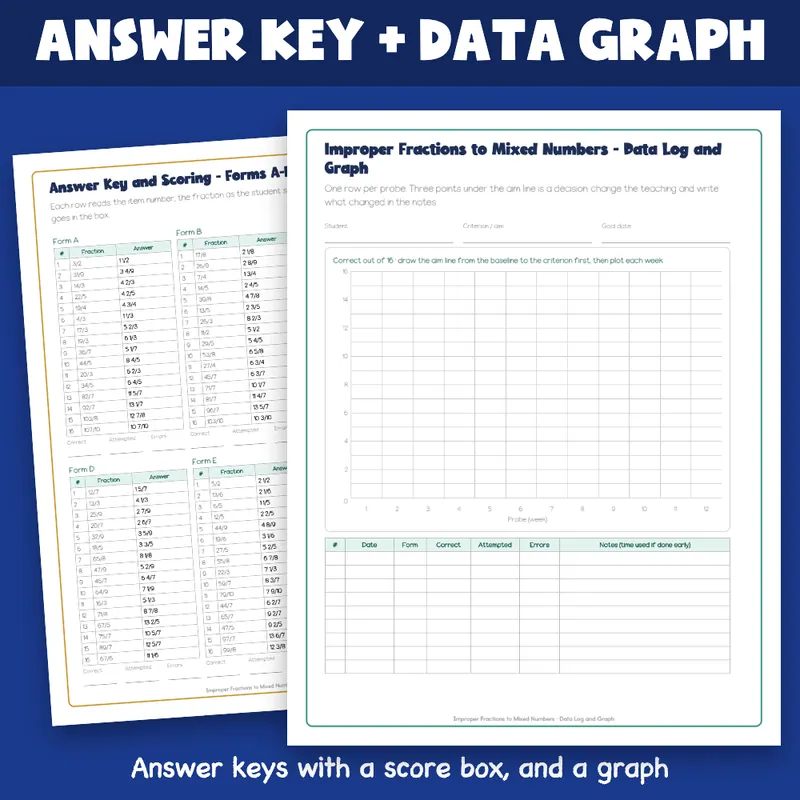
- Two answer-key pages: all ten forms, fraction and mixed number, with a correct / attempted / errors score box under each form, plus the answers to the steps page and the six warm-up items
- Reading the misses: the leftover left off, the leftover over the wrong bottom, misses on one kind of item
Data Log, Graph And Caseload
- A graph scaled 0 to 16 with twelve probe columns, and a nine-row log with correct, attempted and errors
- A caseload summary grid, a filled-in example (Priya, invented) and a family update and team handoff page
What This Is, And What It Is Not
It is a fillable PDF. The goal page, data log, caseload page, family update page and the score boxes on the answer keys are type-in fields: open the file in a PDF reader, click a line or a cell, type, and Save As once per student. The probe forms print: the student writes on paper.
It is not a norm-referenced assessment and it carries no benchmark score or "typical" rate. The time limit (one or two minutes) and the criteria in the sample goal are in brackets because your team sets them from the baseline and the student's IEP. Your district's own rules for goals and scoring go on the blank lines provided.
Who This Is For
Fourth and fifth grade special education teachers and case managers writing fraction goals, intervention teachers, and the paraprofessionals who give the weekly probe.