Counting Coins Worksheets
- 29 pages
- Kindergarten, 1st, 2nd
$4.00
DownloadOr get it with All-Access: pick any 20 resources a month for $7.
New here? Your first month of All-Access is half off with code TEACHERTOK
Already bought this, or a member?
Instant download. One teacher's license: colleagues need their own copy. Each file carries a license number.
Also on Teachers Pay Teachers: see the Bright Path Sped store
About this resource
A counting-coins kit for kindergarten through second grade: naming a coin, counting a group of one
kind, counting a mixed group of two kinds, simple coin-to-coin trades, matching a group of coins to a
target amount, and a cut-and-glue match — six genuinely different ways to practice the same skill —
plus the record-keeping a classroom or small group needs around it.
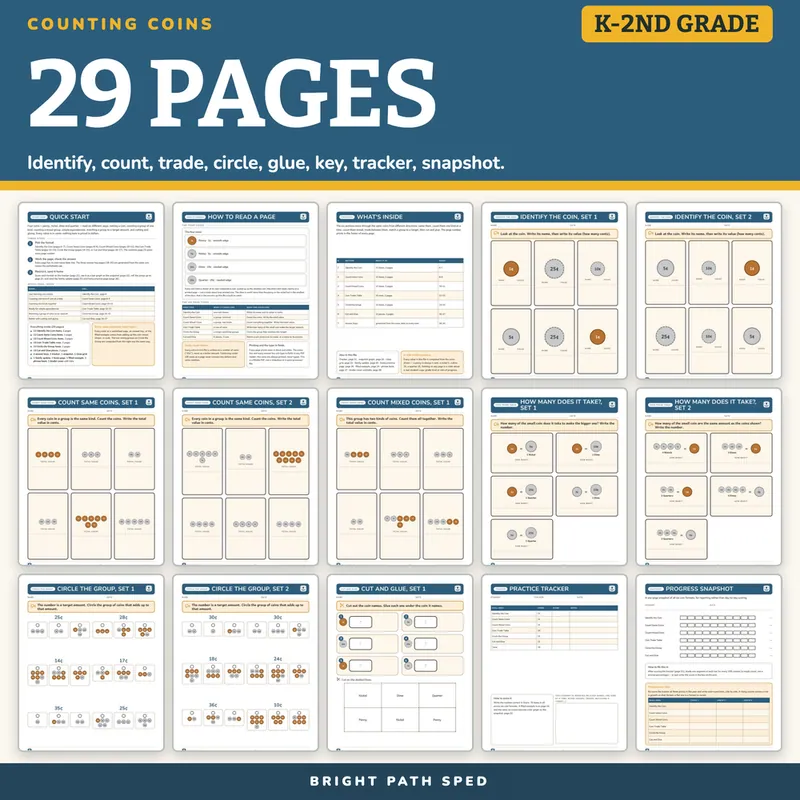
EVERYTHING INSIDE (29 pages)
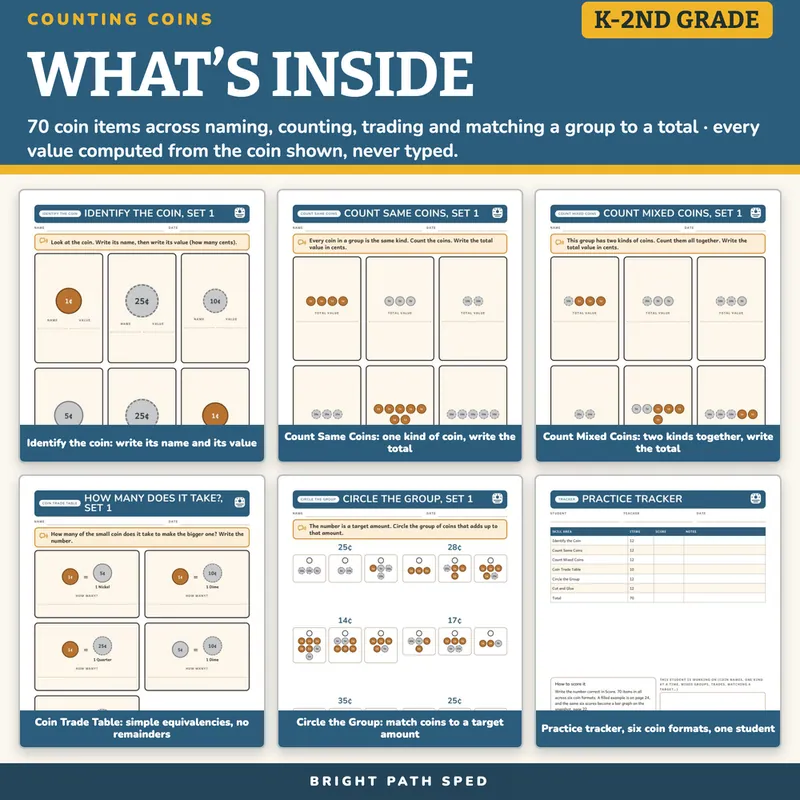
- 12 Identify the Coin items across 2 pages — one coin drawn (penny, nickel, dime or quarter); write
its name and its value in cents
- 12 Count Same Coins items across 2 pages — every coin in a group is the same kind; count them and
write the total value
- 12 Count Mixed Coins items across 2 pages — two kinds of coins in one group; count everything
together and write the total value
- 10 Coin Trade Table rows across 2 pages — simple equivalencies (how many pennies make a nickel, a
dime, a quarter; how many nickels make a dime or a quarter, and the reverse), every answer an exact
whole-number trade, never a remainder
- 12 Circle the Group items across 2 pages — a target amount and three drawn coin groups; circle the
group that matches. The two wrong groups are computed from the right one (take away one coin, or
add one penny), never a random guess
- 12 Cut and Glue pieces across 2 pages — match a coin picture to its name, or a name to its picture
- 3 answer keys, generated from the same coin values every worksheet uses
- 1 practice tracker (one student, six formats), 1 progress snapshot (a bar graph rolling the six
scores into one picture), and 1 class grid (whole class), type-in or print
- 1 family update — a note home with blanks for the week's formats and the district's own wording
- 1 home practice page — a second, self-contained practice set using real coins from a jar or a
pocket, no school materials needed
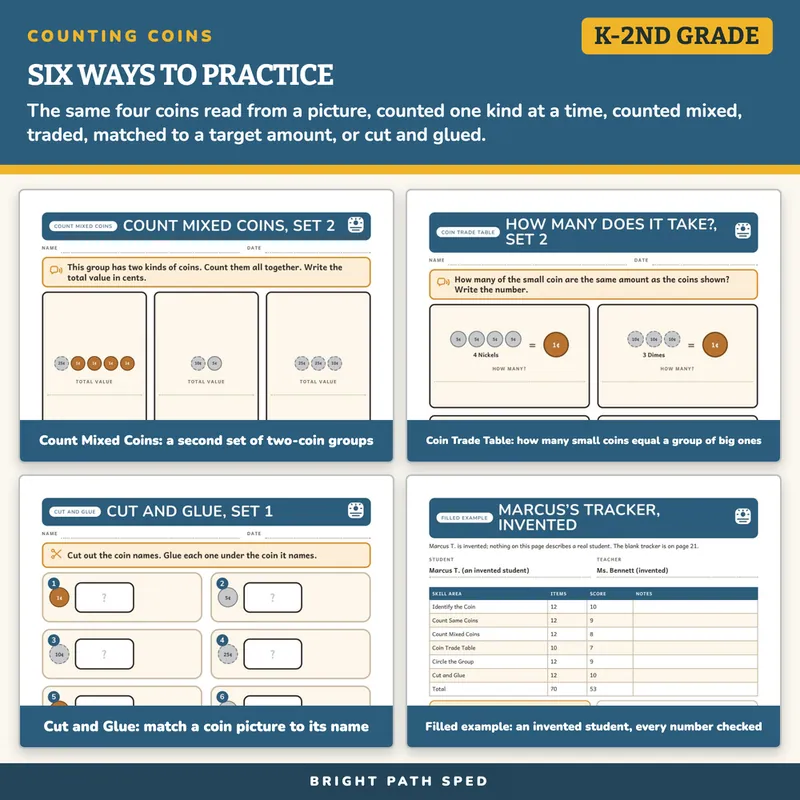
- 1 filled example — an invented student, every number checked against its own table
- 1 phrase bank — progress-note, family-note, next-step and talk-first starters
- 1 binder cover with a spine label and six divider tabs
- Start Here, a how-it-works page with a four-coin reference legend, and a contents page that gives
every page number
Every Coin Value Computed, Never Typed
Every total in this file — on a worksheet page, an answer key, or the filled example — comes from
adding up the coin values shown, in code (a penny is always 1 cent, a nickel 5, a dime 10, a quarter
25). The two wrong groups on Circle the Group are computed the same way: one takes away the group's
highest-value coin, the other adds one penny — never a hand-picked number. Every trade-table answer
is checked to be an exact division before the file is built, so a K-2 page never lands on a remainder.
Six Ways To Practice
Identify the Coin names a drawn coin and its value. Count Same Coins and Count Mixed Coins read a
group of pictures and write the total. The Coin Trade Table works simple equivalencies both
directions. Circle the Group is a quick check matching coins to a target amount. Cut and Glue matches
a picture to a name, or a name to a picture.
Cents, Never Dollars
Every value in this file is written as a number of cents (for example "25¢"), never as a dollar
amount, and every total stays under 100 cents. Nothing in this file is priced inside the PDF.
Type In, Or Print
The name and date lines, the answer lines, the tracker, the snapshot, the class grid, the family
update and the home page are type-in fields in any PDF reader; every coin is always printed, never
typed. This is a fillable PDF; it is not a Google Slides, Google Docs or PowerPoint file.
Who This Is For
Kindergarten through second-grade classrooms, self-contained and resource rooms, and any small group
working on counting coins below or above grade level.
What This Is, And What It Is Not
A coin-identification and coin-counting practice set with the record-keeping around it. It is not a
full math curriculum, not an assessment, and not a claim about any student's age, grade level or rate
of progress. The tracker has a blank line for your own scoring criteria.