Counting Money Game
- 45 pages
- 1st, 2nd, 3rd
$2.25 $4.50 on Teachers Pay Teachers
Half the Teachers Pay Teachers price. The same PDF, sold direct.
DownloadOr get it with All-Access: pick any 20 resources a month for $7.
New here? Your first month of All-Access is half off with code TEACHERTOK
Already bought this, or a member?
Instant download. One teacher's license: colleagues need their own copy. Each file carries a license number.
Also on Teachers Pay Teachers: see the Bright Path Sped store
About this resource
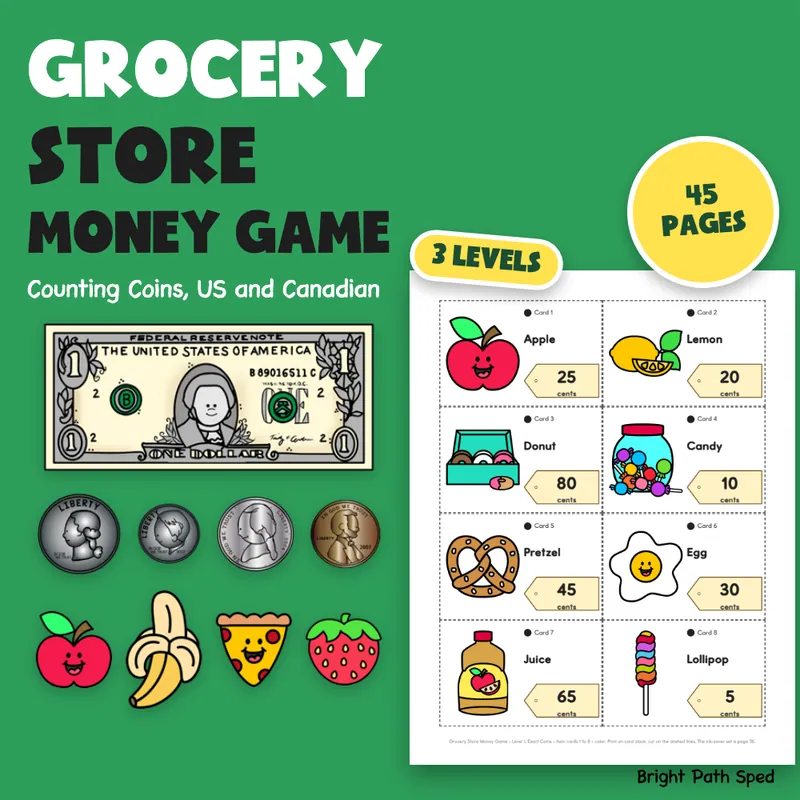
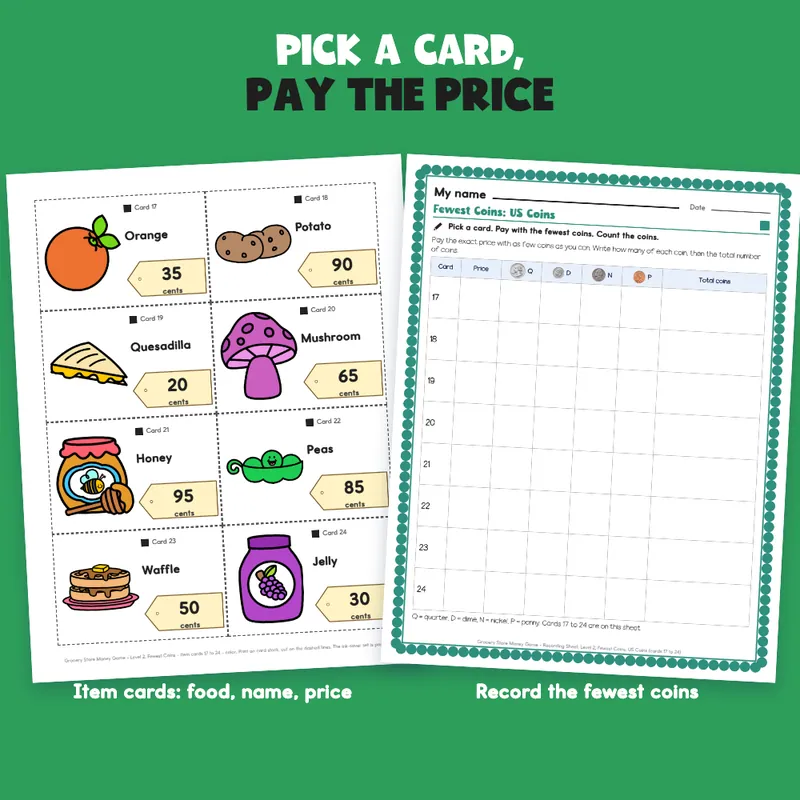
Looking for a grocery store money game that works for coin counting with a partner, and for both US and Canadian classrooms? One student is the Shopper and one is the Cashier. The Shopper turns over an item card (a food picture, its name and a price in cents), pays with coins, and the Cashier counts them. Three levels, marked by a small circle, square or triangle, take the same game from paying the exact price, to paying with the fewest coins, to deciding whether a wallet has enough money for a basket of two items. Every price is a multiple of 5 cents under 1 dollar, so the SAME 48 cards work with US coins (quarter, dime, nickel, penny) and Canadian coins (quarter, dime, nickel, loonie). Everything is practice with invented items and made-up prices.
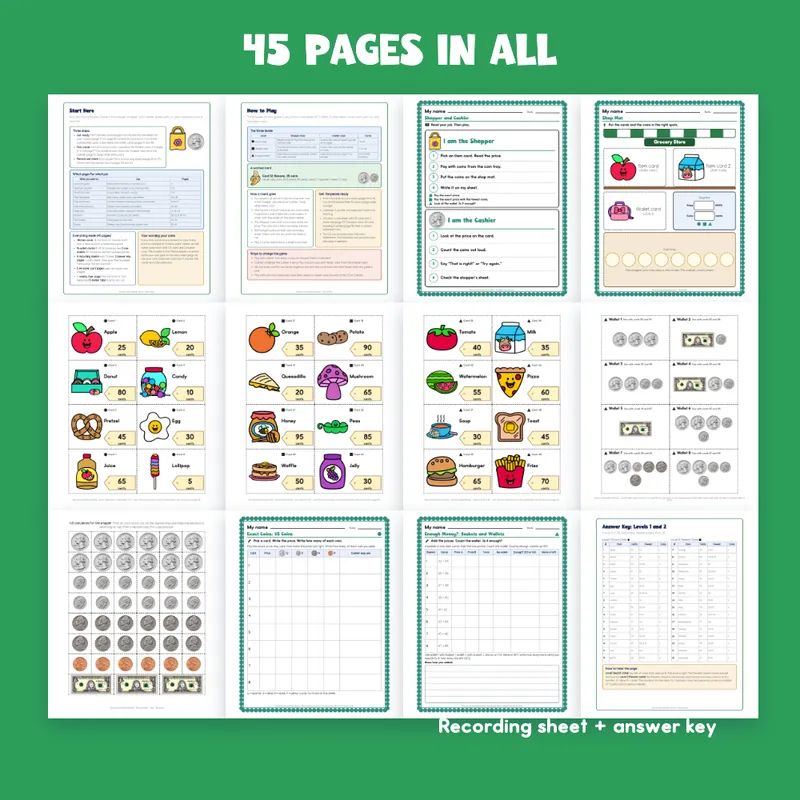
EVERYTHING INSIDE (45 pages)
- 48 item cards, 16 for each of 3 levels, 8 to a page, six sheets: a food picture, the name and a price tag in cents on every card. Prices are multiples of 5 cents from 5 to 95
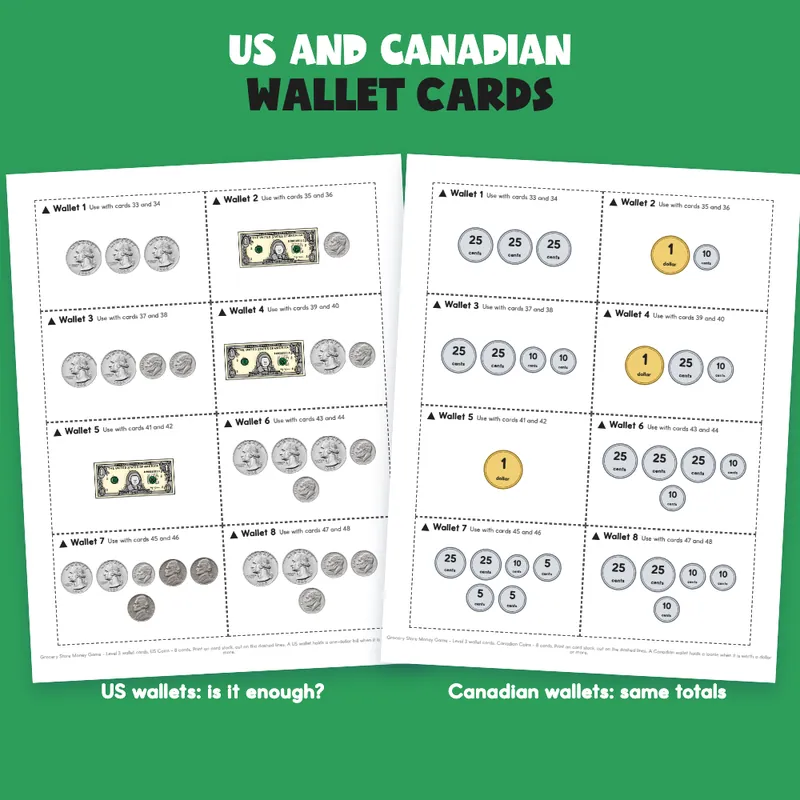
- Level 1, exact coins (circle, cards 1 to 16): pay the exact price with any coins. Level 2, fewest coins (square, cards 17 to 32): pay with as few coins as possible. Level 3, enough money? (triangle, cards 33 to 48): two cards make a basket, add the prices, count the wallet, decide
- 16 wallet cards for Level 3: 8 US wallets (a one-dollar bill or coins) and 8 Canadian wallets (a loonie or coins), same totals, 4 baskets enough and 4 not enough, exactly enough counts as YES
- 2 coin sheets to print and cut: 45 US pieces (12 quarters, 12 dimes, 12 nickels, 6 pennies, 3 dollar bills) and 42 Canadian pieces (12 quarters, 12 dimes, 12 nickels, 6 loonies). Real or plastic coins work too
- A Shopper and Cashier page (each job in four short steps), a shop mat laid out as a store (shelf slots for the item cards, a wallet slot, a register and a coin tray), and a coin helper for each country (US coins, Canadian coins)
- 9 recording sheets with 72 lines: Level 1 and Level 2 each have 4 sheets (US and Canadian, 8 cards a sheet), and Level 3 has 1 sheet of 8 baskets
- 2 answer key pages: the fewest coins for every card in Levels 1 and 2, and every basket total, wallet and YES or NO for Level 3
- A game data sheet, a class progress grid, a filled example (an invented student), a family page and a phrase bank (18 starters in 6 groups)
- 6 ink-saver pages of the item cards and 2 ink-saver coin sheets
- A weekly flyer page: 8 priced foods and 4 find-the-total tasks (add two prices), with answers on the Level 3 key page
- 6 divider tabs to print and cut (Rules, Cards, Coins, Record, Keys, Data)
- A worked card (a banana at 35 cents is a quarter and a dime) and Start Here, with three steps and a page-by-page chooser
Played By Two, For Every Classroom
Two students sit across from the shop mat and swap jobs after every card. The Shopper reads the price and pays; the Cashier counts the coins out loud and says yes or try again. Each student keeps a recording sheet, so every round ends with something written. The recording sheets have a "My name" line, one short instruction with a picture cue and big boxes to write in. The item cards, wallet cards and coin sheets are for the teacher to print on card stock and cut apart before the game. The US coin pictures show the coins themselves. The Canadian coin pictures are plain discs with the value written on them. The food pictures are clip art, and every price is written in numbers, so the file prints clean in black and white.
Invented Items And Prices
Every item and price is made up for practice. Nothing here says what anything costs in a real store. No currency symbol is used anywhere in the file: a price is a number with the word "cents" on its tag. The only student in the file is an invented example, and it says so.
Type In, Or Print
The name line, every box on the recording sheets, the data sheet, the class grid, the family page and the filled-in tables are type-in fields in any PDF reader: click one, type, then save. All of it also prints. The cards and coin sheets are print-and-cut pages. This is a fillable PDF; it is not a Google Slides or PowerPoint file.
What This Is, And What It Is Not
A two-player coin-counting game with its recording and data pages: paying exact prices, paying with the fewest coins and deciding if a wallet is enough. It is not a timed test, a screener, a clinical tool, or a claim about any student's age or rate of progress. There is no IEP goal language or eligibility wording anywhere in the file, and no claim of alignment to any standard. The data sheet has a blank line for your own goal wording.
Who This Is For
Teachers of life-skills and special education classes, math centers and small groups in grades 1-3, and families who want coin practice with a partner, in the US or in Canada.
If You Want More
Coin Anchor Chart | Penny, Nickel, Dime, Quarter Posters, Value Chart, Desk Strips; Canadian Money Worksheets | Coin ID, Counting, Enough Money, Change K-2; I Have Who Has Counting Coins Game.