Create Your Own Map Project
- 30 pages
- 2nd, 3rd, 4th
$1.75 $3.50 on Teachers Pay Teachers
Half the Teachers Pay Teachers price. The same PDF, sold direct.
DownloadOr get it with All-Access: pick any 20 resources a month for $7.
New here? Your first month of All-Access is half off with code TEACHERTOK
Already bought this, or a member?
Instant download. One teacher's license: colleagues need their own copy. Each file carries a license number.
Also on Teachers Pay Teachers: see the Bright Path Sped store
About this resource
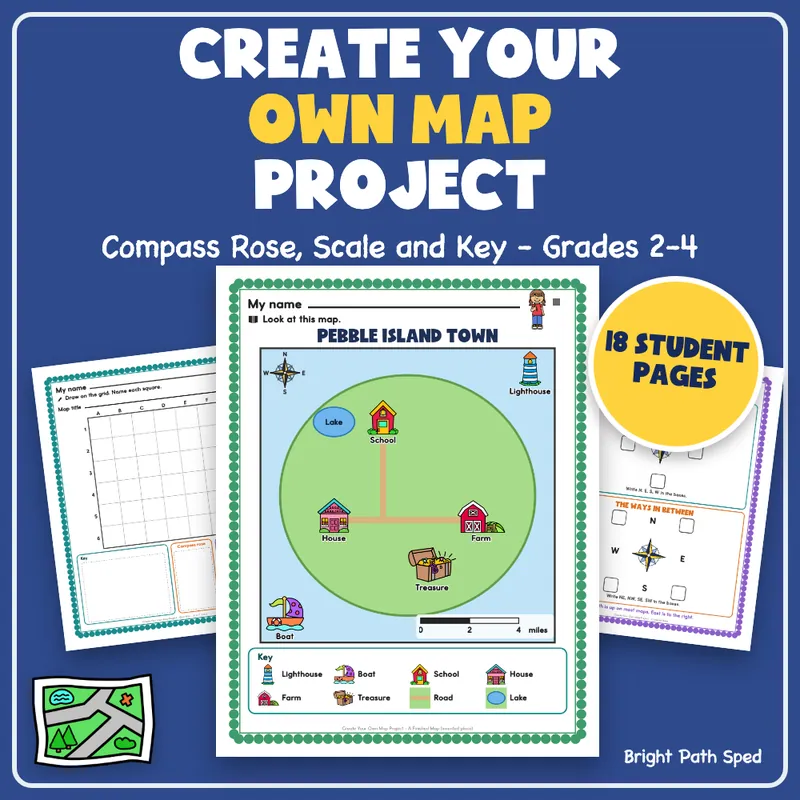
Your class can read a map. Now let them make one. Each child picks a place, plans it, learns how a compass rose, a scale and a key work, and draws a map with every part. This Create Your Own Map Project has a finished example to study, practice pages for the compass, the grid and the scale, blank maps to draw on, a checklist and a rubric, so you can hand it out and run it.
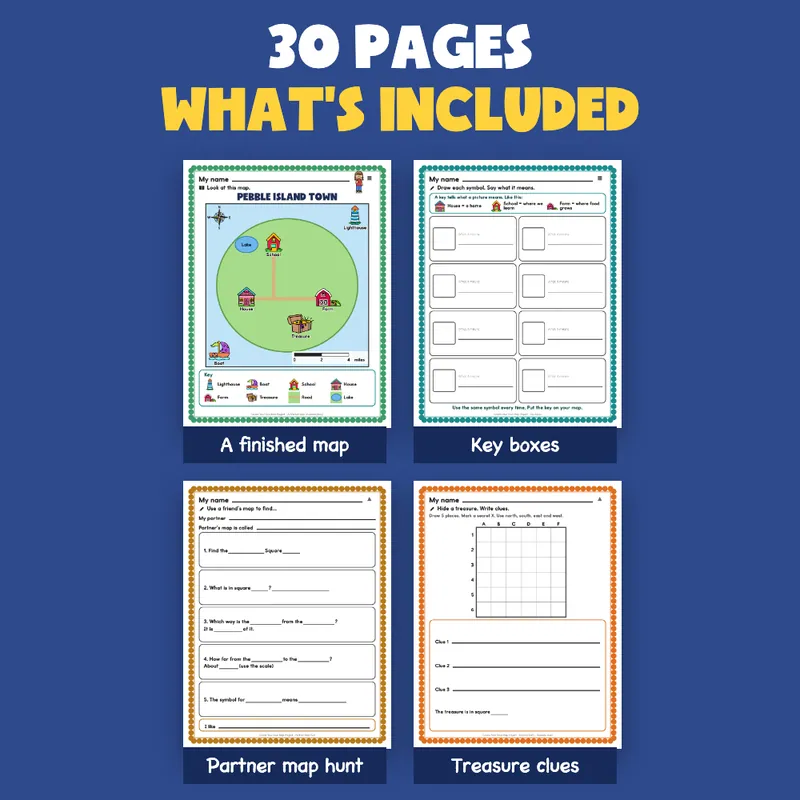
WHAT IS INCLUDED (30 pages)
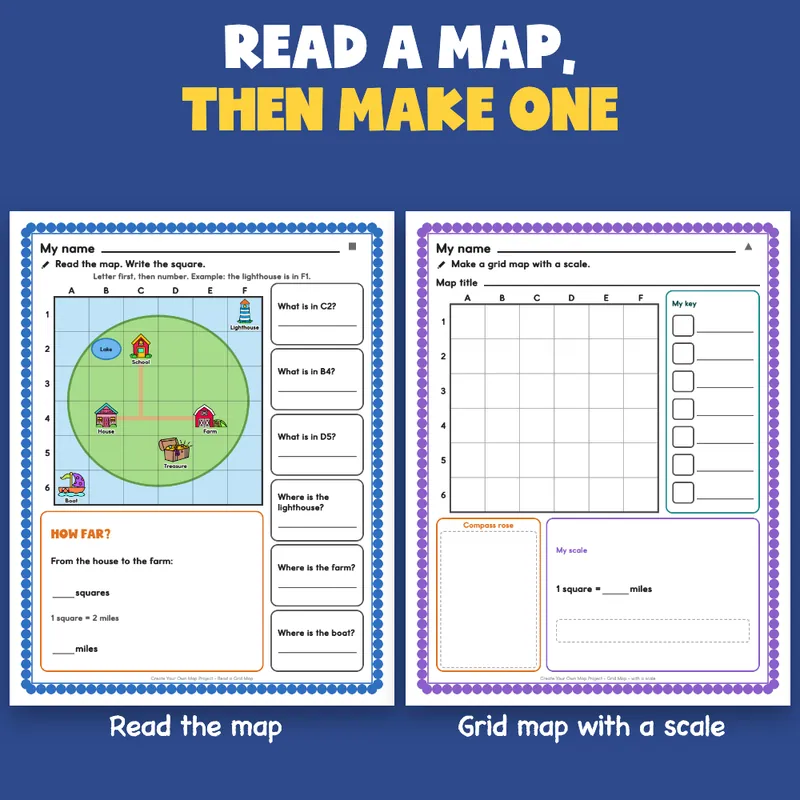
- 18 student pages, each with a big "My name" line, one short direction and room to work: The Steps, a Finished Map (an invented island town with a title, compass rose, scale bar and a key of 8 symbols), Read a Grid Map (6 questions about squares and 1 about distance), 2 compass pages, a Plan page (8 rows), 2 scale pages, Key Boxes (8), 4 map pages, My Checklist (8 boxes), How Did I Do (5 questions), Write About My Map, a Partner Map Hunt (5 questions) and a Treasure Clues page.
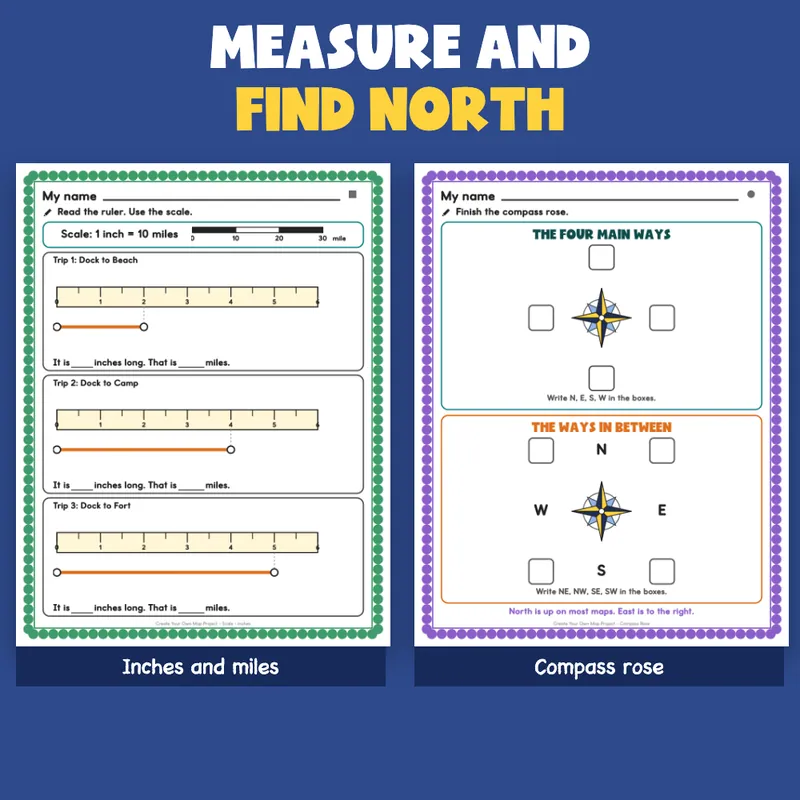
- 2 compass pages: label the four main directions and the four in between on a compass rose, then take 5 walks on the map and name where each one stops.
- 2 scale pages with 6 trips in all: 3 in inches (1 inch = 10 miles) and 3 in centimeters (1 cm = 5 km). Each trip is a line that starts at the zero of a ruler drawn at real size, so a child reads where it ends and then uses the scale.
- 4 map pages: a plain draft, a grid draft (A to F across, 1 to 6 down), a grid map with a scale and a key column, and a final copy. Each has places for the key, the compass rose and the scale.
- Six project rules in kid words (a title, a compass rose, a scale bar, a map key with at least 4 symbols, at least 6 named places, color and neat writing).
- Teacher pages: Start Here with a which-page-when table, how to run it in 4 sessions, a 5-point rubric (5 rows, total out of 25), an answer key, a filled example (an invented child; every answer invented), a note home, a phrase bank of 20 starters in 5 groups, a class roll-up for 10 children, and a binder cover with spine and tabs.
- Terms of use and a thank-you page.
How To Use It
Show the finished map and ask what the title, the compass rose, the scale and the key tell us. Children read squares and take the compass walks, then measure the scale trips. They plan a place, design their key symbols and draw a draft, then a final map. They tick the checklist, trade maps with a partner, and early finishers hide a treasure and write clues. Score with the rubric and use the class roll-up to plan small groups.
Built For The Child Holding The Page
The pages children write on have a big "My name" line and one short direction, big boxes for symbols and big squares to draw on. The map pages are mostly open space for pencil and crayons. Every page reads in black and white too.
Type In, Or Print
The name lines, the plan, the answer blanks, the checklist boxes, the partner page, the writing page, the note home and the class roll-up are type-in fields in any PDF reader. The map pages are for pencil and crayons. You can also print any page and write by hand. Print at 100 percent with fit-to-page turned off so the rulers measure one real inch and one real centimeter. This is a fillable PDF for printing and typing; it is not a slide or word processor file.
Concepts Covered
Compass rose, map scale, map key, grid squares, labeling places, and checking your own work.
Who This Is For
Teachers of grades 2, 3 and 4, resource rooms and self-contained classrooms who want a map project every child can finish. Whole-number scales only.
What This Is, And What It Is Not
Working paper for a map-making project. It is not a full social studies curriculum, an assessment or a therapy program, and it makes no health claims. Your school decides what a child should be able to do and when.