CVC Comprehension Fluency Passages
- 29 pages
- Kindergarten, 1st, 2nd
$2.00 $4.00 on Teachers Pay Teachers
Half the Teachers Pay Teachers price. The same PDF, sold direct.
DownloadOr get it with All-Access: pick any 20 resources a month for $7.
New here? Your first month of All-Access is half off with code TEACHERTOK
Already bought this, or a member?
Instant download. One teacher's license: colleagues need their own copy. Each file carries a license number.
Also on Teachers Pay Teachers: see the Bright Path Sped store
About this resource
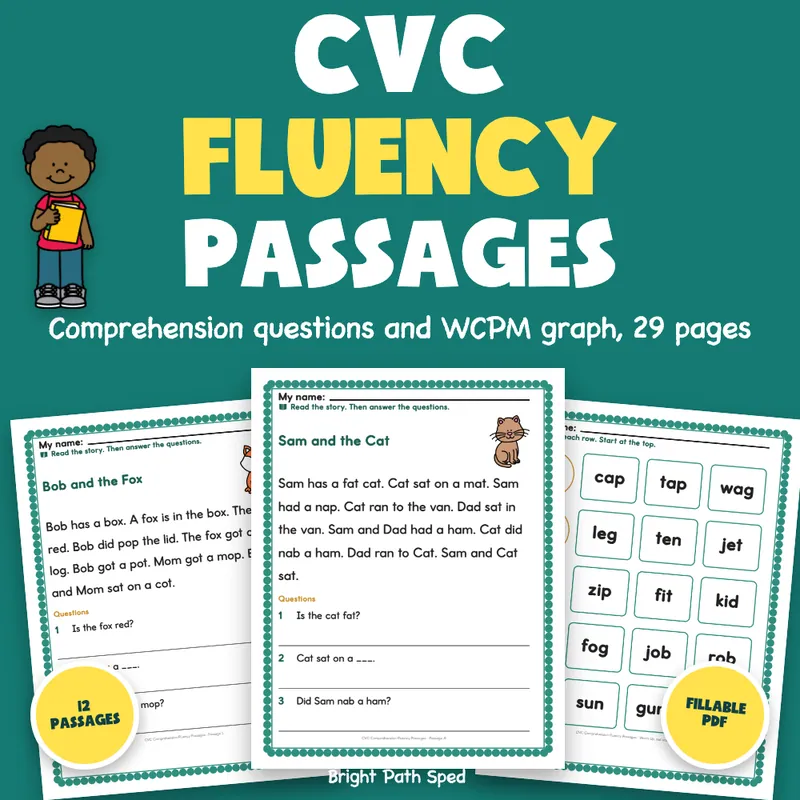
Twelve short vowel stories you can time, one for each week of a marking period. Every passage is 40 to 47 words, made only of CVC words and seven sight words, with three questions whose answers are in the story. A scoring row for every read, a progress graph, a filled-in example, and the teacher pages to score, graph and report it.
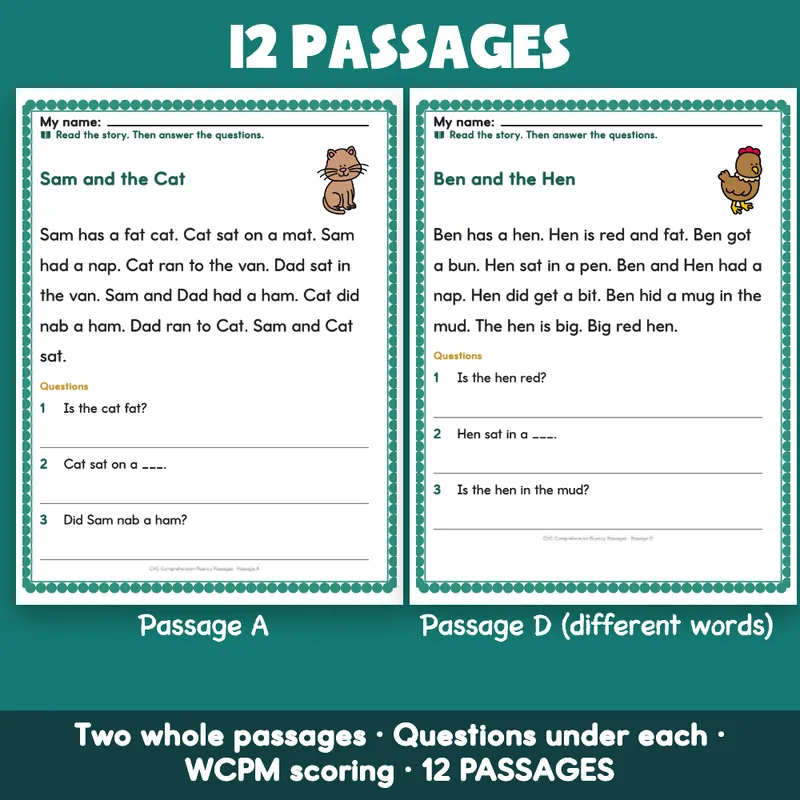
Every word in a passage is one short-vowel CVC word (cat, hen, pig, bus) or one of seven sight words (a, and, in, is, on, the, to). Across the 12 stories that is 517 words: 342 CVC words and 175 sight words, about one in three. There are no blends, no digraphs and no silent e, so the reading practiced is the short vowel. The passages go short a (A-C), short e (D-F), short i (G-H), short o (I-J) and short u (K-L). Each question is a yes or no, or one word to fill in, and its answer is in a sentence of the story.
WHAT IS INCLUDED - 29 pages: a warm-up word list, 12 student passages each with three questions and answer lines, two answer key pages that print each answer's sentence, a word check that counts every word, a WCPM scoring row for every passage, teacher notes with six sentence starters, a progress graph and data log, a caseload summary, a filled-in example, a family update and team handoff, an adult timing script, a binder cover with six divider tabs, a start-here page, a goal and timing page, terms of use, and a thank-you page.
A Student Warm-Up To Start With (Page 6)
- Fifteen CVC words, three for each short vowel, in one row per vowel
- A big My name line and one short instruction with a book picture
- Not scored; the words are never in a passage
Twelve Passages, A Through L (Pages 7-18)
- A title with one licensed picture, then the story in large type
- Three questions, each with a line to write the answer
- No answers, timer or scoring on a student page
The Timing And The Wcpm Scoring (Pages 5 And 22)
- The timing directions in plain steps: start on the first word, stop on the last word, write the seconds
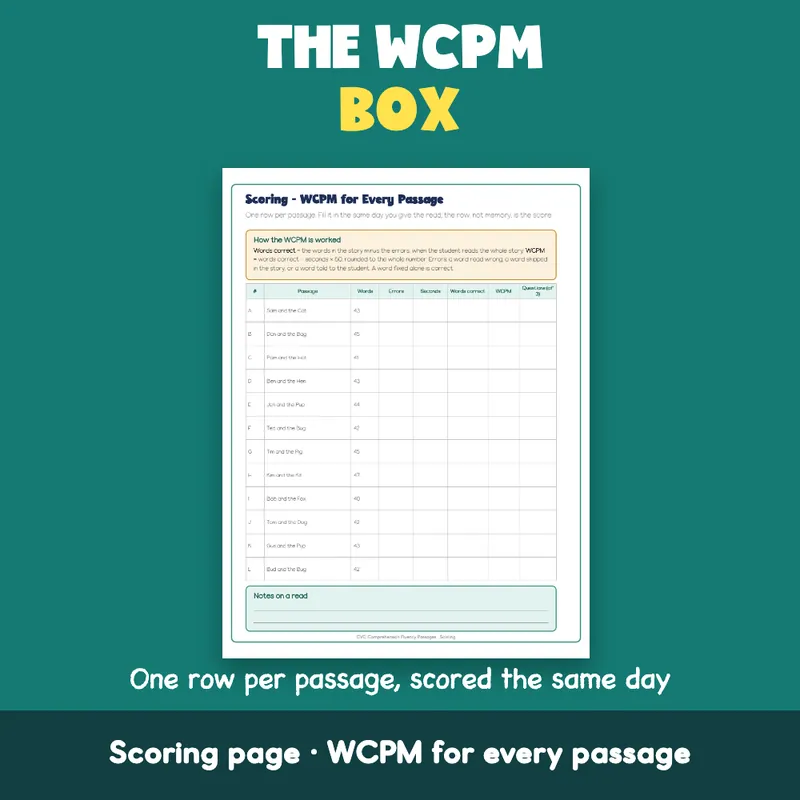
- One row per passage: errors, seconds, words correct, WCPM and the questions right out of three
- The WCPM is worked on the page: words correct divided by seconds, times 60
Answer Keys And The Word Check (Pages 19-21)
- Every answer, with the sentence it sits in printed in full: Passages A-F and G-L
- A word check that counts the CVC words and sight words in every story: 517 story words in all
- The sight list, with how many times each sight word appears in the set
Teacher Notes, Graph And Caseload (Pages 23-25)
- Reading the misses (a vowel changed, a word skipped) and six sentence starters for answers
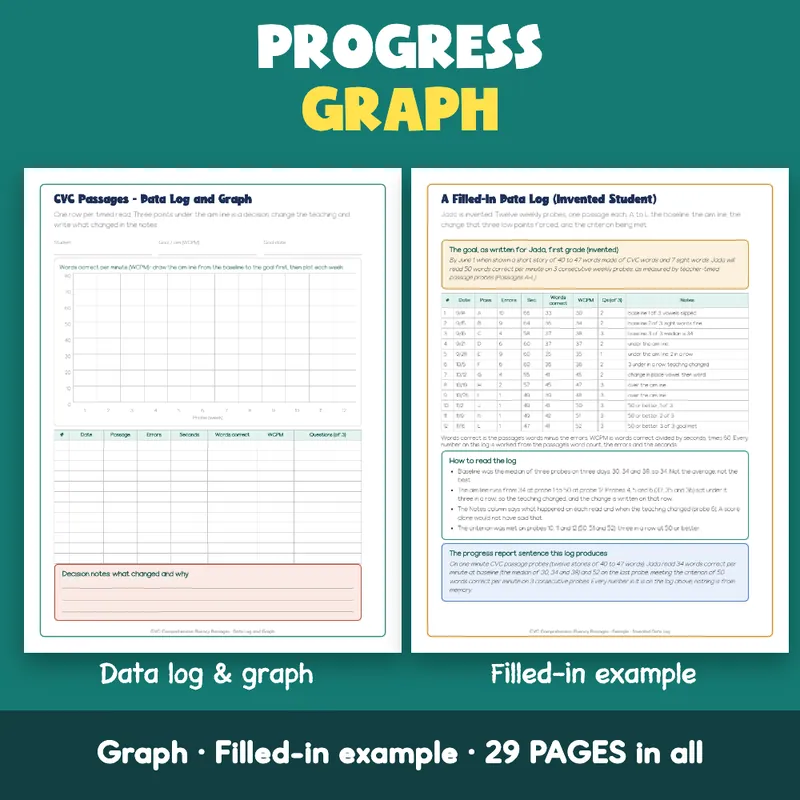
- A WCPM graph scaled 0 to 80, twelve probe columns, and a twelve-row data log
- A caseload summary for the whole group, one row per student
A Worked Example (Page 26)
- Jada, first grade, invented. Twelve weekly probes with a Notes column: a baseline as a median, three points under the aim line forcing a teaching change, and the criterion met on three in a row
- The progress report sentence the log produces, with every number on the log
A Family Update And Team Handoff (Page 27)
- A family note with blanks for this week's WCPM and the goal comparison
- A team handoff checklist and a meeting summary sentence with blanks for two numbers
An Adult Timing Script (Page 28)
- The exact words to say and the steps for one passage, for a paraprofessional, a substitute or a general education teacher who gives the read when you cannot
What This Is, And What It Is Not
It is a fillable PDF. The goal page, the scoring rows, the data log, the caseload page, the family update and the notes lines are type-in fields: open the file in a PDF reader, click a line or box, type, and Save As once per student. The student pages print clean: the student reads on paper.
It is not a norm-referenced test and it carries no benchmark rate or "typical" score. The goal in the sample is in brackets, because your team sets it from the baseline and the student's own plan. It is not a CVC word list: it is connected text, with questions. It is not the CVC word reading probe either, which tests single words. Your district's own rules for goals and scoring go on the blank lines provided. It is not a Google Slides, Docs or PowerPoint file.
Who This Is For
Kindergarten, first and second grade teachers and special education case managers writing a reading goal for short-vowel fluency and comprehension, intervention teachers, and the paraprofessionals who time the weekly read.