Double Final Consonants Progress Monitoring Probes
- 22 pages
- 1st, 2nd
$1.75 $3.50 on Teachers Pay Teachers
Half the Teachers Pay Teachers price. The same PDF, sold direct.
DownloadOr get it with All-Access: pick any 20 resources a month for $7.
New here? Your first month of All-Access is half off with code TEACHERTOK
Already bought this, or a member?
Instant download. One teacher's license: colleagues need their own copy. Each file carries a license number.
Also on Teachers Pay Teachers: see the Bright Path Sped store
About this resource
Double final consonants, one skill, start to finish. An IEP goal, six word-reading forms, a one-minute form, answer keys, and a graph scaled to the probe. Baseline on Monday, goal written by Tuesday, first data point on Friday.
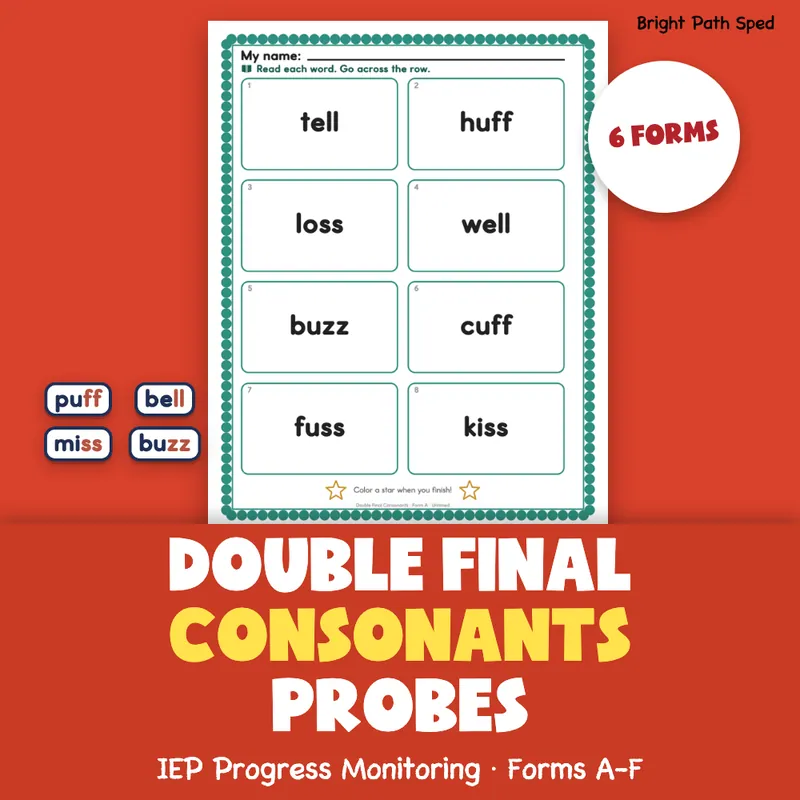
The skill is the FLSZ rule: a one-syllable word with one short vowel that ends in f, l, s or z doubles the last letter (puff, bell, miss, buzz). Forms A to C are short words with one consonant before the vowel (puff, bell, miss, buzz). Forms D to F are blend and digraph words (stuff, spell, chess, shell) plus two exception words on each form, words that end in a single letter and are not doubled (bus, gas, yes). The answer key flags every exception. Every form at a level has the same mix of word types, so a score means the same thing from one week to the next.
WHAT IS INCLUDED - 22 sheets: six reading forms of eight words each (48 words), a one-minute form of twelve words (60 different words in all: 15 ending in ff, 14 in ll, 18 in ss, 4 in zz and 9 exception words), a three-sheet answer key with the ending of every word and an optional spelling check, a goal sheet, a how-to sheet, teacher notes, a graph and data log, a caseload summary, a filled-in example, a family update sheet and a binder cover with divider tabs.
A Binder Cover And Divider Tabs (Sheet 4)
- A binder cover with student, case manager and school year fields
- Six divider tabs, one per section of this file, print and cut
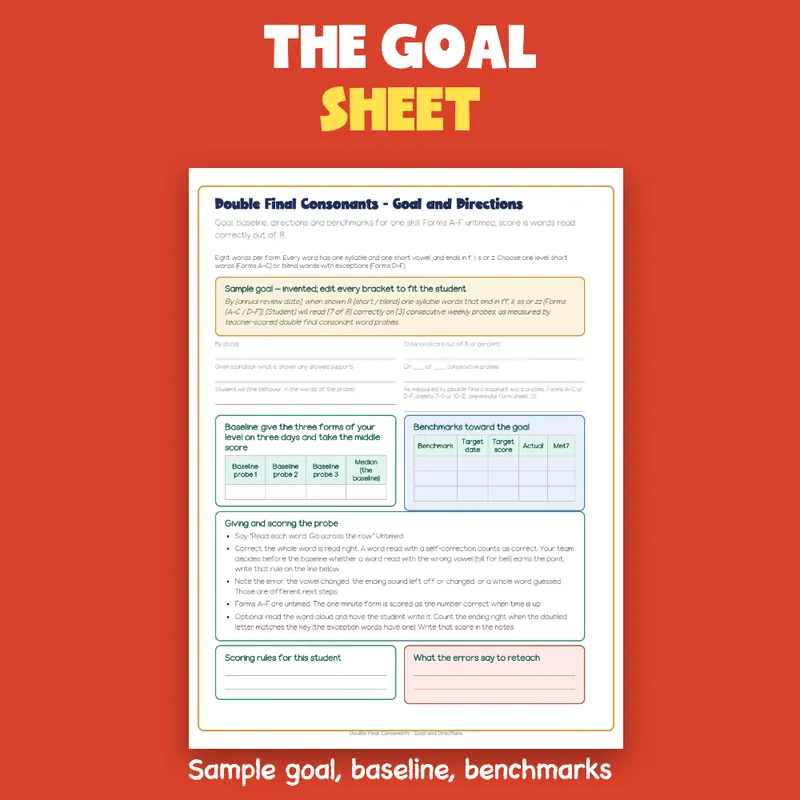
The Goal Sheet (Sheet 5)
- A sample goal with every bracket meant to be edited by the team, and a choice between short words and blend words
- The six-part goal frame as type-in fields
- A baseline table: three probes and the median
- Three benchmark rows with target date, target score, actual score and met
- The giving-and-scoring directions, and lines for this student's own scoring rules
The Doubling Rule (Sheet 6)
- A student sheet: short vowel, then f, l, s or z at the end? Double it
- Worked words (fell, pass, gruff), one rule breaker (pal) and a blank line to write one of your own
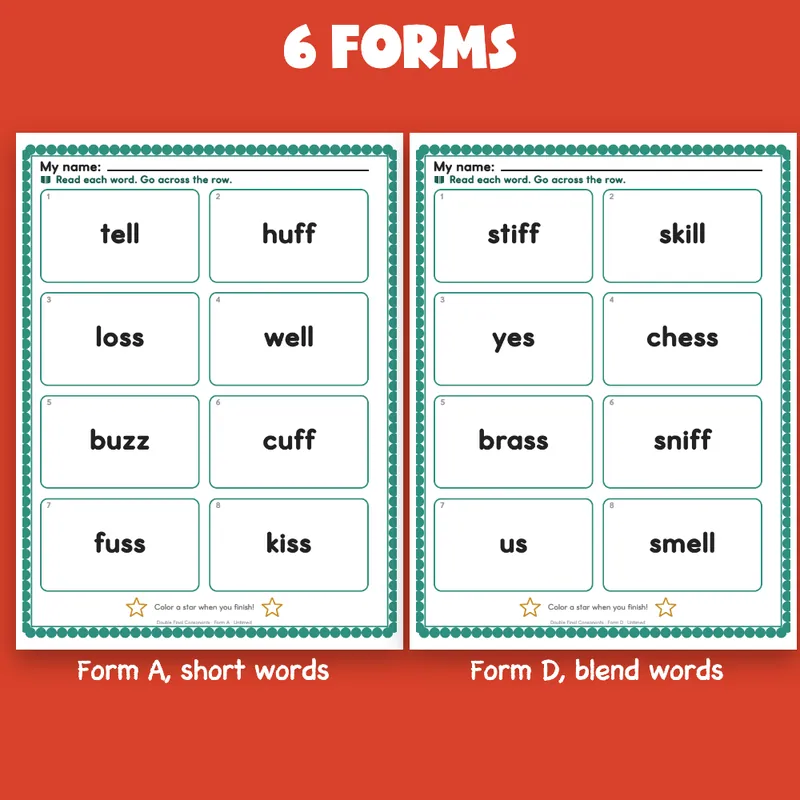
Six Reading Forms, A Through F (Sheets 7-12)
- Forms A to C: short words. Forms D to F: blend words with two exception words each
- Eight words per form, large type, each with a small number so you can mark errors
- A big My name line and one short instruction
- No answers, goal text or scoring strip on a student sheet
A One-Minute Form (Sheet 13)
- Twelve words, nine ending in a doubled letter and three exception words, for a timed check, with its own log on the graph sheet
A Three-Sheet Answer Key (Sheets 14-16)
- Every word on all six forms and the one-minute form, with its ending (ff, ll, ss, zz) or EXC (exception), so a paraprofessional can score without a list of their own
- A Read box and a Spell box for each word, and a Read ___ / 8 box under each form
Teacher Notes (Sheet 17)
- Reading the errors: the vowel changed, the ending left off or swapped, an exception word doubled
- Which words are left out of the pack and why
- A notes block for this student
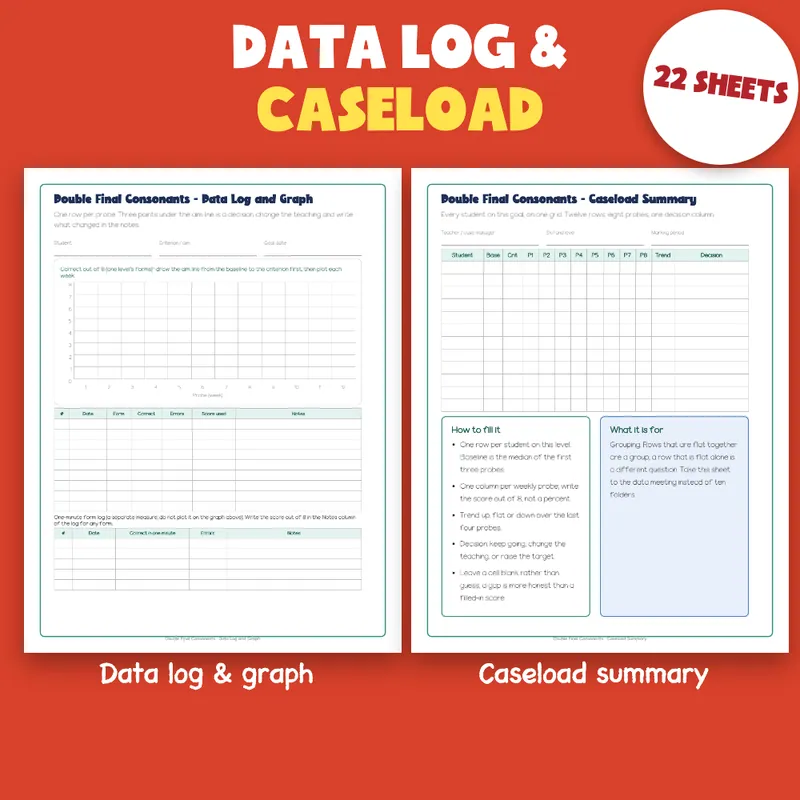
The Data Log And Graph (Sheet 18)
- A y-axis already scaled 0 to 8, twelve probe columns, and the instruction to draw the aim line from the baseline to the criterion first
- A nine-row log with date, form, correct, errors, the score used on the graph and notes, plus a separate five-row one-minute log
The Caseload Summary (Sheet 19)
- Twelve student rows, baseline and criterion, eight probe columns, a trend column and a decision column
A Worked Example (Sheet 20)
- Tomas, second grade, invented. Twelve rows on the short-word forms: the baseline as a median, three points under the aim line forcing a teaching change, the criterion met, and the progress-report sentence the log produces
A Family Update And Team Handoff Sheet (Sheet 21)
- A family update with blanks for this week's score, a team handoff checklist, and a meeting summary sentence with blanks for two numbers off the log
What This Is, And What It Is Not
It is a fillable PDF. The goal sheet, data log, caseload sheet, family update sheet and the mark boxes on the answer key are type-in fields: open the file in a PDF reader, click a line or a cell, type, and Save As once per student. The probe sheets print clean: the student reads on paper.
It is not a norm-referenced assessment and it carries no benchmark score or "typical" rate. The criteria in the sample goal are in brackets because your team sets them from the baseline and the student's IEP. The reading forms are untimed on purpose, so the condition stays the same all year; the one-minute form is a separate measure with its own log. Reading a doubled word aloud sounds the same as reading it with one letter, so the optional spelling check on the key is how you see the doubling itself. The pack covers the ff, ll, ss and zz endings and a short list of exception words; ck, tch and dge endings, vowel teams, silent e, r-controlled vowels and multi-syllable words are left out. Your district's own rules for goals and scoring go on the blank lines provided. It is not a Google Slides, Docs or PowerPoint file.
Who This Is For
First and second grade special education teachers and case managers writing a reading goal on double final consonants, intervention teachers, and the paraprofessionals who give the weekly probe.